

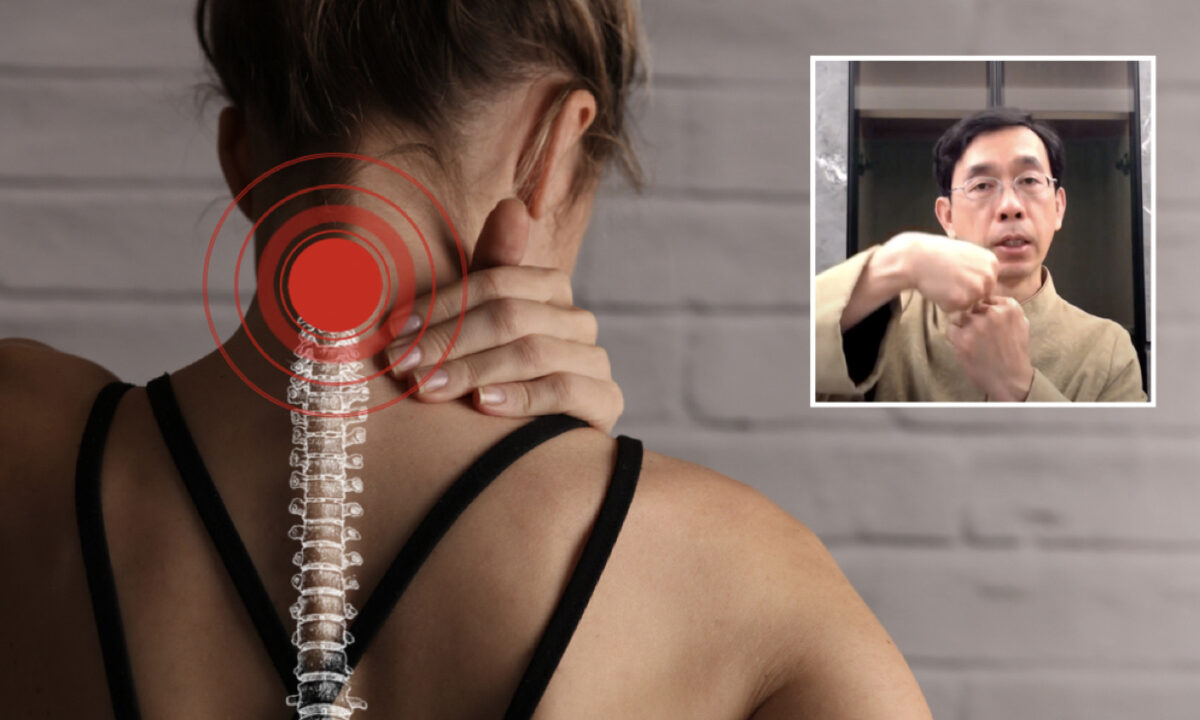
Cervical spondylosis is one of the main causes of pain today. Hunching our shoulders as we use keyboards or scrolling on our mobile phones, we are constantly straining our neck muscles. Even in our moments of relaxation, we may be putting our necks at risk: did you know that using the wrong type of pillow can cause neck injury?
Lack of exercise, bad posture, poor flexibility, and poor blood circulation can lead to muscle and neck pain, stiffness, headache, and vertigo. Dr. Wu Kuo-pin, Xinyitang Chinese Medicine Clinic superintendent, explained the impact of cervical spinal injury and how it can be treated at home.
What Is a Cervical Dislocation?
On its website, the University of Southern California Spine Center, affiliated with the Keck USC Hospital in Los Angeles, defines cervical dislocation or misalignment as a ligament injury in the neck. Two or more of the adjoining spine bones have become unusually separated from each other, which causes instability.
In Western medicine, doctors use diagnostic imaging techniques to diagnose cervical vertebral dislocation. However, treatments for cervical spine dislocation and neck pain are limited. Some patients don’t realize the severity of their neck injuries or disorders and may downplay their symptoms.
Cervical Spine Self-treatment Helps Alleviate Discomfort
Wu, a traditional Chinese medicine (TCM) physician, pointed out that cervical vertebral dislocation is very common. “Instead of suffering from constant pain or relying on painkillers for temporary relief, patients can do cervical spine self-treatment to alleviate discomfort,” recommended Wu.
Wu emphasized that regular stretching and training neck muscles can significantly improve cervical spine misalignment and complications caused by it.
“Most commonly, when it comes to neck pain, it starts from the shoulders,” said Wu, “The tenderness or soreness will later expand to the neck area. As the condition worsens, the patient will suffer from head swelling and migraine. Pain and tension can also travel down the arms and wrists.”
Wu said that by the time the patient experiences pain around the arm and wrist, he or she might suffer from spinal cord dislocation.
Wu explained, “Our cervical spine connects the skull and the body, and it consists of a total of seven bones. The cervical spine contains the spinal cord, nerves, and blood vessels. Its importance is indescribable. However, structurally, it is a very fragile part of our body.”
The doctor warned that poor sitting and prolonged standing postures have detrimental consequences. Bending our necks forward to look down at mobile phones can also easily lead to cervical vertebral misalignment. Spinal misalignment causes shoulder and neck pain, headache, nausea, and tinnitus. Additionally, in the event of an accident, if the cervical spine is injured, in severe cases it can lead to quadriplegia or death.
Studies published in StatPearls have found that 85 percent of people over 60 have cervical spondylosis. Given today’s screen-focused lifestyle, however, patients with cervical spondylosis are increasingly younger.
Wu pointed out that although cervical misalignment is clinically common, it is often ignored. “For instance, the neurological manifestations of cervical spondylosis include concussion sequelae, pediatric cerebral palsy, vascular neuropathic headache, transient ischemic attack, epilepsy, and pro-aging dementia. Cardiovascular system disorders like hypertension and coronary heart diseases are no exception.”
Due to limited Western treatments for cervical spondylosis, patients often seek alternative medicine for pain relief.
How does TCM approach cervical misalignment?
Diagnosis
Wu said there are several ways to detect spinal dislocation or misalignment and that evaluating patients’ sleeping patterns and habits is important: “No matter how many pillows the patient changes, they toss and turn and just can’t get to sleep steadily. Their cervical spine feels sore when they wake up.”
Something to look out for is discomfort in the upper body and difficulty breathing. Wu explained that the head often would feel swollen and painful like a migraine, whereas the neck would feel sore. “When these symptoms occur, the pain affects the patient from the head. The pain then expands to the shoulders and the upper back,” Wu explained.
Wu suggested to press manually and firmly the lateral protrusion of the cervical vertebrae, which would feel a strong soreness.
How to Avoid A Neck or Spinal Injury
Wu gave us a few pointers on how to avoid and minimize neck injuries.
Your neck supports your head, a heavy part of the body. If you are often scrolling on your cell phone with your head down, you are risking neck strain.
Regular exercise and stretching improve blood circulation and metabolic rates. Our metabolism repairs damaged parts of our body. Strength training is also recommended as it lessens injuries. A neck workout is the easiest and most manageable exercise and requires no equipment.
A neck workout is an easy at-home or office workout. It incorporates slow movements of the head, neck, shoulders, and arms so that we can realign our cervical spine and body.
Workout 1: Rise Up
In a sitting or standing position, look up and slowly raise your head. Make sure both shoulders are pulling downwards, away from your head, as it lifts. Repeat five times.
Workout 2: Seesaw
- In a sitting position, place your left hand on the side of the chair.
- Tilt your upper body to the right. Your left hand, upper body, and head should gently pull in the opposite direction. If you do this correctly, you should feel the muscle stretches on the left side of your neck and cervical spine.
- Hold your position for 10 seconds.
- Switch sides.
- Repeat five sets.
Workout 3: Massage Along Vestibulocochlear Nerve
Use the thumb to massage along the groove under the skull, that is, the acupuncture points of traditional Chinese medicine: Tianzhu, Fengchi, Anmian, Yifeng, etc.
You can also firmly press the Fengchi acupressure point with your thumb, relax neck muscles, and shake your head gently from side to side, so the dislocated first cervical vertebra can be gently relocated.
Workout 4: Massage the Back of the Neck
Extend the right hand’s index finger, middle finger, and ring finger to the right side of the cervical spine, and knead the muscles of the right neck from top to bottom. Change to the opposite hand, and massage the left cervical vertebrae.
Workout 5: Transverse Process Pressing
Taking the lateral process of the right cervical vertebrae as an example, place the thumb of the right hand on the dislocated cervical vertebra, and press the transverse process of the dislocated cervical vertebra firmly from the back to the front (if your strength is insufficient, you can use the other hand to support it to increase the pressure). Continue to press for 30 seconds to one minute. When the pain subsides, the dislocated cervical vertebra has returned to its original position.
Workout 6: Neck Rotation
In a sitting position, lean your upper body forward until your cervical spine is level with the ground, nodding and turning your head gently and slowly. During the rotation, if you feel a sore spot, stop at that position for 10 seconds, increase the rotation angle for 10 seconds, and increase the opposite rotation angle for 10 seconds. This way, the point where the cervical vertebra is stuck will slowly loosen.
Workout 7: Neck Rotation in Eight Compass Directions
Turn your head toward eight compass directions, which move all the vertebral bodies of the cervical spine.
Wu pointed out that these first seven neck workouts relax the neck muscles. You will feel more awake as your blood circulation improves. It will also help boost sleep quality.
Workout 8: Butterfly Strokes
This next workout mimics butterfly strokes in swimming.
- Put both hands horizontally parallel to the shoulders.
- With both palms facing down, stretch all your fingers as far as you can.
- Then raise your arms and roll your shoulders backward. Gently raise up and then draw a circle with your arms starting forward. Return to the original position. Repeat 10 times.
- Change directions. Draw a circle with your arms starting backward. Repeat 10 times.
Wu emphasized that the key to this movement is to rotate the scapula from the back to the front. This action can instantly loosen the muscles of the neck, shoulders, and upper back. It may feel very sore when doing it, but the effect is remarkable.
Workout 9: Butterfly Strokes
“This, together with butterfly strokes, results in effective body realignment and opening,” said Wu.
- Following butterfly strokes, tilt your head backward.
- Eyes gaze forward.
- Shake your head slowly to the left and right 10 times.
Wu said doing workouts 8 and 9 consecutively can improve the symptoms of hand numbness caused by the compression of cervical vertebrae 5, 6, and 7, and can effectively improve the symptoms of cervical vertebrae compression.
Wu stated, “Always remember to rotate your neck regularly and don’t hunch forward with your head down.”
Which neck exercise works best for you? Always speak with your doctor before beginning a new exercise program.
Epoch Health articles are for informational purposes and are not a substitute for individualized medical advice. Please consult a trusted professional for personal medical advice, diagnoses, and treatment. Have a question? Email us at HealthReporter@epochtimes.nyc