
If you ever visit a park in China, you’ll see the modalities of traditional Chinese medicine (TCM) in action—tai chi and qi gong practitioners moving through their routines with graceful control and mindful effortlessness. With a closer look, you might spot another, more curious practice: retirees rhythmically tapping their thighs, shoulders, or even clapping their hands as they stroll. It’s not random.
Acupressure is another facet of TCM. Its techniques vary widely, ranging from tapping and massage to pinching or using specialized tools, depending on the specific acupoint targeted. Many older Chinese adults swear by it for keeping energy moving and symptoms at bay.
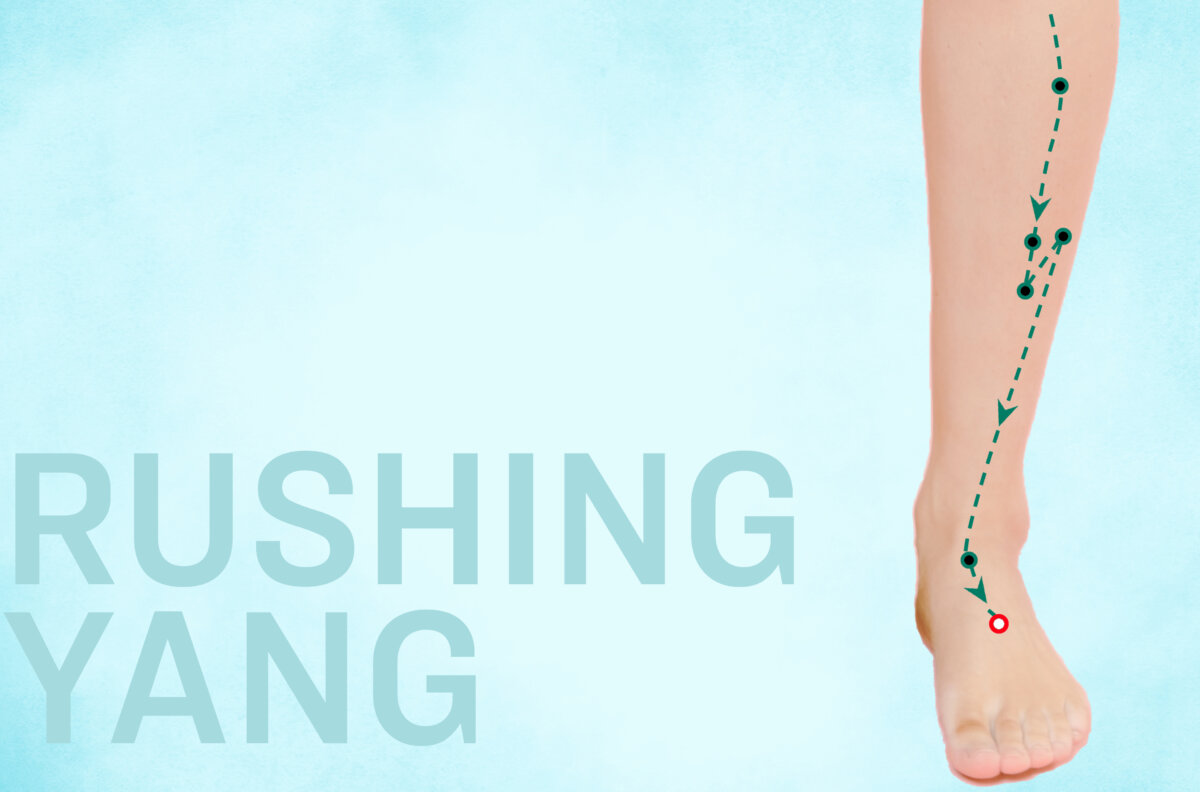
Rushing Yang (Chong Yang, ST42) is one acupoint beloved by the older generation. It sits on the foot and is a powerful tool for supporting your body.
Chong Yang’s Legacy in TCM
Chong Yang was first recorded in the “Ling Shu” (“Spiritual Pivot”), a classical text foundational to acupuncture theory. It is a Yuan Source point of the Stomach meridian. Yuan Source points are known for restoring the balance between Yin and Yang energy, but Chong Yang does more than just balance. It also serves as an exit point on the stomach channel, a gateway where qi—vital energy—from the outside world flows into the body, allowing it to boost the stomach’s function.
In keeping with the TCM principle of treating the head through the feet, Chong Yang can alleviate pain in the upper teeth and frontal headaches. Practitioners also use it for cases of acute facial paralysis caused by wind and cold, two pathogenic factors that can lead to loss of muscle control, pain, or acute, intense symptoms.
Locally, it’s used to relieve swelling on the top of the foot, stiffness, and limited mobility, including difficulties with walking naturally.
Modern Medicine Takes a Closer Look
Modern researchers employ advanced technologies to explore the mechanisms underlying acupoints such as Chong Yang. In one study, scientists used fMRI brain imaging to assess neural responses to acupuncture administered at various times throughout the day. Participants were assigned to one of three groups: the first received acupuncture at Zusanli (ST36) and Chong Yang during the Stomach meridian’s traditional peak hours in the morning; the second group underwent acupuncture in the afternoon; and the third group received sham acupuncture.
Notably, stimulating Chong Yang at the optimal time activated the cerebellum and right insula, regions associated with motor coordination and internal regulation. These findings suggest that Chong Yang is a responsive point, influenced by the body’s natural rhythms.
A separate study incorporated Chong Yang into an acupuncture protocol to alleviate forehead headaches in patients recovering from ischemic stroke. When compared to people treated with a standard pharmaceutical intervention, those in the acupuncture group exhibited better outcomes—lower pain scores, reduced concentrations of pain-related neurochemicals such as substance P and dopamine, and elevated levels of endogenous endorphins, the body’s natural pain-killers.
How to Locate and Stimulate Chong Yang
To locate Chong Yang, find the spot between the long bones running from the second and third toes to the ankle on the highest point of the foot. You’ll feel it in a shallow dip between the bones. If you gently press around that area and feel a little soreness or sensitivity, congratulations—you’ve likely found it.
Ways Stimulate Chong Yang
- Firm pressure: Press firmly for three to five seconds, then relax for three seconds. Repeat for one to three minutes on each side.
- Circular massage: Massage in small circles with your index finger or thumb for one to three minutes on each side
- Massage ball: Gently roll a small massage ball up and down the foot along the location of Chong Yang.
- Herbal patch: Apply an herbal patch overnight for longer activation.
- Advanced methods: Acupuncture or moxibustion (a gentle heat therapy using dried mugwort) by a trained professional can deepen the therapeutic effects.
Precautions
Because Chong Yang lies near a large blood vessel, use caution with needling. If you’ve had a recent injury to the top of your foot, it’s best to avoid direct stimulation. When using herbal patches, choose gentle, natural ingredients, especially if you have sensitive skin.
Why Chong Yang Belongs in Your Routine
TCM has long held that the stomach and its close ally, the spleen, are the bedrock of health after birth. Chong Yang offers a natural, non-invasive way to keep this vital system energized, especially helpful in a world filled with irregular meals, processed food, and modern stress. Whether you’re looking to boost digestion or soothe your feet, give acupressure at Chong Yang a try—you might be surprised at how much difference a little care can make.
TCM expert Shihhsiang Hung reviewed this article for accuracy and clarity.