
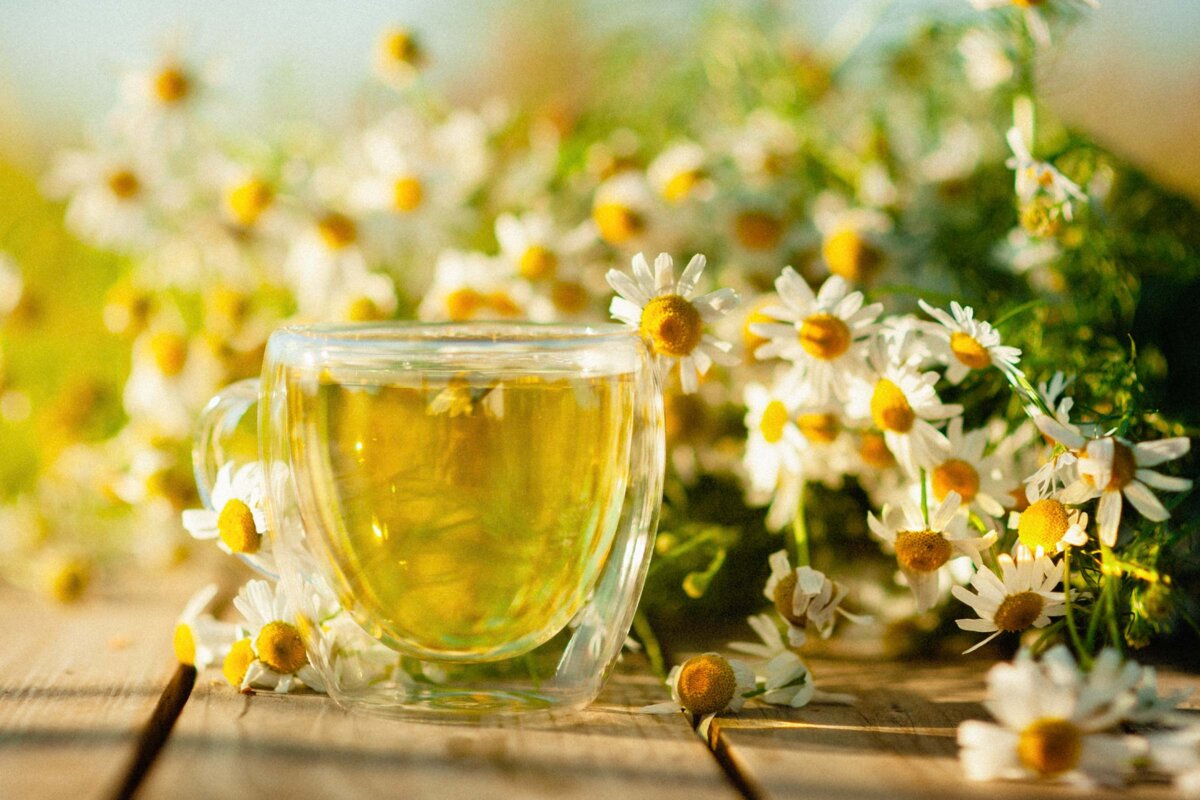
After a close call in Farmer McGregor’s garden, Peter Rabbit’s mother does what mothers have done for centuries: she puts him to bed with a cup of chamomile tea. Beatrix Potter wasn’t making it up. People have turned to this humble, apple-scented flower for calm since ancient times, and now researchers are exploring its benefits.
You’ve likely walked by chamomile a thousand times, growing on lawns or along sidewalks and giving off a faint apple scent from its small, daisy-like flowers. Its Spanish name, “manzanilla,” means “little apple.” Beyond a fragrant ground cover, this common plant is a time-tested medicine with an affinity for the nervous system.
Two types are most commonly used medicinally. German chamomile (Matricaria recutita) is a tall annual, meaning it lasts only one season. Roman chamomile (Chamaemelum nobile) grows low to the ground, is cold hardy, and returns year after year.
Both calm the nervous system. Chamomile is also big business: the United States imports about a million pounds a year—about 90 percent of it for herbal tea—and chamomile flowers are among the most sought-after medicinal plants traded worldwide.
The flowers hold most of the plant’s medicinal properties, including terpenoids and flavonoids. They are harvested in full bloom to extract a vibrant blue volatile oil.
How Chamomile Calms the Body
In herbalism, chamomile is classified as a nervine, a category of herbs that support the nervous system. It is traditionally used to calm a nervous system stuck on high alert. Researchers have identified two main routes by which it works.
Through Ingestion: Chamomile contains apigenin, a flavonoid thought to ease anxiety in several ways. In the brain, apigenin binds to GABA receptors, the same general system targeted by benzodiazepines, dialing down overexcitable nerve signals.
Studies show it balances the hypothalamic-pituitary-adrenocortical axis, an internal communication system that controls the body’s stress response, which may reduce cortisol, the main stress hormone. Research suggests it may also affect serotonin, dopamine, and norepinephrine, which help regulate mood.
Through the Olfactories: You don’t have to swallow chamomile for it to work. Aromatherapy delivered through smell enters through the olfactory system, which is connected to the limbic system, the brain’s emotional control center. Because the limbic system helps regulate stress, aromas can affect mood, blood pressure, heart rate, and muscle tone, explaining chamomile’s relaxing effects.
Soothes Anxiety
Anxiety disorders are the most common mental health conditions worldwide. Between 1990 and 2019, the number of cases rose by about 55 percent, and an estimated 470 million people were affected in 2023, as reported by the World Health Organization.
Chamomile is one of the best-known natural remedies for anxiety disorders. A 2024 systematic review examined the effect of chamomile taken by mouth for anxiety. The review included 844 people, and chamomile preparations included extracts, capsules (250 mg to 2 grams daily), and tea (1 to 2 cups daily). Nine of the ten trials reported a significant anxiety reduction. One trial reported that anxiety patients with depression had a substantial reduction in depressive symptoms as well.
Standard anxiety treatments, including benzodiazepines, selective serotonin reuptake inhibitors, and serotonin-norepinephrine reuptake inhibitors, help some people but can cause significant side effects. These vary by drug and per person and can include headaches, weight gain, digestive problems, seizures, sexual dysfunction, and suicidal ideation. Benzodiazepines also carry a risk of dependence. Because of this, the review’s authors concluded that chamomile may be a safe and effective alternative worth further study.
Alleviates Stress
A cup of chamomile tea is a wonderful way to unwind after a long day.
World-renowned herbalist David Winston also refers to Peter Rabbit: “After Peter Rabbit’s run-in with Farmer McGregor, when Peter Rabbit got home, what does Mrs. Rabbit do? She gives him a cup of chamomile tea,” Winston told The Epoch Times. “So how do we know it works? Because it’s in the literature.”
Stress and anxiety are often used interchangeably, but they are different. Stress has a clear external trigger, such as an upcoming work deadline, a disagreement, or an unexpected bill you can’t pay. Stress usually goes away once the external issue is resolved. Anxiety, on the other hand, is an ongoing sense of excessive worry or fear with no clear external cause.
Chamomile may help calm the body’s physical stress response, in addition to making us feel more relaxed. In one study, researchers exposed participants to a stressful stimulus, and their adrenocorticotropic hormone (ACTH) levels increased. The pituitary gland releases ACTH, which tells the adrenal glands to produce cortisol. Inhaling the aroma of chamomile oil reduced the stress-related increase.
Assists Sleep
Sleep problems have become common in our fast-paced world, where it’s increasingly difficult to slow down and relax. Chamomile is a relaxant and mild sedative that helps ease us into sleep, especially if anxiety or stress is the reason we can’t get there.
A 2024 systematic review and meta-analysis of clinical trials with 772 participants found that chamomile improved sleep. Overall sleep quality improved: in 3 of 4 studies, people fell asleep more quickly, and 2 of 3 studies found it helped people stay asleep or reduced the number of times they woke up. The review also found chamomile didn’t consistently increase how long people slept or improve daytime fatigue. In other words, chamomile may help you drift off and sleep more soundly, but it is not a cure for chronic insomnia.
For herbalists, chamomile is a go-to sleep remedy. “Chamomile is without doubt one of the most widely recognized herbs for mild insomnia and is especially valuable for small children and the elderly,” celebrated herbalist Rosemary Gladstar wrote in her book “Herbs for Stress and Anxiety,” noting that while chamomile makes a delicious tea, it also works in baths and footbaths.
How to Use Chamomile
Chamomile comes in several forms: tea, tincture (a liquid herbal extract), capsules, creams and ointments, essential oil, and personal-care products such as skin products and shampoos that gently lighten blond hair.
To Make Tea
Pour one cup of boiling water over 2 teaspoons of dried chamomile flowers and leaves. Steep for 5 to 10 minutes; a longer steep gives a stronger flavor and stronger effects. Add lemon and, for adults and children over 12 months, honey to taste.
For Aromatherapy or a Bath
-
Add a few drops of essential oil to a diffuser to promote relaxation and sleep.
-
Mix a few drops into a carrier oil for massage so it can be absorbed through the skin.
-
Add a few drops of oil, or a handful of dried flowers, to a warm bath for whole-body relaxation.
Chamomile baths also soothe the skin and are traditionally used on minor wounds.
Chamomile is considered a very safe herb for adults and children, especially when taken as tea. However, many people take medications, and often several at once, Feather Jones, an herbalist, told The Epoch Times. In those cases, consult a healthcare professional before taking any herb in medicinal doses to ensure you do it safely.
Chamomile can cause allergic reactions in people with allergies to ragweed or other plants in the daisy family (Asteraceae).
Final Thoughts
While many of us may reach for a pill to help us through a sleepless night, or struggle to unwind after a stressful day, relief can come from a simple cup of tea, a few drops of essential oil in a hot bath, or simply the scent of flowers that have helped people relax for thousands of years.