
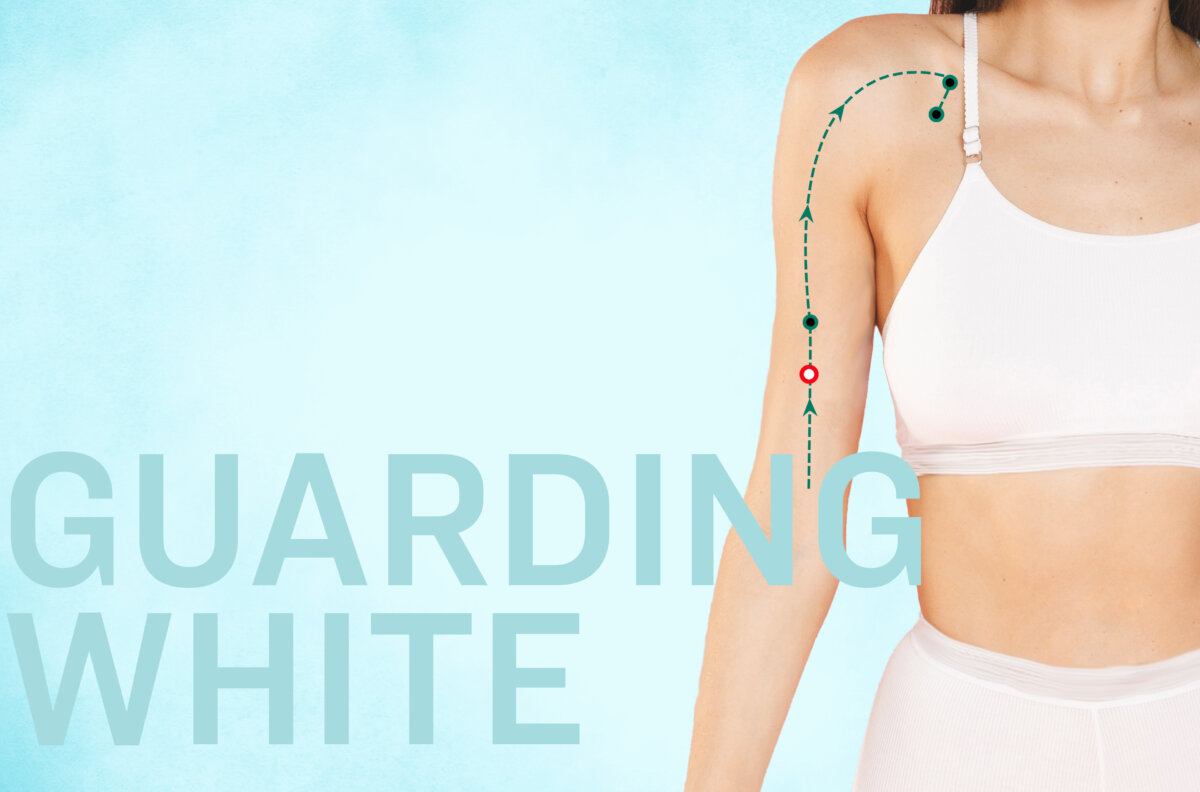
If you’ve just powered through an upper body workout, you know the aftermath: sore biceps, aching deltoids, and an ouch when you try to lift your arms. When that familiar post-lifting soreness arrives—without any real injury—it’s tempting just to let your muscles rest and wait for the pain to fade. However, in traditional Chinese medicine (TCM), gently working with the tender spot can help it bounce back.
The acupoint, Guarding White (Xia Bai, LU4), could be the missing piece in your recovery routine. With benefits for both body and mind, this point offers much more than simple relief for aching muscles.
Guarding White in TCM
Xia Bai was first documented in the “Zhen Jiu Jia Yi Jing” (“The A-B Classic of Acupuncture and Moxibustion”), the oldest surviving acupuncture text. In this foundational text, acupoints were described both by location and by their energetic significance. The word “white” in Guarding White isn’t random—white is the color associated with the lungs in TCM. This point lies on the Lung meridian, which governs respiration and emotional states tied to courage and openness. Interestingly, the first character in the name of the acupoint, Xia, is also found in martial arts novels, where it refers to chivalrous heroes and distinguished martial artists, further emphasizing this point’s connection to courage and resilience.
Practical Applications
What makes Xia Bai unique is its dual purpose. From the location perspective, it’s said to direct vital energy or qi deeper into the muscle tissue, helping the muscles recover and strengthen. From the mental health perspective, it’s believed to support the lungs and foster positive emotions associated with lung health, such as resolve, initiative, and the courage to face challenges.
Its applications reflect balance—it’s used to ease respiratory symptoms like coughing and shortness of breath, as well as to support people struggling with fear, hesitancy, or a lack of drive. Still, Xia Bai is most commonly used locally to relieve pain in the upper arm and shoulder, the exact region where the lung meridian travels.
Works Behind the Scenes
There isn’t an abundance of clinical research focused on Xia Bai, but that’s not necessarily a red flag. Some points, especially those easy to stimulate with acupressure, simply lend themselves to home care instead of formal medical protocols. However, one clinical study does shed light on this point’s potential.
Researchers compared three therapies for shoulder periarthritis—electroacupuncture, transcutaneous electrical nerve stimulation, and acupoint massage—using eight common shoulder points, including Xia Bai. After four weeks of treatment, all groups showed pain reduction and improved mobility. However, it was the acupoint massage group that stood out with the highest success rates and the most significant improvements. This suggests that Xia Bai responds especially well to hands-on techniques like massage, something anyone can try at home without fancy tools or machines.
How to Locate and Stimulate Xia Bai
To locate Xia Bai, start at the inner crease of your elbow. From there, measure about six finger widths up the arm, along the outer edge of your biceps muscle. Once you’re in the general area, press gently around until you find a tender spot—that’s your target. Some people describe the sensation as soreness, while others describe it as a dull ache. If the area is particularly sensitive, your body may be indicating that there’s energetic congestion or muscle tension that requires attention.
Ways to Stimulate Xia Bai
- Firm pressure: Press firmly for three to five seconds, then relax for three seconds. Repeat for one to three minutes on each side.
- Circular massage: Massage in small circles with your index finger or thumb for one to three minutes on each side.
- Herbal patch: Apply an herbal patch overnight for longer activation.
- Advanced methods: Acupuncture, cupping, or moxibustion (a gentle heat therapy using dried mugwort) by a trained professional can deepen the therapeutic effects.
Precautions
If you have any injuries around the upper arm, avoid stimulating Xia Bai until you’ve healed. Acupressure can help ease tension and promote flow, but it shouldn’t be used in areas with structural damage. When using herbal patches, opt for formulas without harsh chemicals, especially if your skin is prone to allergic reactions.
A Little Courage, a Lot of Relief
You don’t have to believe that pressing a point on your upper arm can inspire courage, but if it does, whether through tradition or placebo, why not welcome the effect? Regardless of your belief system, it’s empowering to take small, practical steps toward recovery and resilience. Xia Bai is one such tool. Whether you’re dealing with sore biceps or need a push to face something difficult, this simple technique may give you the power to keep going.
TCM expert Shihhsiang Hung reviewed this article for accuracy and clarity.