
Being “tech savvy” often translates to long hours of sitting still and typing, whether you’re a student, writer, lawyer, digital artist, or anyone with a modern-day desk job. Most of us spend hours a day on keyboards and mice without moving our hands much beyond basic repetitive motions.
From the traditional Chinese medicine perspective (TCM), such a lifestyle affects more than mobility levels. It also causes stagnation of blood and qi, the body’s vital energy. Fortunately, TCM offers tools to counter these modern challenges. The acupoint, Yang Stream (Yang Xi, LI5), addresses the exact discomfort caused by prolonged immobility in the hands.
A Classical Point With a Local Focus
Yang Xi was first mentioned in the “Ling Shu” (“Spiritual Pivot”), a classical TCM text on acupuncture. It is classified as a Jing-River point on the Large Intestine meridian. Jing-River points are described as locations where the flow of qi or vital energy accelerates. Understanding these points helps explain their role in protocols for treating issues in the local area of muscles and tendons.
A Practical Tool for Hand and Wrist Discomfort
Yang Xi can be used in cases involving facial swelling, eye pain, headaches, and toothaches. However, its primary clinical use is for addressing wrist pain and a comprehensive condition often called the “stiff hands syndrome” in TCM practice. It usually results from prolonged periods of writing or keyboard use, during which the hands remain relatively static. Stagnation of qi and blood leads to cramps, aches, and wrist discomfort. Yang Xi is used to reinvigorate local circulation of qi and blood, thereby relieving these symptoms.
Additionally, classical literature recommends Yang Xi alongside another Large Intestine point for cases of psychosis or hallucinations, described historically as “seeing ghosts.”
Yang Xi in Current Research
While acupuncture is rooted in tradition, modern research is investigating both the localized and systemic effects of acupoints, including Yang Xi. One study reviewed acupuncture treatments for rheumatoid arthritis and found that Yang Xi was frequently chosen to address wrist joint symptoms. It was commonly paired with Yang Chi (TE4) and recorded 28 times, suggesting practitioners favor the pairing.
Another study examined how acupuncture points on the Lung and Large Intestine Meridians relate to colon function. Electroacupuncture at Yang Xi and Pianli (LI6), a neighboring acupoint on the Large Intestine meridian, was shown to increase movement in the colon and activate the cardiopulmonary sympathetic nerve. These results were similar to those from stimulating points on the Lung meridian, providing evidence of a relationship between these meridians and colorectal function.
How to Locate and Activate Yang Xi
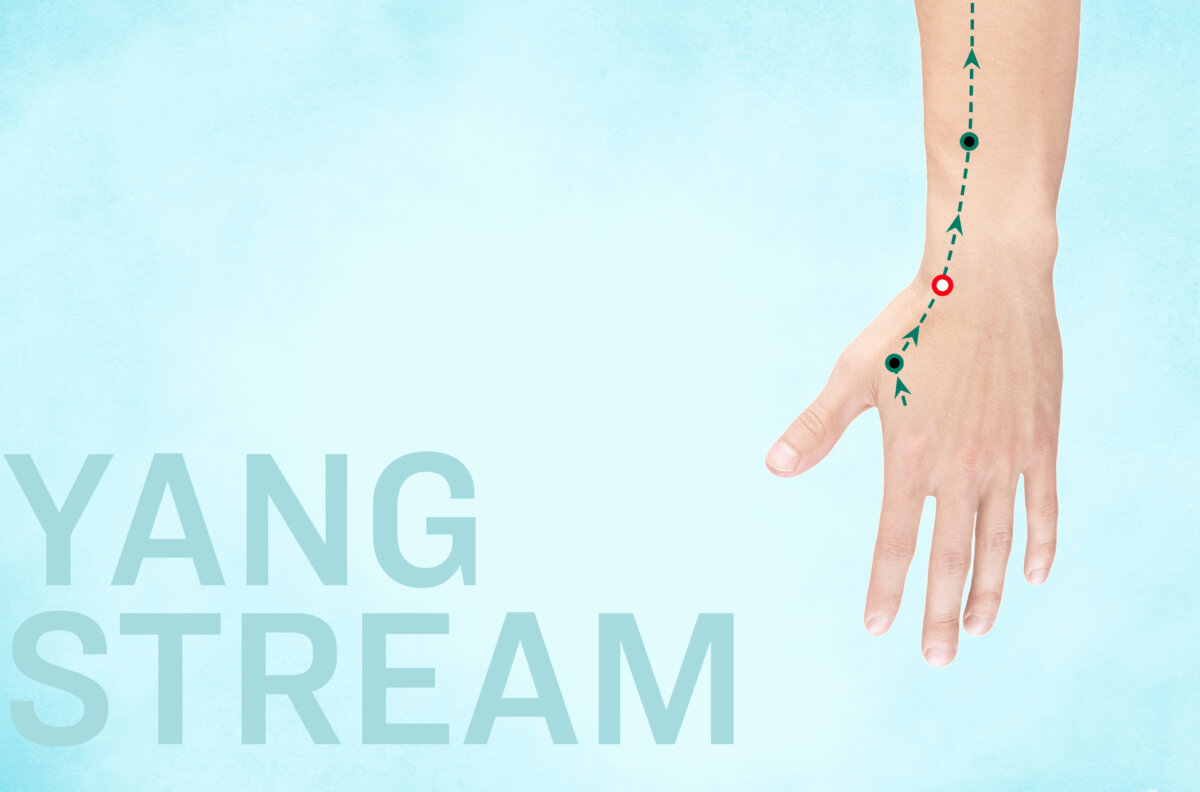
Yang Xi is found on the thumb side of your wrist. To locate it, raise your thumb and look for the hollow between the two tendons. This dip is where Yang Xi is located. Gently press around this area to find a sore or tender spot, also known as an “ashi point” in acupuncture. Practitioners use these sensations to pinpoint the exact location of the acupoint for each person. If you have a lingering injury or blocked energy in this area, you may experience higher sensitivity.
Ways to Activate Yang Xi
- Firm pressure: Press firmly for three to five seconds, then relax for three seconds. Repeat for one to three minutes on each side.
- Circular massage: Massage in small circles with your index finger or thumb for one to three minutes on each side.
- Herbal patch: Apply an herbal patch overnight for longer activation.
- Advanced methods: Acupuncture or moxibustion (a gentle heat therapy using dried mugwort) by a trained professional can deepen the therapeutic effects.
Precautions
Avoid activating ang Xi if you have a wrist injury. If using an herbal patch, opt for ones without harsh or artificial ingredients, especially if your skin is sensitive.
Close the Day With Self-Care
Do you have a small ritual to end your workday? Maybe straightening up your desk or grabbing a glass of water? Try adding a short massage of Yang Xi to that routine. It’s a way of thanking your hands for their work while helping your qi and blood catch up. A few minutes of focused attention on this point can prevent long-term issues from developing. Your hands may not get what they need from your job, but they can from you.
TCM expert Shihhsiang Hung reviewed this article for accuracy and clarity.