

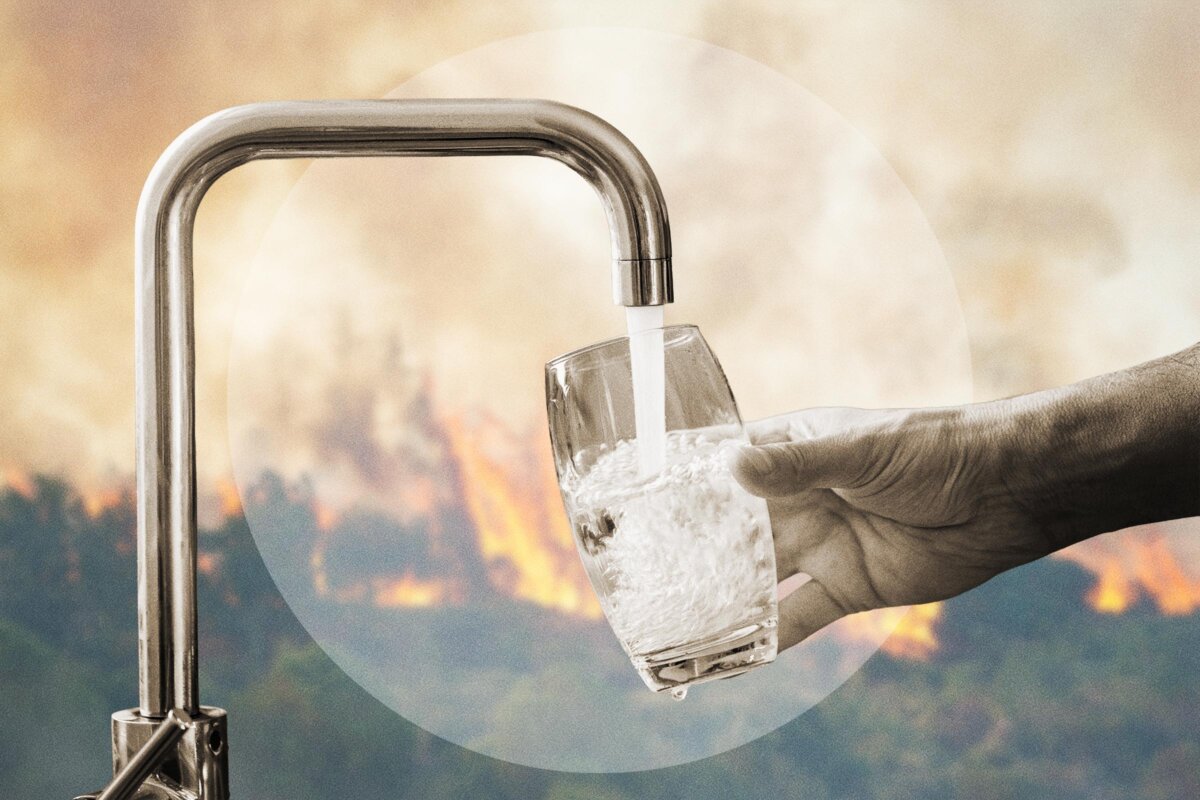
People may be drinking the aftereffects of a wildfire long after the flames have been extinguished.
Ash and other pollutants can wash into reservoirs and surface water—the same sources that most water treatment plants use to provide public drinking water. These contaminants pose a challenge for water treatment plants because the extra disinfectants they add to kill pathogens can create health risks in the aftermath of wildfires—and so can the pipes themselves.
A Catch-22 for Treatment Plants
Treatment plants face an impossible challenge after wildfires. If they don’t add enough chemicals to disinfect water after it’s contaminated with ash and debris, pathogens may flourish. But adding more chemicals to deal with the risk can end up creating more disinfection byproducts.
Disinfectant byproducts form when organic material in the water interacts with disinfection chemicals, such as chlorine. This interaction can continue to occur in the pipes as water makes its way to people’s homes. The more disinfectants used, or the more organic material in water, the more byproducts come out of the tap. Many of these byproducts remain understudied, while others pose known health risks.
A U.S. Environmental Protection Agency (EPA) report published in Science of the Total Environment in 2022 found that up to 71 percent of drinking water sourced from surface water impacted by wildfires had higher levels of disinfection byproducts.
Recent research shows that the organic matter and toxic chemicals from wildfire ash and debris can contaminate drinking water sources for up to eight years. Meanwhile, another EPA report noted that plants and storage systems may not be equipped to handle the influx of contaminants.
Because water treatment plants follow strict protocols to handle wildfire contaminants, they may have to maintain heightened disinfection protocols for years after the fire is extinguished.
Arsenic and Nitrate
Wildfires can contaminate water with chemicals and compounds such as nitrate and arsenic at levels that can exceed federal safety standards, the EPA report stated.
Research has also found evidence that high nitrate levels in drinking water can increase the risk of methemoglobinemia—a condition that affects red blood cells—as well as colorectal cancer, thyroid conditions, and neural tube defects.
Long-term exposure to elevated arsenic levels in drinking water can increase the risk of lung and bladder cancer, heart disease, and developmental conditions in children.
The Plastic Pipe Controversy
One of the most contentious debates surrounding wildfire contamination centers on the cause of contamination in distribution pipes when the source water doesn’t appear to be the factor.
The issue became clear after California’s 2017 Tubbs Fire and 2018 Camp Fire.
For the first time, scientists discovered chemical contamination in the water distribution network itself—the pipes that travel to people’s homes—not in the water sources used by treatment plants to provide public drinking water. Tap water in affected areas contained benzene and other volatile organic compounds (VOCs) at levels exceeding state and federal exposure limits.
Their study also found that an estimated 2,438 private drinking water wells were affected by VOC contamination during the Camp Fire alone.
Some researchers believe that one cause of the contamination could be plastic indoor and outdoor plumbing pipes, which can leach benzene and other VOCs into the water after exposure to intense heat from wildfires.
In a 2021 study published in Environmental Science: Water Research & Technology, researchers exposed several types of plastic drinking water pipes to elevated temperatures ranging from 392 to 752 degrees Fahrenheit. They found that most of the pipes leached VOCs, including benzene. The scientists concluded that plastic plumbing pipes, even those buried underground, could be exposed to sufficient heat during a fire to release VOCs into the drinking water traveling to people’s faucets.
However, the Plastics Research Council, an independent research institute, stated in an analysis that much of the science pointing to plastic pipes as a source of post-fire VOC contamination has “major flaws,” as research has shown that contamination occurs in other ways.
Chris DeArmitt, who has a doctorate in polymers and surface science and is the founder and president of the Plastics Research Council, told The Epoch Times that during wildfires, smoke from burning trees gets sucked into plumbing systems, which can contaminate the water with benzene. Reports suggest that each kilogram of hardwood burned creates 1 gram of benzene in wood smoke.
According to an American Water Works Association study, smoke and VOCs, such as benzene, from wildfires can enter plumbing pipes following pressure loss due to power outages or pipe damage.
Reports suggest that metallic pipes, such as copper, can also become contaminated if smoke enters the system; however, they are more easily flushed of contaminants than plastic.
When Burned Homes Poison the Water Supply
While smoke and VOCs from burned trees create problems, they may be less severe than the ash that comes from burned homes and structures. Ash can trigger highly toxic disinfection byproducts in drinking water after chlorination, according to a study published in Environmental Science & Technology in July.
The study simulated the impact of ashes on drinking water, including ashes from burned homes, storage buildings, a tool shed, and even a boat and trailer.
When chlorine is used to disinfect water that has been contaminated with ash from burned building materials, it creates more toxic byproducts, specifically those containing bromine, iodine, and nitrogen, than it does when disinfecting water contaminated with ash from burned plants, the study’s coauthor, Susan D. Richardson, told The Epoch Times. Richardson worked at the EPA for about 25 years and is now a professor of chemistry at the University of South Carolina.
A total of 65 disinfection byproducts were identified in the study, she said, including emerging and more toxic byproducts not regulated by the EPA. The EPA has set limits for four disinfection byproducts in drinking water, including bromate, haloacetic acids, trihalomethanes, and chlorite. Water utilities test drinking water for these byproducts on a regular basis.
However, research has linked exposure to these byproducts—particularly trihalomethanes—to bladder and colorectal cancer, even at levels within regulated limits. A study published in the Journal of Hazardous Materials revealed there are hundreds, if not thousands, more disinfection byproducts that remain unregulated and understudied.
How Water Utilities React to Wildfire Contaminants
While the dangers of wildfire-related water contamination are likely limited to regions affected by fires and areas inundated by the resulting smoke, an EPA report shows that from 1984 to 2022, approximately 70 percent of community water systems in the western United States, relying on surface water sources, were exposed to wildfires.
According to the National Interagency Fire Center, more than 54,000 wildfires have burned just over 4.7 million acres since Jan. 1 in the United States. Therefore, a substantial number of Americans may face exposure to wildfire-related water contaminants.
People living in wildfire-affected areas will likely be exposed to higher levels of more toxic disinfection byproducts, along with polycyclic aromatic hydrocarbons, which are widespread environmental pollutants, heavy metals, and other harmful chemicals from the ash itself, Richardson said.
When wildfire-related water contamination is suspected or present, water utilities issue drinking water advisories such as:
- Do Not Drink: Tap water should not be used for drinking, cooking, ice, or baby formula. People should avoid taking long baths or showers in hot water to reduce the risk of inhaling VOCs.
- Boil Water: People should boil tap water before using it for drinking or cooking purposes.
- Do Not Drink/Do Not Boil: Tap water is unsafe to drink and should not be boiled. Water may contain high VOC levels, which people could inhale during the boiling process.
- Do Not Use: Tap water should not be used for any purpose, including bathing or showering.
Utilities provide detailed instructions to follow until the water supply is deemed safe and advisories are lifted.
Steps You Can Take
According to the Water Quality Association, people affected by wildfire-related water quality issues may need to rely on bottled water until treatment facilities can repair the damage and flush the system, which could take weeks or months.
The Water Quality Association notes that even after utilities declare water safe, people may need to flush and sanitize their household plumbing and equipment, such as water heaters, refrigerator dispensers, and ice makers, to remove any remaining contaminants.
However, people concerned about their water quality during or after a wildfire can take steps to ensure their drinking water is as safe as possible.
“It could be good to use an activated carbon filter if your drinking water has been impacted by these wildland-urban fires or drink bottled water during this time,” Richardson said.
Activated carbon filters and reverse osmosis filtration systems can reduce harmful disinfection byproducts that may remain even after water treatment plants have cleared their systems of other wildfire-related contaminants.
DeArmitt suggests that people should continue to monitor their water for any unusual taste during and after a wildfire. The presence of an off-taste or smell can indicate contaminants in the water.
