


In the dark of night, a biologist discovered what it feels like to become light. From her boat, she watched millions of tiny plankton illuminate the ocean into a bright blue-green stretching as far as she could see. As she entered the water, her whole body began to glow; with the slightest movement, she became a “swirling part of the glowing tapestry.” Fish swam nearby, each creating a streak of ethereal light as they surrounded her.
The scientist, interviewed as part of sociologist Brandon Vaidyanathan’s research on science and spirituality, recalls the paradoxical experience: Even though she understood exactly why those organisms were glowing, the scientific explanation didn’t diminish her sense of wonder.
Instead, it deepened it and led to a profound sense of spirituality.
Her experience challenges one of our most entrenched cultural assumptions: that science and spirituality occupy separate realms.
Research shows that far from diminishing spiritual longing, science may actually awaken it. For many scientists, the lab is not just a place of logic, but a portal to wonder and a deeper search for meaning.
The Cosmos as a Cathedral
The narrative of science versus spirituality is rooted in Max Weber’s theory of disenchantment, which suggests that as science advances, spiritual yearning necessarily retreats.
“Modernity strips away the sense of magic and mystery from reality, and science in particular,” Vaidyanathan, a sociologist at the Catholic University of America, told The Epoch Times. “Scientific thinking is opposed to magical thinking, and it’s all about reducing our experience of reality to atoms, molecules, formulas, and so on.”
However, Vaidyanathan has spent years discovering a more nuanced perspective. He interviewed 104 biologists and physicists across India, Italy, the UK, and the United States and found that scientists—whether religious, spiritual but not religious, or entirely secular—experience spiritual yearning in remarkably similar ways.
Vaidyanathan’s team used text analysis software to examine which words scientists used together when describing their experiences.
When religious scientists described their yearning, words such as “belief,” “God,” “prayer,” and “community” clustered together, reflecting how they integrate spiritual yearning within their faith traditions.
One religious scientist said, “This yearning to reach the stars enables us to understand something about ourselves as well.”
For them, science becomes a way to understand divine creation even more deeply.
Spiritual but not religious scientists experience their spirituality as a dynamic, personalized journey shaped by emotional connections and transcendent experiences. Their word clusters centered on “connection,” “experience,” “transcendent,” and “nature.”
[epoch_component type=”photo_gallery” position=”left” section_title=”Words that appear close together were frequently used in the same context during interviews. Larger words appeared more often, while connecting lines show which concepts scientists linked together. (Illustration by The Epoch Times)” width=”600″ items=”5908399,” image_stays=”false” stays_for_paragraphs=””][/epoch_component]
Nature frequently serves as their primary spiritual medium. One described their yearning: “By the side of the sea … for me, that’s super calming, even when it’s rough and cold and horrible because it’s almost like you’re looking into infinity. There’s nothing there, [yet] it moves all the time.”
Nonreligious and nonspiritual scientists might seem immune to spiritual experience, but Vaidyanathan found that they often express similar yearnings through intellectual curiosity and existential questioning. They frame their pursuit of meaning in terms of personal growth and connection to nature or the cosmos. Their word clusters emphasized “curiosity,” “meaning,” and “connection.” One scientist described it as “a drive to keep asking questions.”
“That’s how we orient ourselves in a vast universe,” the scientist said.
What unites all three groups, the research revealed, is their capacity for awe. Martin Nowak, a professor of biology and mathematics at Harvard University, suggests that science and spirituality share one fundamental attribute.
“Both long for truth,” he told The Epoch Times. “Both have to deal with wonder and awe.”
‘Awe as the Gateway’
The synergy of science and spirituality runs deep and far back. Galileo studied the stars, believing they were the work of God’s hands. Newton saw the laws of motion as signs of divine order. As British writer C.S. Lewis put it, “men became scientific because they expected Law in Nature, and they expected Law in Nature because they believed in a Legislator.” For many renowned scientists, faith didn’t compete with discovery; it inspired it.
A 2023 study published in the Journal of Personality and Social Psychology introduced the concept of “spirituality of science”: feelings of meaning, awe, and connection derived through scientific ideas.
The research found that this spirituality of science predicted stronger engagement and learning with scientific information and provided psychological benefits similar to religious spirituality, even among atheists and agnostics.
This finding may help explain why Einstein described religious and scientific union as a “cosmic religious feeling” and considered it “the strongest and noblest incitement to scientific research.” Einstein believed that science and spirituality shared a fundamental drive toward truth and wonder.
Contemporary scientists echo Einstein’s sentiments. Sarbmeet Kanwal, a theoretical physicist from the California Institute of Technology, told The Epoch Times: “Awe and wonder serve as a gateway to experiencing an aspect of reality for which we do not as yet have a firm scientific grounding.”
That gateway, however, does not close when we find a scientific explanation. As mathematician and philosopher of science John Lennox points out, explanations can work on different levels without canceling each other out. If you ask why water is boiling, one answer might describe the transfer of heat that breaks hydrogen bonds between molecules; another might simply say, “Because I want a cup of tea.” Both are true—they just answer different questions. In the same way, knowing the chemistry of glowing plankton does not drain them of wonder.
The Sacred From Macro to Micro
The experience of awe operates at every scale of scientific inquiry.
For Mario Livio, a former Space Telescope Science Institute astrophysicist who helped operate the Hubble Space Telescope for 24 years, the spiritual dimension of science manifested when the first results from the “Hubble Deep Field”—the deepest image of the universe captured at that point—arrived.
“It did leave me speechless, realizing how small we are,” he told The Epoch Times.
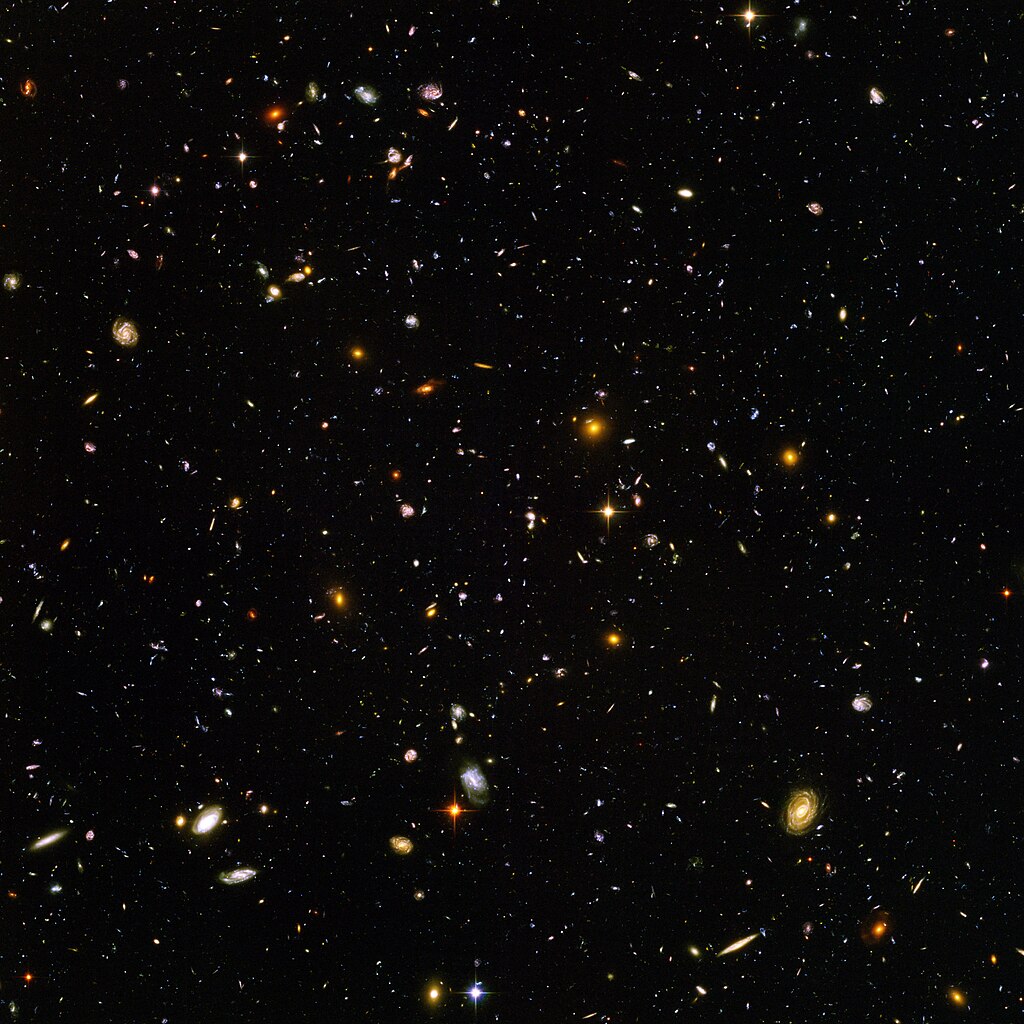
“While we have discovered that we are but a speck of dust from a physical perspective, it is human knowledge that has expanded and allowed us to understand the cosmos,” he said.
The spiritual dimension of scientific discovery isn’t limited to astronomy’s vast scales. Vaidyanathan recalls interviewing a biologist in India who showed him slides of bacteria she was studying.
The biologist pointed to the needle of the bacteria, and then she showed Vaidyanathan a close-up of what looked like a pillar from a 3,000-year-old Hindu temple.
“If I don’t tell you that this is a bacterial needle, you may easily mistake this for one of these beautiful ‘stambha’ [ornamental pillars found in Hindu temples] in an archaeological site,” she said.
[epoch_component type=”photo_gallery” position=”left” section_title=”(Adapted from Schraidt et al., PLoS Pathog 2010, CC BY 4.0., Shutterstock)” width=”900″ items=”5908398,” image_stays=”false” stays_for_paragraphs=””][/epoch_component]
“If we even think of making it, manufacturing it, we may take ages,” she said. “And they do it within minutes. They are no less than a beautiful piece of art.”
Common Ground
Not every scientist experiences spiritual yearning, and Vaidyanathan’s research acknowledges these limits. Some maintain a more traditional rationalist perspective, finding satisfaction in material explanations without any sense of longing for transcendence. Others view science as revealing human limitations rather than cosmic significance.
Yet many scientists “see no tension whatsoever between spiritual experience and scientific inquiry,” Kanwal said.
“Scientific pursuit is a way to ground our human experiences in a natural order that pervades the universe we live in,” Kanwal said.
“Some day, and this could be centuries in the future, we might be able to explain spiritual experience as part of the universe’s order. But until then, we must hold it as a mystery yet to be explored, but not something that opposes science in any way.”
Kanwal suggests that if science naturally evokes spiritual yearning across belief systems, then the supposed conflict between reason and transcendence may be largely artificial—a false dichotomy that limits both scientific and spiritual understanding.
Vaidyanathan’s study concludes: “Even though, as we have seen, some scientists do not express spiritual yearnings, science can still inspire new paths of spiritual and existential exploration, offering a unique spiritual resource for believers and nonbelievers alike.”