
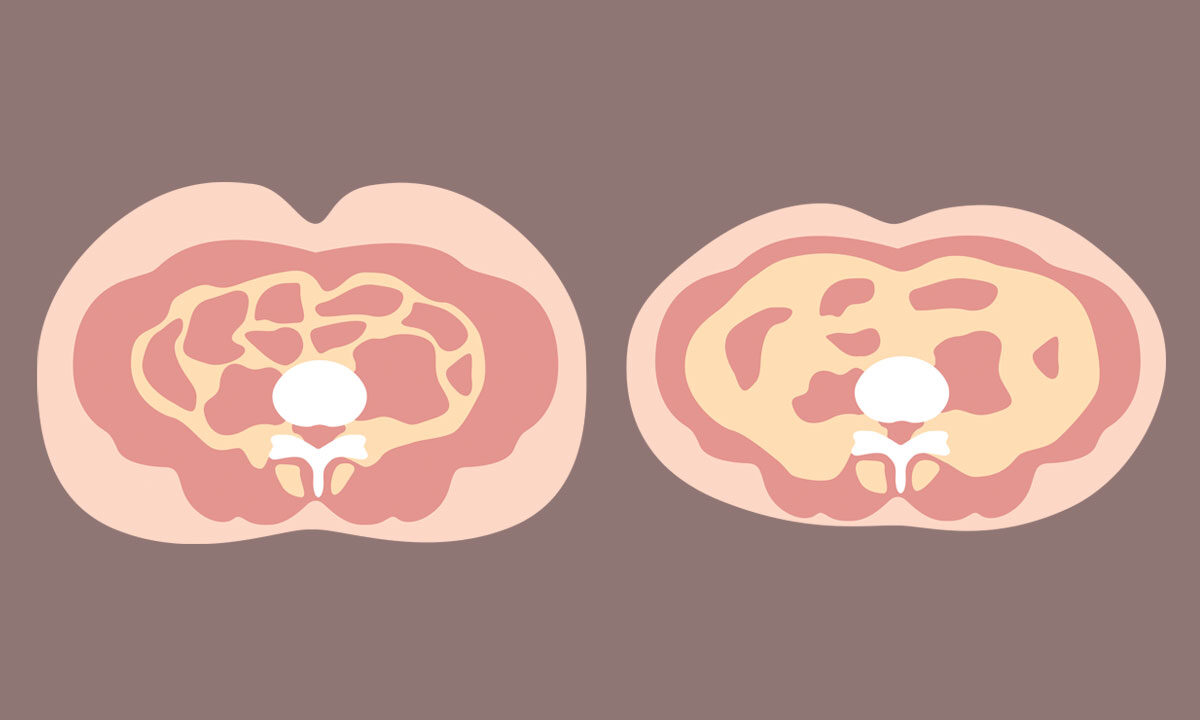
A protruding belly and hidden fat will increase the risk of many chronic diseases, and people with a “thin” appearance should not ignore them, either. However, the results of some methods that emphasize “belly fat loss” or getting rid of belly fat can be disappointing.
Visceral Fat Should Not Be Ignored, Healthy Weight Can Be Deceiving
Human body fat can be divided into subcutaneous fat and visceral fat. Subcutaneous fat is under the skin and can be pinched with hands, while visceral fat cannot be pinched.
Visceral fat includes fatty tissue that surrounds organs such as the heart, lungs, liver, and intestines. According to Australia’s Health Direct, it makes up about one-tenth of all fat stored in the body. People with bulging bellies and apple-shaped figures (as opposed to pear-shaped ones) have excess abdominal fat, which is just the tip of the iceberg of visceral fat.
Visceral fat acts as a cushion that protects the internal organs. However, when people consume too many calories, visceral fat will accumulate in the abdomen. This can lead to abdominal obesity, which affects health. For example, it increases the risk of metabolic syndrome, cardiovascular disease, insulin resistance, and type 2 diabetes.
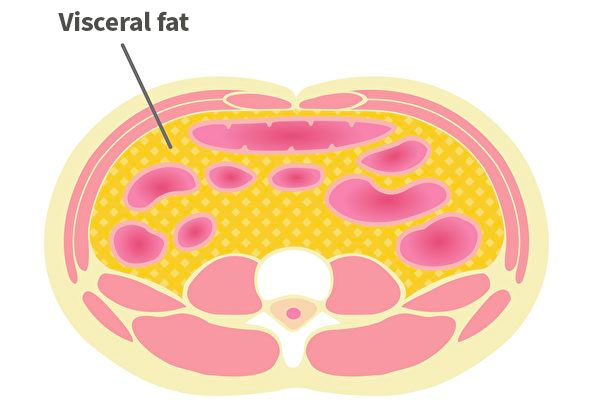
According to Harvard Medical School, visceral fat can be considered an endocrine organ as it secretes hormones and other substances that profoundly affect our health. Excess visceral fat will disrupt the balance and function of hormones in the body.
The easiest spot to determine the amount of visceral fat is the waist circumference.
According to the standard of the Ministry of Health and Welfare in Taiwan, the waist circumference of a healthy man should be less than 35 inches (about 90 centimeters), and the waist circumference of a woman should be less than 31 inches (about 80 centimeters).
The U.S. Centers for Disease Control and Prevention recommends that men’s waist circumference should not exceed 40 inches (102 centimeters), while women should not exceed 35 inches (89 centimeters).
However, even seemingly thin individuals face these risks if they have excess belly fat.
Body mass index (BMI) is a measure of obesity based on height and weight, calculated by dividing weight (in kilograms) by the square of height (in meters), but it does not directly measure body fat. The BMI of a healthy weight is between 18.5 and 24.9 kg/m2. According to the American Heart Association, people with excess abdominal and visceral fat have an increased risk of heart disease even if their BMI falls within the healthy range. Meanwhile, people whose BMI falls into the obese category, but who have low levels of abdominal fat, have a lower risk of heart disease.
A large-scale UK study found that the risk of coronary heart disease will increase with increasing waist circumference regardless of the BMI category (<25, 25–29.9, ≥30 kg/m2).
According to Harvard Medical School, as people enter middle age, their proportion of fat to body weight tends to increase, and the extra fat tends to accumulate around the abdomen—particularly in postmenopausal women, where body fat tends to shift to the abdomen.
Visceral Fat Leads to Various Diseases, Including Dementia and Cancer
A growing number of studies have found that visceral fat is associated with a number of chronic diseases and increased mortality risk. In addition to cardiovascular disease and diabetes, other diseases include:
1. Dementia
A 36-year study found that those with the highest levels of abdominal obesity in middle age had nearly a threefold increased risk of developing dementia three decades later than those with the lowest levels of abdominal obesity.
2. Cancer
More and more studies suggest that excess visceral fat is an important risk factor for esophageal, pancreatic, colorectal, breast, endometrial, kidney, and prostate cancers.
3. Risk of premature death
A study published in the British Medical Journal found that excess visceral fat is associated with a higher risk of early death, regardless of total body fat. For roughly every 4-inch (10-centimeter) increase in waist circumference, the risk of all-cause mortality increased by 11 percent.
4. Liver disease
Excessive visceral fat can cause nonalcoholic fatty liver disease (NAFLD). If improvement is not made, it may slowly progress to cirrhosis and liver cancer.
5. Asthma
A study of 88,304 women conducted by the Cancer Center of Northern California found that a waist circumference greater than about 35 inches (88 centimeters) was associated with an increased risk of asthma in both obese women and women with a normal BMI.
6. Depression
A survey of more than 2,000 adults over the age of 20 in the United States found that abdominal obesity was significantly associated with an increased likelihood of major depression and moderate-to-severe depression.
‘Spot Reduction’ Does Not Exist, These 2 Traditional Methods Are Most Effective
You have probably seen ads on the internet for products that claim to help you lose belly fat or for exercises to get rid of your belly. However, their results may be disappointing.
Scott Wang, director of the Star Rehabilitation Clinic, said bluntly that this is because “spot reduction does not exist.” He pointed out that abdominal exercises will not target belly fat, and arm exercises will not target arm fat either.
The most reliable ways to get rid of bulging belly and visceral fat are the traditional methods: calorie control and exercise. According to Health Direct, medication is not as effective in reducing visceral fat as exercise.
While both aerobic and strength training burn calories, a meta-analysis showed that moderate- to high-intensity aerobic exercise had a greater effect on visceral fat than lower-intensity aerobic exercise or strength training.
Moderate- to high-intensity aerobic exercise, such as running and spinning, can burn more calories. It is recommended to exercise 150 minutes a week and do it consistently. High-intensity interval training (HIIT) can also help you lose fat, but it is more suitable for people with a foundation in sports. “I often encounter people who rarely exercise and get injured due to sudden high-intensity exercise,” Wang said.
Are abdominal exercises such as sit-ups really useless at targeting fat, as Harvard Medical School claims? Although sit-ups can tighten the abdominal muscles, they cannot burn a lot of visceral fat.
Wang emphasized that strength training cannot target and eliminate abdominal fat; abdominal fat is accumulated solely due to excessive calorie intake. Therefore, exercise is very important, but overall it is not very effective; the key lies in diet control.
Think about it: A 132-pound (60-kilogram) individual burns about 300–400 calories during an hour of moderate-intensity aerobic exercise, which is only about the same as a serving of French fries. A little over two pounds (one kilogram) of fat is about 7,700 calories, so how long does a person need to exercise to lose two pounds of fat? Wang emphasized not neglecting diet and only using exercise as a weight loss tool because the results will definitely be very disappointing.
A small-scale study also found that a hypocaloric diet alone had a greater effect on visceral fat loss than exercise.

Meng-fan Lu, a nutritionist at Metagoso clinic in Taiwan, pointed out that the most proven way to lose weight is a calorie-deficit diet—that is, eating fewer calories than you burn. However, she emphasized that “neither diet control nor exercise can target fat loss to specific body parts; body fat can only be reduced as a whole, and it is not certain which part of the body will lose fat first.”
When implementing a calorie-deficit diet, start by minimizing your intake of refined sugars and increasing your servings of dietary fiber and high-quality protein.
Modern people generally do not get enough dietary fiber, so it is recommended to consume more than two servings of vegetables and one to two servings of fruits every day. Try to replace refined starch with whole grains as the staple food. Whole grains include brown rice, oats, barley, red beans, mung beans, sweet potatoes, corn, etc. For high-quality protein, beans and fish are preferred, followed by eggs and red meat.
Meng-fan said that she has met many people who are afraid of fat intake because they are trying to lose weight, but fat is actually an essential nutrient. You can eat healthy as long as you control your caloric intake and choose fats with a higher percentage of monounsaturated or polyunsaturated fats. She emphasized that excessive intake of good oil or good grains will still make you fat, so calorie control is still the key.
Wang added that low-calorie diets can make people feel hungry. To strike a balance between lower calorie intake and feeling full, it is important to consume enough protein and fiber, as well as minimally processed foods. This way, you won’t be consuming high-calorie junk food, and the total calorie intake will naturally decrease.