
Gone are the days when the doctor’s office was the only place to find joint pain remedies.
Before online videos and content were readily available, the best and only course of action for relief was to go to the doctor for a scan or see a chiropractor or physical therapist, said Juliet Starrett, mobility expert and co-author—with husband Kelly Starrett—of “Built to Move.”
“Oftentimes you may be experiencing pain in the joint, but really it’s being caused by a stiff quad or hamstring or a stiff piece of connective tissue,” she told The Epoch Times. “If you have some nonspecific knee pain, get on the floor with a foam roller and work on your tissues upstream and downstream of whatever pain you’re having.”
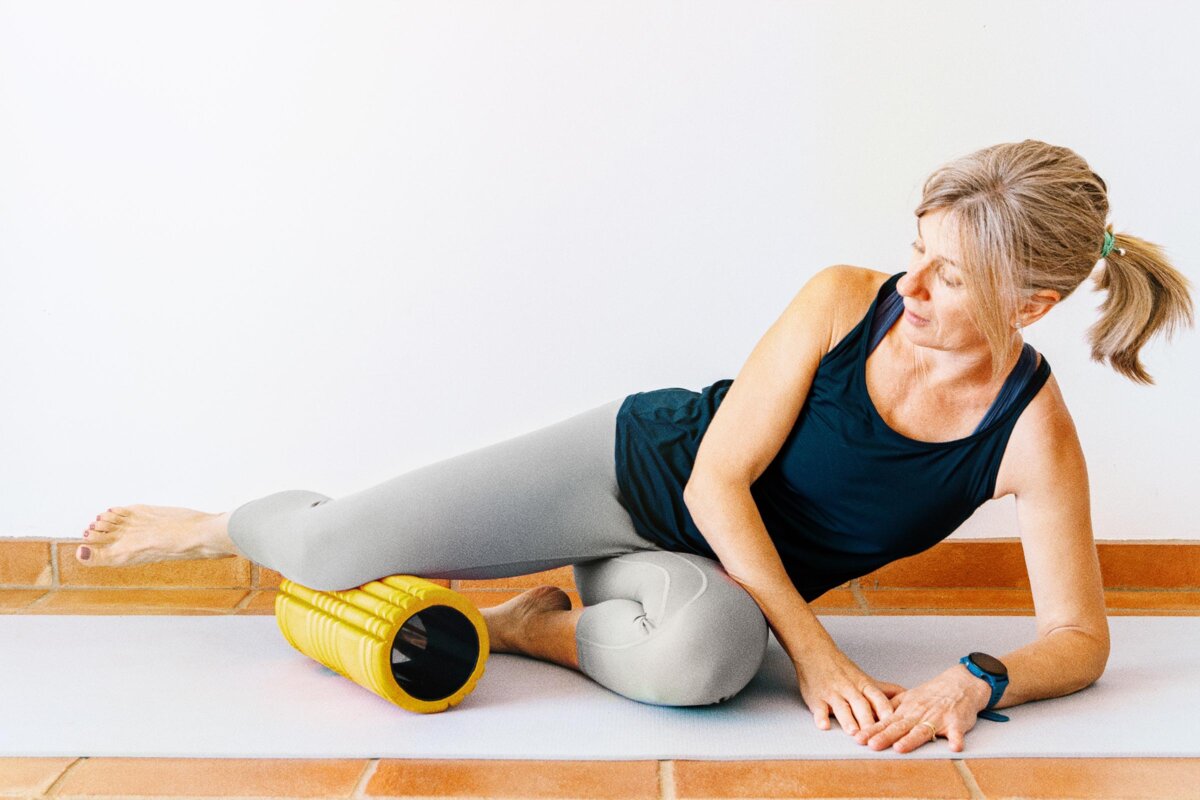
Today, 10 minutes a day spent using inexpensive foam rollers can improve stiff, sore joints and restore range of motion. While specific exercises such as those the Starretts and other mobility experts post online may be helpful, Starrett said tutorials are unnecessary. All you need is a lesson in how to respond to your body’s feedback.
Benefits of Foam Rolling
It can be helpful to imagine your tissue like a rubber band; when it becomes too tight, it restricts the movement of nearby joints, whether small joints such as your wrist, large joints like your hip, or even the interconnected joints of the spine, Starrett said. Sensations such as aches, stiffness, and pain are your body’s clues that it needs slack in the rubber band.
“You almost think about it in physics terms to feed a little slack to your knee,” she said. “We’re trying to have a mental shift.”
Besides fibers, muscles are made up of water and fascia, which is connective tissue that holds the muscles—as well as organs, bones, blood vessels, and nerve fibers—in place. Myofascia refers specifically to the fascia that wraps around muscles.
A study published in Physiotherapy Theory and Practice compared two groups of people using home exercises for hip pain and found that 92 percent of those who used foam rolling experienced pain relief, compared with 41 percent of those who didn’t use foam rolling.
Another study found that one session of foam rolling improved mobility in the lumbar spine. While one session didn’t alleviate pain, four weeks of foam rolling did lead to a significant increase in pain tolerance and even greater improvements in mobility. Published in Frontiers in Physiology, the study found that the effects were still noticeable at a six-month follow-up, even when foam rolling wasn’t used beyond the four-week period.
A meta-analysis published in Sports Medicine involving 290 participants found that foam rolling for at least four weeks increased joint range of motion when used on hamstrings and quadriceps.
The reasons foam rolling is effective are not well-understood, the researchers wrote. Potential explanations for the mechanism of action include:
- Increased Stretch Tolerance: Unpleasant or painful stimuli increase the pain threshold to improve mobility.
- Golgi Reflex Arc: A feedback mechanism that triggers an inhibitory interneuron, which causes contracting muscles to relax, allowing them to stretch without tearing.
- Mechanoreceptors: Neurons that respond to touch. For example, they can adjust fluid in an area of tissue and reduce muscle tension.
Other hypotheses are that the pressure from foam rollers stimulates fascia hydration, reduces fascia inflammation, or releases myofascial trigger points—knots of hyperirritable muscle fibers.
Fascia interacts with bone, muscle, hormones, and nerves. The spiderweb-like network of fascia envelops every nerve, muscle, blood vessel, and organ. It’s loaded with nerves: 25 percent more nerve endings than muscles or even the skin. Influencing posture and movement, fascia can become restrictive and hamper movement, increase pain, and create sensitive areas in the muscles.
The study authors noted that it would be useful to compare foam rolling with other mobility exercises, such as stretching, and to compare different rolling tools—smooth versus textured, vibrating versus nonvibrating, hard versus soft. They also suggested exploring more structured forms of foam rolling that take into account the pressure applied and time spent on exercises.
Foam Rolling Strategies
Most people with mild to moderate pain can use foam rolling to work out aches, Starrett said.
Some tips to get started:
Warm Up the Muscles
Take a walk for two to five minutes, or roll tissues after you’ve been active, Megan Graf, an athletic trainer and yoga instructor, told The Epoch Times.
Be Mindful
Identify muscles around problematic areas—upstream and downstream of the pain, Starrett said. Before and during rolling, be aware of your body’s cues of stiffness and sensations. You can roll around those areas for up to 10 minutes per day until you notice relief.
Key targets usually feel intense but not painful, according to Graf.
“Let what you notice be your guide, so to speak, because you’ll feel the places where it feels intense,” she said. “That place where you kind of don’t want to be is where you should linger because it’s where you need it the most.”
Pick the Right Tool
The tool you use should reflect the size and sensations of the tissues you will be rolling.
For instance, the larger muscles of the shoulders, back, and upper legs may require a bigger roller. The more generalized the area, the bigger the roller, Graf said.
You can lie on top of the roller on the floor or, if it feels better or you have trouble getting on and off the floor, place the roller between your body and a wall.
Rollers that look like rolling pins with handles can help you access more specific areas. For very small trigger points, tennis balls and massage balls can help break up knots or tension in tissue in areas such as the feet, hands, and even small areas within larger muscles, such as hamstrings and glutes.
Linger Long Enough
Stretching in a stiff area with or without a foam roller should involve a static hold for about 30 seconds, Graf said.
“If you hold it for too short of a time, your body is still in fight mode, so you can actually increase the tension instead of creating a release,” she said. “It takes 15 seconds for a signal to go from the muscle that’s stretching to your brain and for your brain to tell it, ‘Hey, this is OK. It’s on purpose. You’re safe to … relax into the stretch.’”
Breathing during the stretch can help the nervous system move from the fight-or-flight mode into the rest-and-digest mode, Graf said. Each session and each muscle may feel different.
“Sometimes it feels really good because you can feel it rolling out the problem, and it’s very relaxing,” Graf said. “Other times it’s a dig in, and that dig in is a little bit painful, but you’re not very likely to do any damage to yourself.”
After deeper, specific work, you may want to leave a day between sessions to help tissue recover, she said. Drinking plenty of water afterward is also helpful.
If you happen to notice any stabbing pain, you should stop rolling and assess the area, Starrett said. Persistent pain that doesn’t improve with rolling or with stretching exercises such as yoga may warrant a trip to the doctor.
Foam Rolling for Anyone
Foam rolling is particularly popular with athletes and active folks, although anyone can and should consider it, even those who aren’t experiencing pain.
“It’s really helpful for your range of motion, to release the muscles and keep them flexible and pliable, so it could definitely benefit everyone,” Graf said.
Foam rolling problematic areas for 10 minutes per day results in more than an hour of focused body work weekly—invested time that might keep you out of doctor’s offices, according to Starrett. The strategy sounds “like voodoo,” she said, but she’s collected enough stories to know that it works.
“What we’ve seen over the years is that we’ve really medicalized common musculoskeletal pain and injury,” she said. “Pain is a normal experience for humans, and it’s an especially normal experience for humans who do anything with their body, like exercise.”
Her goal is to normalize mobility exercises and recovery so bodies can function optimally. Starrett compared foam rolling to taking care of a car.
“Imagine the day you’re born, your parents give you a Corvette, and they’re like, ‘This is the only car you’re going to get your whole life,'” she said. “Imagine how you would take care of that. That’s how we’re trying to have everybody think about their own body.”