
Sourdough has been on the map lately, with a New York City bakery selling loaves for $60. The exorbitant price tag is well beyond what an average loaf would cost—but it reflects how making authentic sourdough is much more than baking—it’s bread you raise.
A social media meme by Really Very Crunchy mom Emily Morrow plays its uniqueness up in one video: her children begging for attention and her husband begging her to step away from her “bread.”
“It’s not bread,” she quips. “It’s sourdough.”
Anyone who has made sourdough knows that time and patience are part of what sets the result apart. Unlike conventional bread making, sourdough needs ongoing feeding and care.
A sourdough loaf is fermented by a starter—a living culture of wild yeast and bacteria the baker keeps going with regular feedings of flour and water. The fermentation takes time. A sourdough loaf can take most of a day to make, and some bakers extend the process overnight or longer.
Fermentation does more than give sourdough its characteristic tangy taste. The process changes the grain in ways that may affect how the bread is digested.
The starter can develop a life of its own—often passed from one person to another, sometimes continuing through generations.
“The story behind an old starter is so special and worth having,” Sienna Walters, head baker at Leaven Foods, told The Epoch Times in an email.
 (Illustration by Ran/The Epoch Times)
Foods rich in phytic acid are not inherently unhealthy, but it binds to minerals such as iron, zinc, and calcium and affects how much the body absorbs. During fermentation, natural enzymes, including phytase, can break down phytate. This process may increase the availability of some minerals in the finished sourdough bread.
One approximately 59-gram slice contains:
-
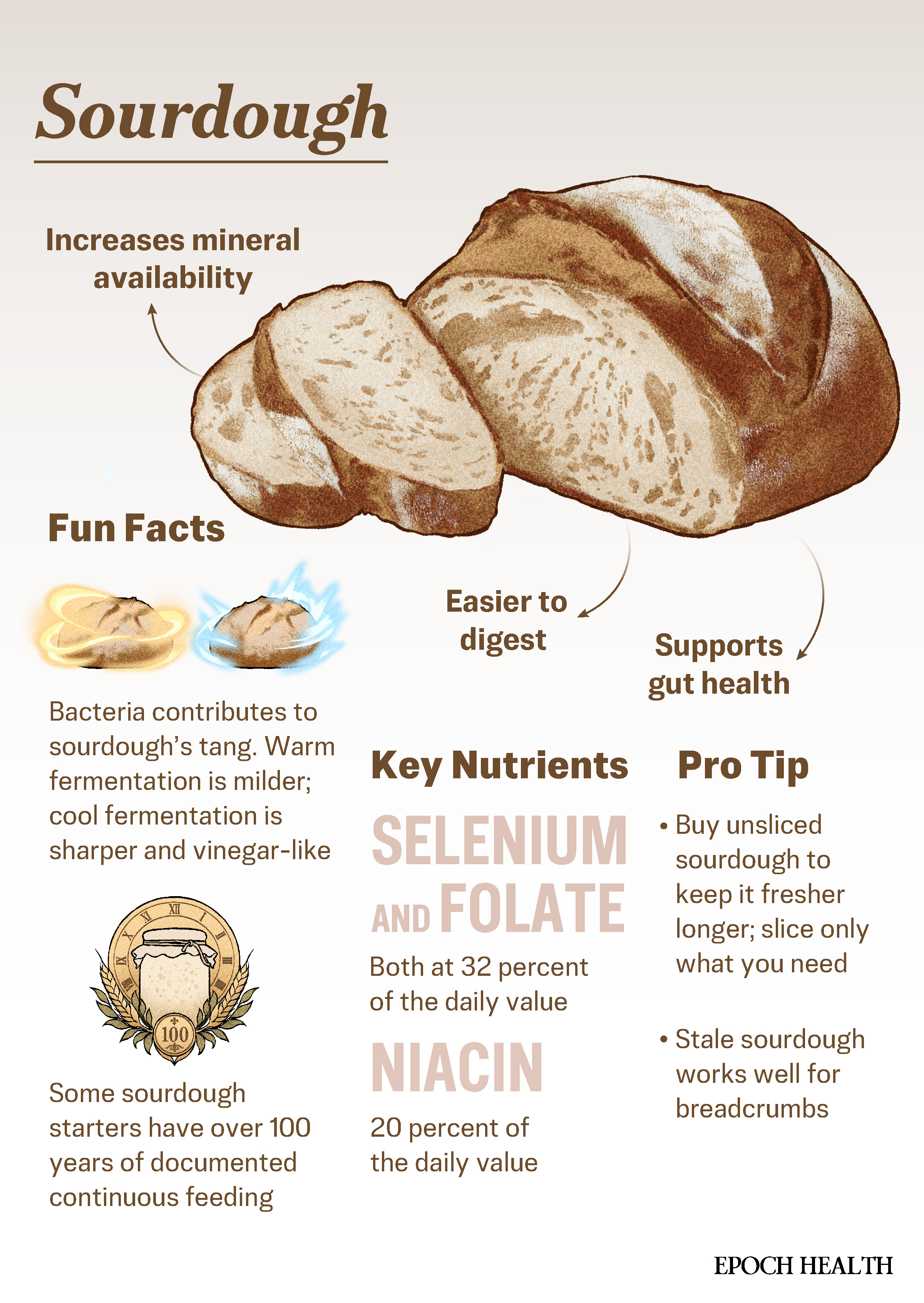
Selenium: 32 percent of the daily value (DV)
-
Folate: 32 percent of the DV
-
Thiamine: 21 percent of the DV
-
Niacin: 20 percent of the DV, compared with about 8 percent in a slice of enriched white bread.
-
Iron: 13 percent of the DV; enriched white bread has about 5 percent.
Nutrient content can vary by recipe, flour type, enrichment, and serving size.
[shortcut_anchor id=”anchor_1792756681815″ label=”Benefits”]Health Benefits[/shortcut_anchor]The potential health effects of sourdough depend on more than simply how long the dough ferments.
“As a rough guide, a loaf that is fermented only with a starter usually takes six to eight hours or more from mixing to baking in a warm kitchen. Many bakers stretch that to 18 or 24 hours by resting the dough in the refrigerator overnight,” Walters said. Commercial bread often takes only a few hours compared with sourdough leavened solely with a starter.
Fermentation time is just one factor. The type of flour matters as well because different grains and levels of refinement contain varying amounts of phytate, fructans, fiber, minerals, and naturally occurring enzymes.
“Temperature, hydration, acidity, starter amount, and the particular yeasts and bacteria involved also shape the fermentation,” Cameron Martino, of Leaven Foods, who has a doctorate in bioengineering, told The Epoch Times in an email.
Easier to Digest
Sourdough fermentation may make bread easier to digest by partially breaking down carbohydrates and proteins before the bread is eaten. A 2024 review published in Foods found that fermentation can reduce FODMAPs (specific short-chain carbohydrates), including fructans, and improve protein digestibility.
In other words, fermentation can essentially give digestion a head start, with acids and enzymes beginning to break down components of the bread before it is eaten. These changes may make sourdough more tolerable for some people, although the effects vary depending on the fermentation process and the individual.
“The extent of that reduction varies considerably, so sourdough bread should not automatically be assumed to be low FODMAP,” Martino said.
A 2023 systematic review found that sourdough may improve gastrointestinal comfort for some people, with some studies reporting less digestive distress after eating sourdough bread.
However, differences in fermentation methods, microbes, flours, and recipes make it difficult to determine how much of the effect comes from sourdough fermentation itself.
In a 2019 study including 36 healthy adults, sourdough breads scored higher than baker’s-yeast bread on several measures of digestibility. The sourdough breads were also associated with faster stomach emptying and intestinal transit time.
The effects varied among the sourdough breads, depending in part on fermentation time and acidity, with the traditionally and longer fermented bread producing the greatest differences in gastrointestinal transit.
Sourdough fermentation can also partially break down wheat proteins, including gluten. The acidity activates enzymes in the flour that break down proteins, while enzymes produced by microbes can also contribute to the process, Martino said.
Supports Gut Health
Sourdough fermentation may influence the compounds that reach the gut. A 2021 review published in Microorganisms found certain prebiotic compounds such as beta-glucans produced during fermentation that may support beneficial gut bacteria.
The review also suggests that eating sourdough may support the digestion and uptake of nutrients such as iron, calcium, and zinc, and provide substrates that beneficial gut microbes can use. However, the live microbes in sourdough generally do not survive baking, so sourdough bread should not be considered a probiotic food simply because it is fermented.
A separate 2021 study used a laboratory gut model and found that sourdough bread increased production of short-chain fatty acids, compounds produced by gut microbes associated with several aspects of intestinal health.
The researchers found that sourdough appeared to affect microbial activity without substantially changing the composition of the microbial community. However, human clinical trials are needed to determine whether these effects occur in the gut after eating sourdough bread.
Increase Mineral Availability
“Fermentation is not adding minerals to the bread. It is changing the grain in a way that can make some of its existing minerals more available,” Martino said.
Research suggests this effect may be particularly relevant for whole-grain, high-fiber breads.
“It switches on the flour’s own enzymes. Sourdough fermentation breaks down considerably more [phytic acid] than yeast fermentation does,” James Gaffney, a microbiologist, told The Epoch Times in an email.
Benefits Blood Sugar and Cholesterol
Sourdough bread may produce a smaller rise in blood glucose after a meal compared with bread made with baker’s yeast, a commercial leavener used to make bread rise quickly. Research has found lower post-meal glucose responses with some sourdough breads, although the effect varies depending on the flour, starter, fermentation process, and finished bread.
One reason may be the way fermentation can increase resistant starch while reducing rapidly digestible starch, potentially slowing the rate at which carbohydrates are broken down. These changes have been associated with a lower estimated glycemic index of sourdough bread, with the greatest effect seen in whole-wheat sourdough made using a specific fermentation method and temperature.
Organic acids produced during fermentation may also play a role. In several human studies, sourdough bread produced a lower post-meal glucose response than bread made with baker’s yeast, including in people with impaired glucose tolerance.
“Organic acids are among the best studied, which give sourdough bread its sour flavor. Lactic acid may slow starch digestion, while acetic acid can affect how quickly food leaves the stomach,” Martino said.
Fermentation can also change starch in ways that slow its digestion.
A 2022 systematic review and meta-analysis found that some sourdough breads modestly reduced post-meal blood glucose, but the researchers rated the evidence as low to very low certainty. Another review concluded that there isn’t enough evidence to show a consistent advantage for sourdough over yeast-leavened bread.
“Some studies find lower post-meal glucose responses with sourdough breads compared with control breads. But that should not be interpreted to mean that every sourdough bread has a low glycemic response.” Martino said.
Some research also suggests whole-wheat sourdough bread may improve cholesterol levels. In one randomized controlled trial, whole-wheat sourdough significantly reduced total and LDL cholesterol compared with white wheat yeast bread. However, more research is needed to determine whether sourdough fermentation itself has a cholesterol-lowering effect.
[shortcut_anchor id=”anchor_1792756702098″ label=”How to Choose “]How to Choose a Good Sourdough[/shortcut_anchor]A couple of simple choices can help make the minerals in sourdough more available for absorption:
-
Choose Well-Fermented Sourdough: Fermentation influences how much phytate is broken down. Factors including time, temperature, flour type, and the microorganisms all play a role. A well-fermented sourdough depends on a combination of these factors, and longer fermentation doesn’t necessarily lead to greater phytate breakdown in every loaf.
-
Choose Whole-Grain Sourdough: Whole-grain breads generally provide more minerals and other nutrients than breads made from refined flour. Fermentation can also reduce some of the phytate in whole grains, potentially making minerals such as iron, zinc, and magnesium more available for absorption.
[shortcut_anchor id=”anchor_1792756710898″ label=”Storage”]Optimal Storage [/shortcut_anchor]How you store sourdough depends on how quickly you plan to eat it. The goal is to keep the interior from drying out while preserving a crisp crust.
“A slowly fermented sourdough stays good on the counter much longer than a bread made quickly with commercial yeast,” Walters said.
-
The First Few Days: Keep sourdough at room temperature in a bread box, paper bag, or wrapped in a kitchen towel. This allows some airflow while protecting the loaf from drying out. If the loaf has been cut, storing it cut-side down can help protect the exposed interior.
-
Longer Room-Temperature Storage: If you wish to keep sourdough at room temperature beyond the first three to four days, place the bread in a sealed plastic bag or airtight container. This helps retain moisture and keep the interior soft, although the crust may become softer.
-
Long-Term Storage (up to three months): Freeze sourdough while it’s still fresh. Slice the loaf before freezing if you want to remove individual pieces as needed, then wrap it well or place it in a freezer bag with as much air removed as possible. Slices can go straight from the freezer to the toaster.
-
Skip the Fridge: Refrigerating bread can actually make it get stale faster. Cooler temperatures can accelerate the starch changes associated with staling.
-
Cool Homemade Bread Completely: Let freshly baked bread cool completely before storing it. Storing warm bread can trap steam inside the packaging, creating excess moisture and making for a soggy crust.
Keeping Your Starter
While a baked loaf stays fresh for days, a sourdough starter can be maintained for decades with regular feedings of flour and water. If you don’t bake often, you can store it in the refrigerator and feed it about once a week, or dry some of the starter for long-term storage, where it can keep for many months or longer, Walters said.
[shortcut_anchor id=”anchor_1792756718649″ label=”Tips”]Pro Tips[/shortcut_anchor]
-
Don’t toss a loaf just because it has lost its softness. Stale sourdough works well for croutons, breadcrumbs, French toast, panzanella (a traditional Tuscan and Umbrian summer bread salad), stuffing, and bread pudding.
-
Buy sourdough unsliced when possible. A whole loaf has less exposed surface area than sliced bread, which can help the interior stay fresh longer. Slice only what you plan to eat.
-
If your loaf has gone stale, a few minutes in a hot oven or toaster can refresh it and restore some of its crisp texture.
-
Keep the heels of the loaf. Instead of throwing the ends away, freeze them in a freezer bag. Once you’ve collected enough, use them for breadcrumbs, croutons, stuffing, or bread pudding.
-
Check the ingredient list. “The word sourdough is not regulated in the United States, so some bread sold as sourdough is a yeast bread with sour flavor added. You can usually tell from the ingredient list. A traditionally fermented loaf needs only flour, water, salt, and a starter,” Walters said.
-
To care for a starter, keep it at room temperature and feed it once or twice a day. If you bake less frequently, store it in the refrigerator and feed it once a week by adding fresh flour and water. Before baking, bring a refrigerated starter back to room temperature with two or three feedings so it is active again.
“Go by what you see in the jar, not by the clock,” Gaffney said.
A healthy starter should rise predictably after feeding, with bubbles throughout and a domed top that is just beginning to flatten at its peak. If liquid collects on top, the starter is usually hungry rather than ruined. Mold or pink or orange discoloration means the starter should be discarded.
[shortcut_anchor id=”anchor_1792756750348″ label=”Recipe”]Recipe: How to Make Sourdough[/shortcut_anchor]Courtesy of Minoo Mahdavian, recipe creator at Minoo Makes Stuff.
This beginner-friendly sourdough recipe is a loaf that anyone can make without all the scary sourdough equipment and terminology. One tip: if you have time, let it sit in the fridge overnight or up to 24 hours. Although not necessary, it helps to deepen the good bacteria and sourdough flavor.
Prep Time: 8 hours
Cook Time: 45 minutes
Yield: One loaf
Ingredients
-
1/2 cup plus 2 tablespoons active sourdough starter (at peak)
-
1 1/2 cups warm water
-
3/4 tablespoon salt
-
4 cups plus 2 tablespoons all-purpose or bread flour
Instructions
-
Add your starter to a bowl, along with warm water. Mix well until most of the starter is incorporated, then add in salt and flour.
-
Mix with a spatula or your hand until a shaggy dough forms, and there’s no dry flour left. Scrape down the sides of the bowl to bring everything to the center, then cover with a kitchen towel or plastic and let sit for one hour.
-
After one hour, start doing stretch and folds: With wet hands, grab one side of the dough, pull up as high as it will go (stretching the dough), then fold over the rest of the dough. Turn the dough 90 degrees, then repeat for all four sides.
For the first set of stretch and folds, go around the bowl 10 times, but for every other set, do only four. After your first set of stretch and folds, cover for 30 minutes before starting the next set. Do four sets of stretch and folds total, every 30 minutes over two hours.
-
After your last set of stretch and folds, start the bulk fermentation: Cover the dough and place it in a warm place to rise undisturbed for two hours.
-
Your dough should now be 50 to 75 percent larger. Remove it from the bowl—try not to pull it; let it roll out if possible—onto a floured surface. Stretch your dough out into a rectangle, then fold one side into the middle and the other side over it—like a pamphlet. You should now have a long rectangle. Roll that tightly into a ball, then shape with your hands.
-
To shape, roll your dough on the counter with your hands under the dough to tuck the loose ends under, creating a round shape and tension on the surface of the dough. Cover the dough and let it rest for 20 minutes; this is your first rough shape.
-
After 20 minutes, repeat the shaping process. Pull out the dough into a rectangle—it’ll be harder this time, so be gentle with the dough—fold pamphlet style and roll. Roll and tuck your dough until you’re happy with the shape.
Place your dough in a banneton (a traditional basket to support and shape artisan dough), seam side up, and sort of stitch it shut. Cover with plastic wrap and place in the fridge for two hours.
Note: If you don’t have a banneton, use a bowl lined with a tea towel and dusted with rice flour.
-
After two hours, turn your dough onto a piece of parchment paper, and score the top. Place the empty dutch oven, with the lid on, in the oven and preheat to 450 to 500 degrees Fahrenheit. Once preheated, carefully transfer the dough into the hot dutch oven. Cover and bake for 35 minutes. Reduce the oven temperature to 425 degrees Fahrenheit, remove the lid, and bake for another 10 to 15 minutes. Allow your loaf to fully cool and enjoy.
[shortcut_anchor id=”anchor_1792780564049″ label=”Precautions”]Precautions[/shortcut_anchor]A common misconception is that sourdough is gluten-free—it’s not. Traditional sourdough made with wheat or rye still contains gluten and is not safe for people with celiac disease. Fermentation can break down some gluten proteins, but it does not reliably remove enough to make conventional sourdough safe. People with a wheat allergy should also avoid wheat-based sourdough.
Sodium levels vary. Sourdough isn’t inherently high in sodium, but the amount can vary considerably between recipes and brands. If you’re watching your sodium intake, check the label and compare loaves.
Know when to throw a oaf away. If you see mold, discard the entire loaf rather than cutting away the visible spot. Mold can spread below the surface where it isn’t visible.
[shortcut_anchor id=”anchor_1792756763265″ label=”Fun Facts”]Fun Facts[/shortcut_anchor]
-
San Francisco sourdough has a bacterium named after it: Fructilactobacillus sanfranciscensis.
-
Sourdough is alive. The bread relies on wild microbes that work together to ferment and help the dough rise.
-
The “sour” comes from bacteria. Lactic acid bacteria produce acids during fermentation that contribute to sourdough’s characteristic tang. “Warm fermentation tends toward lactic acid, which is milder. Cool fermentation tends toward acetic acid, which is sharper and more like vinegar.” Gaffney said.
-
Like snowflakes, no two sourdough starters are alike. Starters can contain different ecosystems of yeasts and bacteria depending on factors such as flour, environment, temperature, and how they’re maintained.
-
Sourdough has gone to space. Scientists have sent sourdough starter to the International Space Station to study how its microbes and fermentation behave in microgravity.
-
Some sourdough starters have an impressive lineage. “There are sourdoughs with more than 100 years of documented continuous feeding,” Gaffney said.
[shortcut_anchor id=”anchor_1792756768265″ label=”Tips for Kids”]Tips for Kids[/shortcut_anchor] (Illustration by Ran/The Epoch Times)
Toast a piece and cut it into strips for dipping into eggs, hummus, or any of their favorite dips, or turn slices into mini pizzas with tomato sauce, cheese, and favorite toppings.
For a little extra fun, use cookie cutters to make stars, hearts, animals, or other shapes, and save the leftover scraps for breadcrumbs or croutons. You can even turn sourdough starter into a simple kitchen science experiment: After feeding the starter, mark its height on the jar and have kids track how much it rises over the next several hours.
When a sourdough loaf gets slightly stale, put it to good use by making a kid-favorite French toast.