
Many people think high blood pressure is just an inevitable part of aging. However, even younger people with constant stress and sedentary lifestyles can be affected. At the early stages, this condition is often asymptomatic and thus goes unnoticed, making proactive care essential.
Various health care approaches offer a range of measures, from lifestyle changes to medication, diet, and meditation practices. Traditional Chinese medicine (TCM) is no exception. In TCM, the acupoint next to the elbow called Pool at the Crook (Qu Chi, LI11) is regularly included in treatment protocols for high blood pressure. It’s not limited to adults—Qu Chi is relevant for various age groups.
From Ancient Theory to Modern Applications
Qu Chi was first mentioned in the “Ling Shu” (“Spiritual Pivot”) and holds three key roles in TCM theory. First, it is a He-Sea point. These points are known for their strong connection to the corresponding organ, in this case, the large intestine. Qu Chi can clear “heat” pathogens and normalize the flow of vital energy (qi) in the meridian or energy pathway.
When heat rises unchecked through the body, it manifests in “damp heaty” symptoms. If the pathogens affect the skin, patients typically present with symptoms such as acne, herpes, or hives. During hormonal changes, the accumulated heat can manifest as hot flashes. Qu Chi can restore the healthy flow of energy, thereby resolving these heat-related issues.
Because of its strong link to the large intestine, Qu Chi also helps this meridian function properly by supporting normal waste elimination. If the flow of qi in this channel is disrupted, symptoms such as abdominal pain, diarrhea, or vomiting can occur. Qu Chi is particularly effective in relieving these problems when they are accompanied by a burning sensation, which signals excess heat in the meridian.
Finally, Qu Chi is one of the 13 ghost points—a categorization introduced later in the history of TCM by the outstanding physician Sun Simiao. The 13 ghost points were traditionally used to address mental health challenges broadly grouped under terms like “mania.” While this application is less common in modern practice, it highlights the wide therapeutic scope attributed to Qu Chi.
Scientific Support
Qu Chi is among the widely studied acupoints, with modern physicians examining how it affects the body and investigating its many clinical uses. In one study, electroencephalograms showed that acupuncture at Qu Chi affected brainwave activity. Specifically, it reduced alpha-band energy in several brain regions and weakened internal network connectivity. These changes suggest a shift in how efficiently the brain processes and transfers information following acupuncture at this point.
Another study explored Qu Chi’s role in treating hypertension. Eighty patients with high blood pressure were divided into two groups. One group took medication alone, while the other added weekly acupuncture at six points, including Qu Chi, for eight weeks. The acupuncture group had significantly greater reductions in systolic, diastolic, and mean arterial pressure compared to the medication-only group. This suggests that Qu Chi, as part of a larger protocol, can effectively complement hypertension treatment.
How to Locate and Stimulate Qu Chi
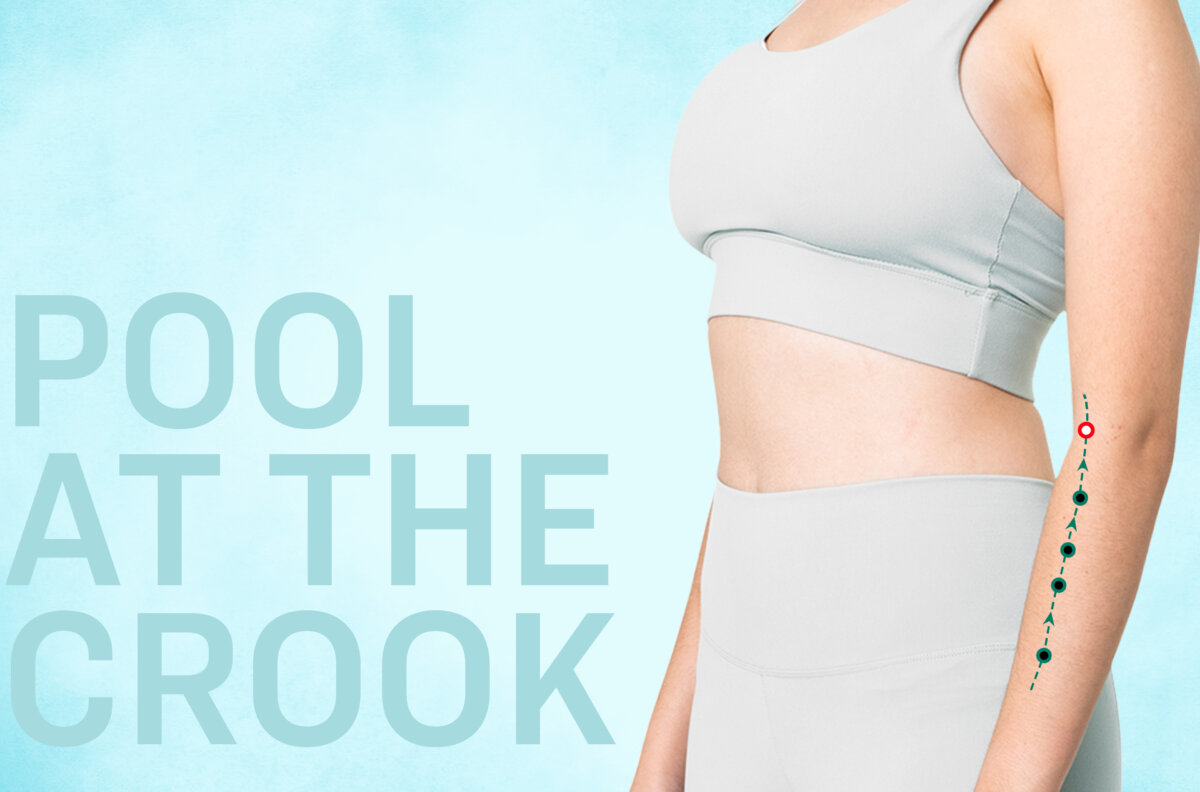
Bend your elbow and find the outer end of the crease where your arm folds. Qu Chi is located halfway between the elbow crease and the bony bump on the outside of your elbow. Feel around the area for tenderness. That’s your spot. You may notice more tenderness if you have an injury along the meridian pathway that disrupts the healthy flow of qi, or if you are experiencing any of the symptoms related to this point.
Ways to Stimulate Qu Chi
- Firm pressure: Press firmly for three to five seconds, then relax for three seconds. Repeat for one to three minutes on each side.
- Circular massage: Massage in small circles with your index finger or thumb for one to three minutes on each side.
- Herbal patch: Apply an herbal patch overnight for longer activation.
- Advanced methods: Acupuncture or moxibustion (a gentle heat therapy using dried mugwort) by a trained professional can deepen the therapeutic effects.
Precautions
Avoid this point if you have unhealed injuries in the area. If using herbal patches, opt for those without harsh synthetic ingredients to prevent irritation, especially if you have sensitive skin.
An Acupoint for the Entire Family
Qu Chi is like a wellness multitool, clearing heat, soothing irritated skin, balancing blood pressure, and keeping digestion on track. Its versatility and simplicity make it an easy addition to any self-care routine. Whether you’re caring for a teenager with breakouts or an older adult managing blood pressure, Qu Chi offers support for every member of your family. With just a few moments of attention, you can tap into the benefits of complementary medicine anytime, anywhere, and for free.
TCM expert Shihhsiang Hung reviewed this article for accuracy and clarity.