

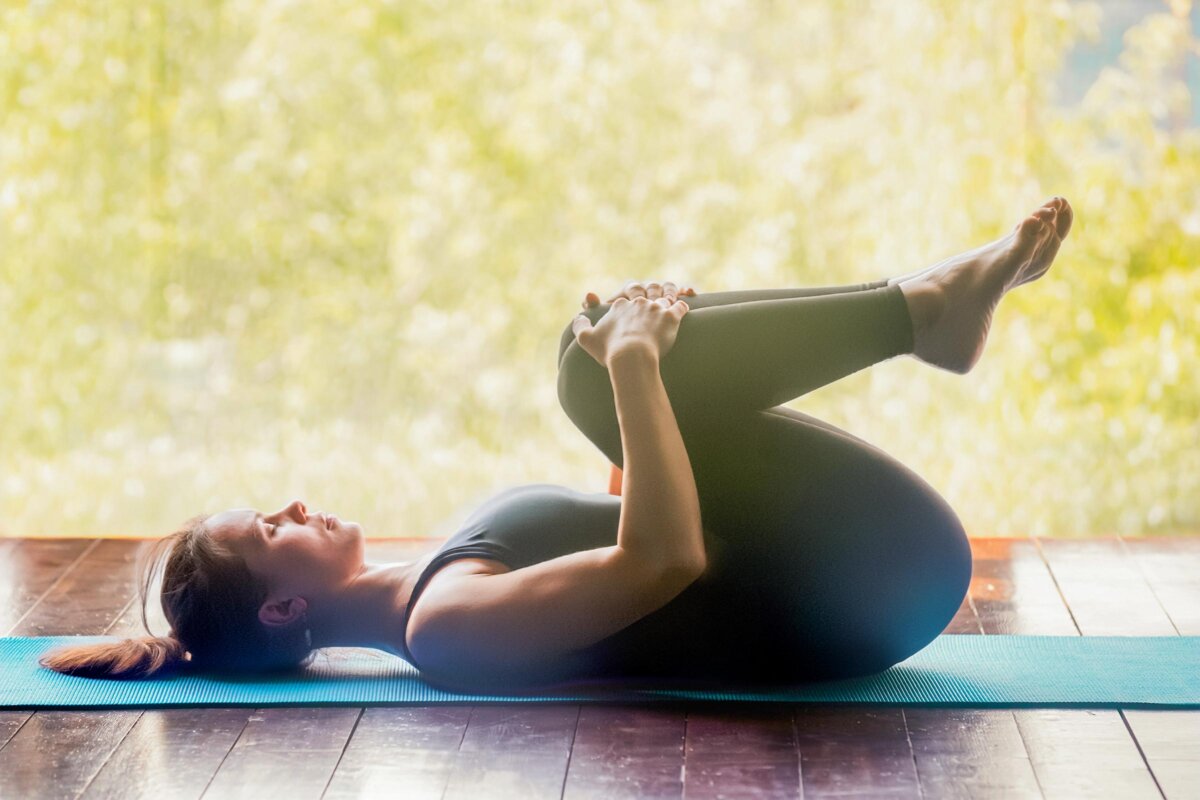
A 55-year-old woman who carried bricks for a living suffered from sciatica due to severe lumbar spondylolisthesis—a condition in which one of the lower back bones slips out of place—nearly reaching Grade II on the Meyerding scale, a system doctors use to show how far one vertebra has shifted over another, from mild (Grade I) to severe (Grade IV). The condition left her barely able to walk.
Acupuncture initially relieved her discomfort, but her spinal misalignment persisted. To address the root cause, traditional Chinese medicine expert Kuo-Pin Wu prescribed her a simple exercise that she could do at home to aid lumbar spine realignment. She diligently followed his guidance, and in less than a month, she reported remarkable improvement.
Upon follow-up examination, I discovered that her spine had notably realigned, said Wu.
Spondylolisthesis occurs when one vertebra slips forward over the one below it, reducing the space available for nerves to pass through. This is especially important because the sciatic nerve—which controls major muscle movement and sensation in the legs—can become compressed, leading to radiating pain, numbness, and weakness in many patients.
In more severe cases, it can significantly impair walking ability.
However, surgery might not always be necessary for lumbar spondylolisthesis. In many cases, targeted self-realignment exercises can help restore better spinal alignment and relieve pressure on nearby nerves.
Exercises for Lumbar Spondylolisthesis
For patients with lumbar spondylolisthesis, I recommend a targeted, practical self-rehabilitation approach that includes prone stretches on a half-round foam roller, combined with leg lift and press-down movements, said Wu.
1. Prone Stretch on Half-Round Foam Roller
Ease pressure on your lower back with this simple stretch that helps realign the spine using a half-round foam roller.
Purpose: Realign the lumbar vertebrae and relieve nerve pressure.
Steps:
- Align your navel with the highest point of the half-road foam roller if the spondylolisthesis is between the fourth and fifth lumbar vertebrae (whether the vertebra has shifted forward or backward), then lower your entire body from top to bottom onto it in a prone position. Be careful to keep your alignment from shifting.
- Lower your upper body as much as possible to maintain the body’s natural curvature. Let your head rest on the bed surface with your forehead touching it. Allow your shoulders to sink naturally without shrugging, position your arms beside your head, and spread your legs apart to shift your hips as far back and down as possible.
- Next, practice abdominal breathing—expanding the belly on inhalation and contracting it on exhalation—creating a gentle rise and fall in the lumbar area. The deeper and slower the breaths, the better.
- Avoid lifting or arching your hips when performing this exercise with abdominal breathing. Keep them sinking backward and downward to maintain an arched curvature in the lumbar spine, which helps to open up the slipped vertebra.
Note: Perform the prone stretch for 15 minutes each time, two to three times per day.
The success of this exercise varies from person to person. Those who stick to the routine consistently often see better results, while inconsistent effort may lead to slower or limited progress. Some people find lying prone uncomfortable due to stomach, shoulder, or neck discomfort, which can make it harder to stay committed.
The condition of a person’s muscles and joints also matters. Stiff muscles or joints can slow down the realignment process, while more flexible ones may speed it up. In some cases, patients using a semicircular pillow or foam roller have reported noticeable improvement in just one week.
In my clinic, I saw this firsthand with a woman who had a 20 percent—Grade I slip, where one vertebra had moved forward on the one below it by up to 25 percent of its width, meaning her lower back vertebrae were slightly misaligned. She embraced this simple exercise, lying face down on a half-round foam roller. After just three days, her pain was nearly gone. Two weeks later, a follow-up exam showed her spine was almost fully realigned.
Her tips for recovery? She tapped into the power of her mind. While lying prone, she focused intensely on the exact spot of her lower back pain, mentally urging her spine to shift back into place—like giving her back a motivational pep talk. She believed this focused mindset boosted her recovery.
The recommended routine was three 15-minute sessions daily, but she took it up a notch, extending each session to 25 to 30 minutes and doing it four to five times a day. By combining mindset-strengthening, she achieved an alarmingly fast recovery.
2. Double-Leg Lift and Double-Leg Press Down
This exercise uses the lever principle to guide slipped vertebrae back into position.
When performing this exercise, visualize your hips as the oval bowl of a spoon and your legs as the slender handle. Pressing the handle downward tilts the oval end upward, while lifting it tilts it downward.
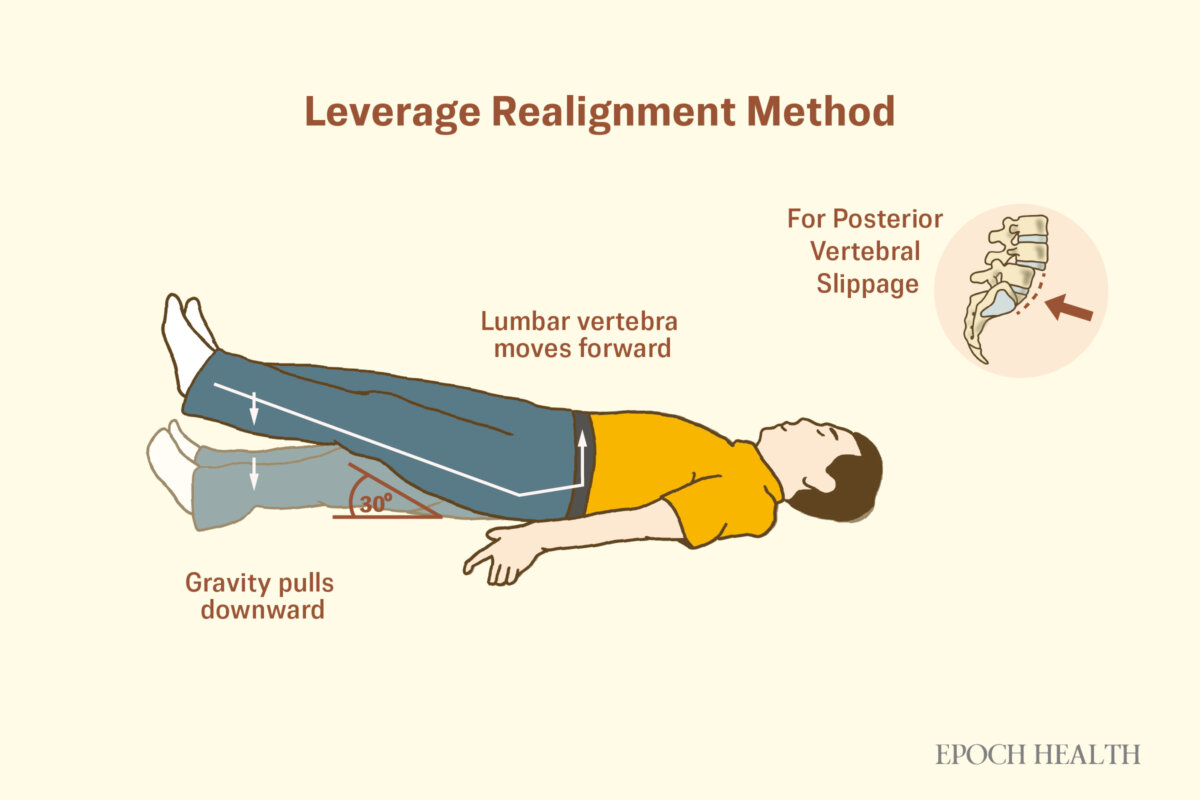
Self-Rehabilitation for Posterior Vertebral Slippage (Slipping Backward)
If your vertebra has slipped backward, this variation uses gentle leg lifts to help guide it back into proper alignment.
Steps:
- Lie on your back.
- Raise both legs together to about a 30-degree angle.
- Hold for seven seconds, then lower your legs.
- Rest briefly, then repeat the lift-and-hold for seven seconds, completing 14 repetitions.
- If stamina is limited, start with seven repetitions and gradually increase over time.
The key to this exercise lies in the lever principle: The raised legs, pulled downward by gravity, create a force with the hips acting as the fulcrum. This generates a reaction force that helps the posteriorly displaced vertebra move back toward the abdomen. To maximize effectiveness, you should feel the lumbar spine engaging and a sensation of the vertebra being gently pushed forward.
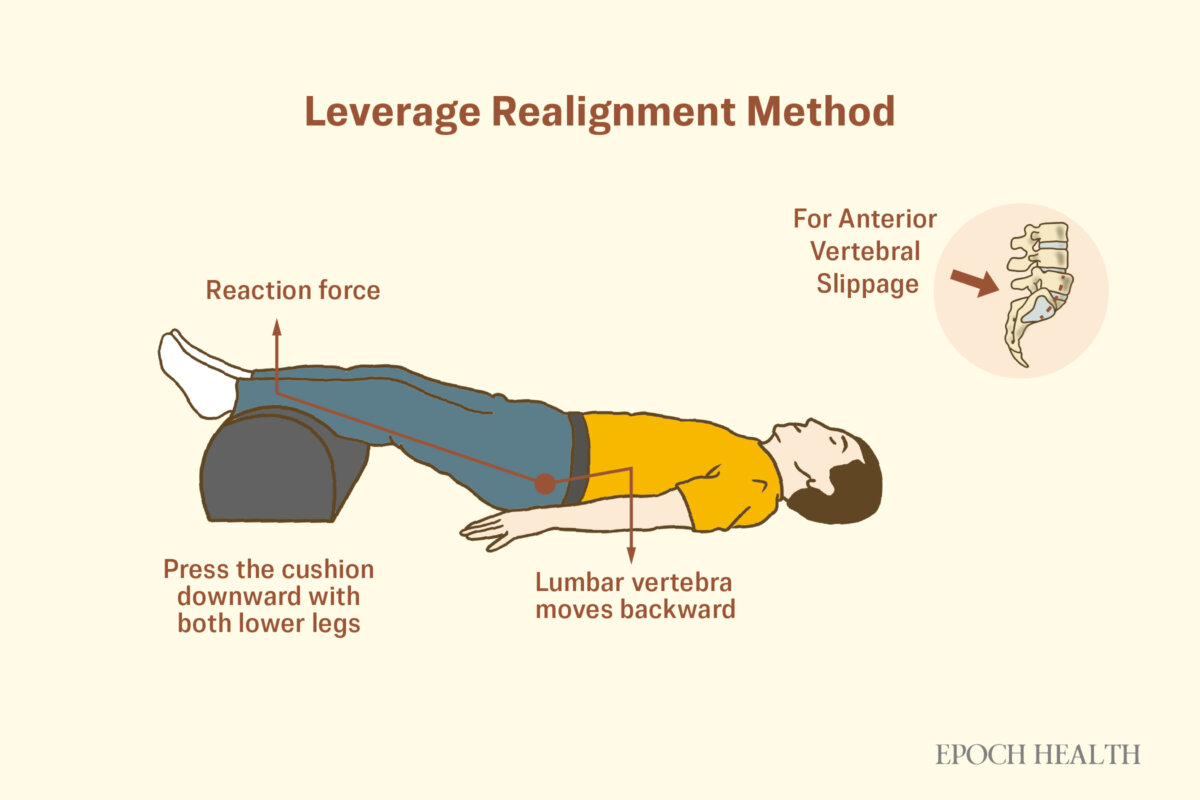
Self-Rehabilitation for Anterior Vertebral Slippage (Slipping Forward)
If your vertebra has slipped forward, this gentle exercise helps guide it back into place by using downward leg pressure for support.
Steps:
- Place both lower legs on a cushion or pad, ensuring the height allows the reaction force to act on the forwardly slipped vertebra.
- Press both lower legs downward onto the pad with moderate force.
- Feel the upward push created by the reaction force as your legs press down.
In this movement, the hips serve as the fulcrum, allowing the lumbar vertebrae to shift backward and thereby alleviating the symptoms of anterior spondylolisthesis.
3. Bound-Legged Knee-to-Chest Hold
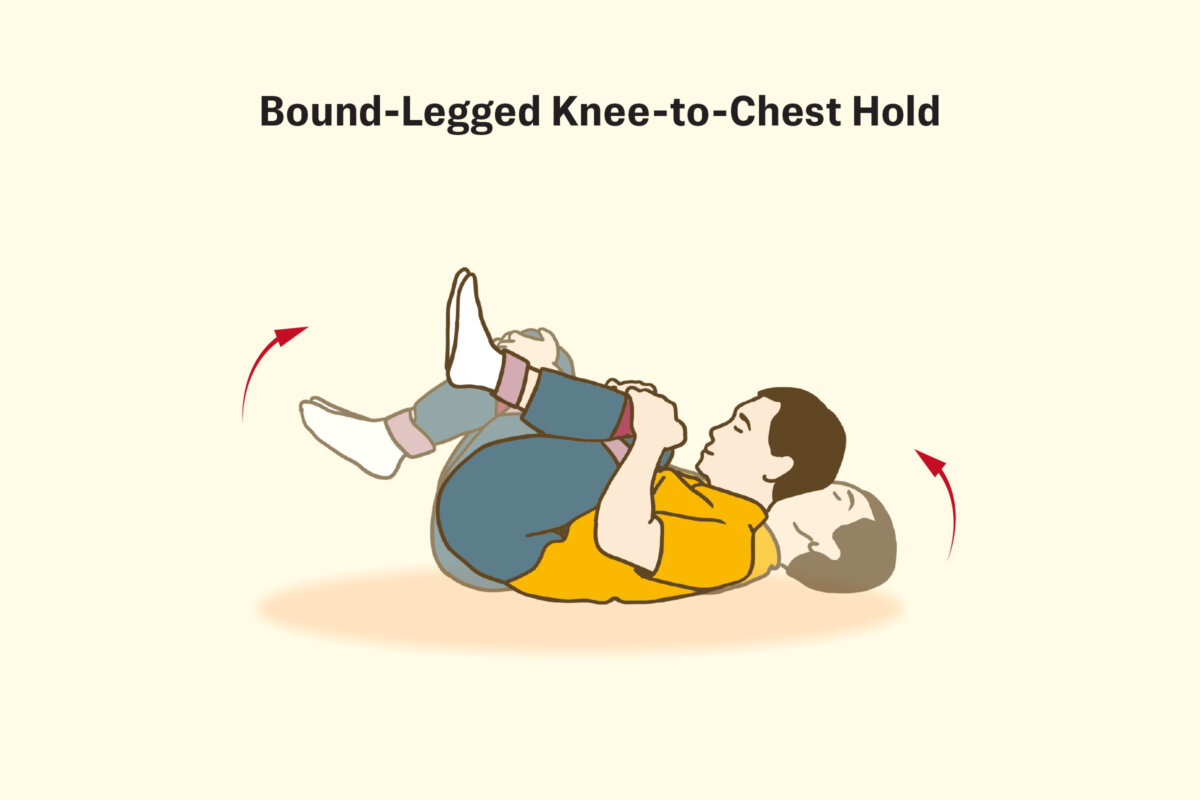
For patients with lumbar spondylolisthesis, the knee-to-chest hold with legs bound is highly recommended. This movement mimics the curled-up position of a fetus in the womb, aiming to bring the chin as close to the knees as possible.
Steps:
- Secure a strap just below both knees. Optionally, place additional straps above the knees and around the ankles to apply more effective force and ensure proper form.
- Lie on your back, hug both knees with your hands, and gently pull your legs toward your abdomen, shaking them lightly 20 times.
- Hug both knees tightly toward your abdomen while bringing your head as close as possible to your knees. Hold this position for three seconds, then lie flat on your back, keep your knees bent, and place both feet on the bed. Repeat this 20 times.
- After completing the above steps, repeat the shaking motion from Step 2.
- Sway both knees side to side 20 times to relax and soften your body.
This exercise should be performed consistently every day, with a minimum of 100 repetitions. In severe cases, up to 200 repetitions may be necessary. These methods require time and effort but can yield significant results with dedication.