
Our local parks offer an excellent place to build fitness year-round. As fall arrives and temperatures cool, many people take advantage of the beautiful weather to head to the parks. The trees can be absolutely beautiful when the leaves change, and in my neighborhood, whatever combination of factors needs to come together to produce that beauty has done its magic—the leaves are as pretty as I’ve seen them in over a decade.
Distributed throughout our parks, the humble park bench stands ready to let you rest as needed, serve as a place for quiet reflection, or provide a vantage point to observe the surrounding festivities. There’s something else that the average park bench offers beyond these things, however—exercise.
6 Powerful Park Bench Exercises
A park bench, or even a vacant picnic table, can provide excellent support for turning your walk in the park into a complete outdoor workout.
While the following exercises are safe and quite effective, I suggest consulting your medical provider first to ensure they’re right for you.
1. Bench Crunches
Strengthening your abs is a vital component of an overall workout, and a park bench offers a creative option that lets you work them without having to lie down in the grass—especially if the geese have been there before you.
Step 2: Lean back and slowly bring your knees toward your chest, then extend your legs forward.
Step 3: Moving your legs out and then back in counts as one repetition. Try to perform three sets of 20 repetitions.
Modifications: Only lift your legs as far as you comfortably can during this exercise. Feel free to experiment with sets and repetitions to suit your needs best.
Why I Like It: The park bench crunch is stable and highly controllable, making it easy to focus carefully on proper form and muscle engagement.
2. Triceps Dips
The triceps dip is an upper-body exercise that works everything above your beltline. All you need to do to assume position for this exercise is to put your hands on the bench and slide your hips forward. It doesn’t get any easier than that, and technically, you even remain in a sitting position.
Step 2: Support your body weight on your hands, firm your shoulders, and gently slide forward until you’re off the seat with your arms supporting your weight.
Step 3: Bend your elbows and gently lower down until your elbows are bent to 90 degrees, or as far as you comfortably can, then press back up.
Modifications: Only dip as deep as you comfortably can. Be especially mindful of your shoulders. Feel free to modify the sets and repetitions to best suit your needs best. After each set, scoot back onto the park bench to rest for a minute.
Why I Like It: While moving into and out of this exercise position is fairly easy, the net gain is deep strengthening of your upper body, including your pectoralis, triceps, and core musculature.
3. Bench Squats
Bench squats are a modification of the classic chair squats. They emphasize using both legs in a partial squat, providing powerful, deep strengthening to both legs at the same time.
Step 2: As soon as you touch the seat, rise back up as you lower your arms back to your sides.
Step 3: Sitting down and then standing up counts as one repetition. Try to perform three sets of 15 repetitions.
Modifications: Experiment with sets and repetitions to see what works best for you. At first, move only as far as you comfortably can, and increase your range of motion as you grow stronger over time. Another modification is to stand behind and face the park bench, hold onto the back, lower into a standing squat with your knees and hips at 90 degrees of flexion, and then rise back up.
Why I Like It: The bench squat builds on your basic functional sitting biomechanics. It’s easy to perform and highly stable.
4. Bench Pushups
The classic floor-height push-up can easily be modified using a park bench. Fresh air, fun, and push-ups—what’s not to like?
Step 2: Bend your elbows and slowly lower down to 90 degrees of flexion while keeping your trunk straight, then push back up.
Step 3: Moving down and then back up counts as one repetition. Try to perform three sets of 15 repetitions.
Modifications: Only move as deep into the push-ups as you comfortably can. Experiment with sets and repetitions to see what works best for you. To make it more challenging, you can perform the movement off the seat instead of the seatback. The lower version is considerably more challenging than using the back of the park bench or picnic table, but the benefits are greater.
Why I Like Them: Most of us can manage a few bench push-ups, and they offer tremendous core-strengthening benefits.
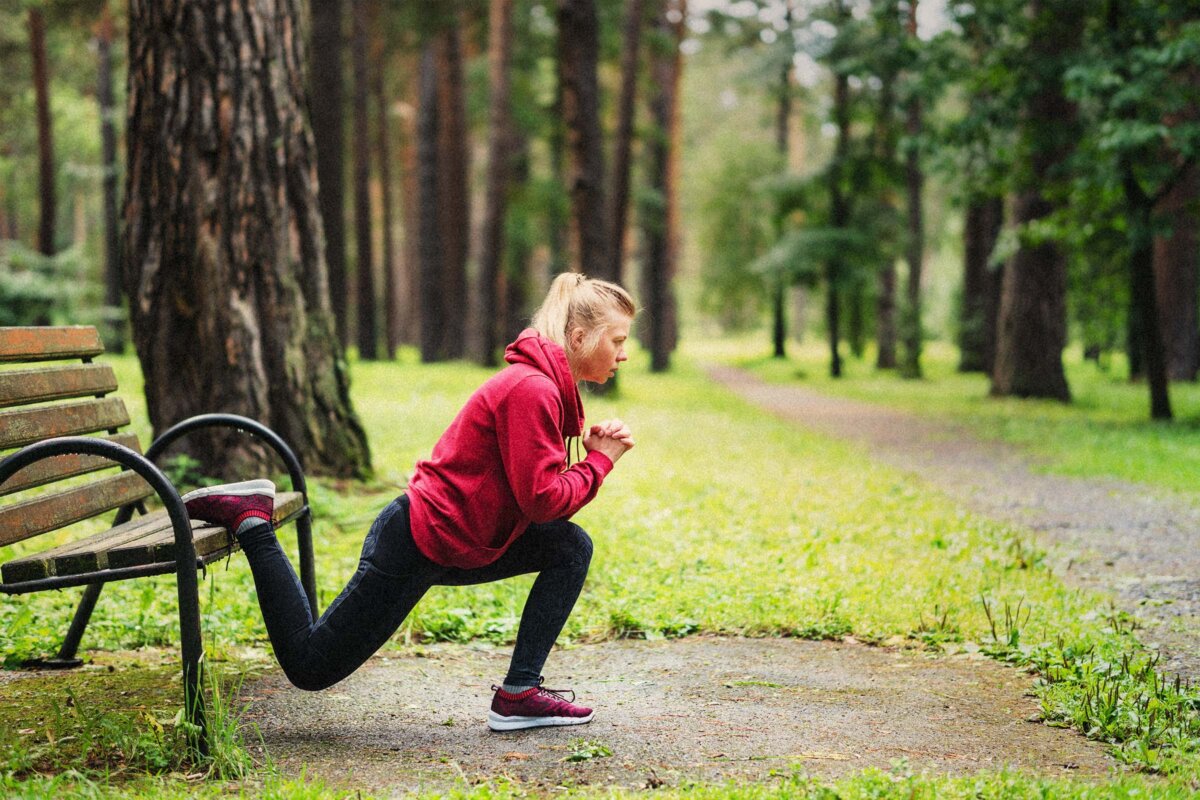
5. Bulgarian Split Squats
Bulgarian split squats focus on squatting with a single leg while the other leg is positioned on a supportive surface.
Step 2: Squat down with your left leg as far as you comfortably can or until your right knee makes contact with the ground before rising back up into standing.
Step 3: Moving into the squat and then rising back up counts as one repetition.
Step 4: Try to perform three sets of 10 repetitions, or whatever is right for your body.
Modifications: Only move as far into the squat as you comfortably can, either due to discomfort or bench height. If you struggle with balance, hold your arms straight out to the sides for better stability.
Why I Like Them: Bulgarian split squats demand balance and train proper postural form—you can’t really do them without proper form. This exercise deeply connects you to the subtle postural and balance nuances your body uses to get through it.
6. Mountain Climbers
While mountain climbers are effective at ground level, using a park bench adds a benefit: Your slightly elevated position reduces pressure on your hands and shoulders.
Step 2: Briskly step your right foot forward, then back again, alternating back and forth with the opposite leg. Start slowly to develop form, then pick up speed as you feel comfortable.
Step 3: Bringing a leg forward and back again counts as one repetition. Try to perform three sets of 30 repetitions—15 repetitions per side.
Modifications: You can experiment with increasing sets and repetitions as well as speed to see what works best for you. In general, the faster and longer the better, but be sure to maintain proper form and only move as fast as you can comfortably control. You can also do these exercises off the back of the park bench or at the picnic table, both of which are higher positions that lower the difficulty and reduce pressure on your hands, arms, and shoulders.
Why I Like Them: The fast, reciprocal motion of mountain climbers intensifies the movement mechanics you were already using to walk around the park.
Together, these exercises give you a great workout and can easily fit into your park visit. Why not do them every time you go to the park? My guess—you won’t be able to resist.
About the Fitness Model: Aerowenn Hunter is a health editor for The Epoch Times. She is an accredited yoga therapist with more than three decades of teaching experience.
Views expressed in this article are the opinions of the author and do not necessarily reflect the views of The Epoch Times. Epoch Health welcomes professional discussion and friendly debate. To submit an opinion piece, please follow these guidelines and submit through our form here.