
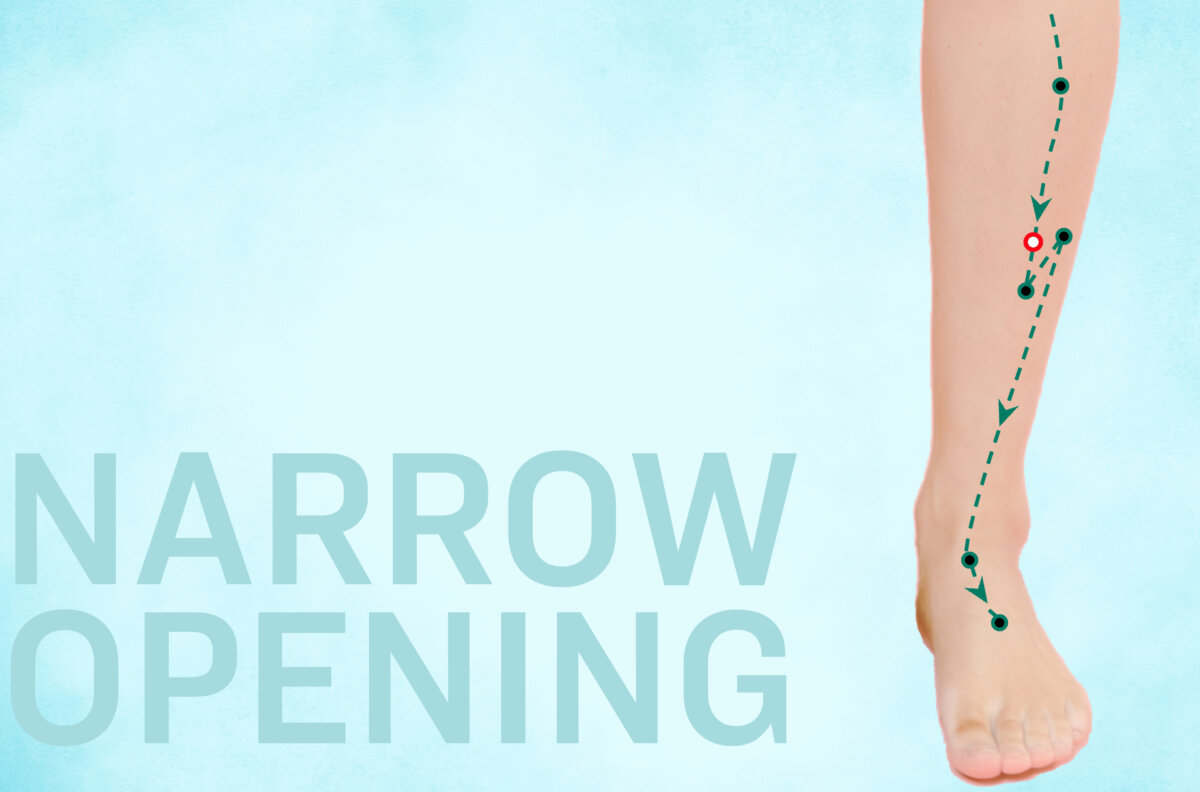
If you’ve ever experienced acupuncture, you know that moment when the practitioner presses around a point and asks, “Does that feel sore?” That reaction—whether it’s a deep ache, tingling, or sharp tenderness—is no accident. It’s how ancient practitioners located effective treatment points, often referred to as “ashi” points in modern practice.
Legend traces the origin of ashi points to one particular acupoint: Narrow Opening (Tiao Kou, ST38), located on the lower leg. Sun Si Miao, one of the most revered traditional Chinese medicine (TCM) physicians, is said to have cured a hunter’s chronic pain after observing a strong response to pressure on this point simply by needling it. Today, Tiao Kou continues to hold its reputation, particularly in the treatment of shoulder disorders. Though it is located far from the shoulder itself, its effect is far-reaching.
From Classical Texts to Clinical Significance
Tiao Kou was first recorded in “The A-B Classic of Acupuncture and Moxibustion,” the earliest surviving acupuncture manual compiled in the 3rd century. What sets Tiao Kou apart is its ability to expel external pathogens of wind and dampness, which are common TCM culprits behind dull aches, heaviness, limited mobility, and sharp pain during joint movement.
An essential principle in TCM states that acupoints can treat body parts located at a similar distance from the body’s horizontal midline as the acupoint itself. This explains how a point on the lower leg can influence the shoulder. Tiao Kou is especially noted for its effectiveness in treating frozen shoulder and chronic shoulder pain, earning it the nickname “the frozen shoulder acupoint.”
Research Supports Role in Shoulder Relief
In one clinical study, researchers investigated the effect of acupuncture from Tiao Kou to Chengshan (BL57) on patients with frozen shoulder. Two groups received the same acupuncture protocol, but only one group was instructed to actively move their shoulder during the session. Both groups showed reduced pain, improved shoulder mobility, and better ability to perform daily tasks. However, the group that combined movement with acupuncture achieved significantly better outcomes, suggesting that incorporating physical movement into acupuncture treatments can enhance therapeutic results.
In another study focused on chronic shoulder pain, researchers examined how brain activity changed following acupuncture at Tiao Kou. Patients received acupuncture either on the same side of the body as the pain or on the opposite side. While both groups improved, those treated on the opposite (non-painful) side experienced greater gains in shoulder function. Brain scans revealed different patterns of neurological activity, supporting the concept that acupuncture’s effects depend not only on point location but also on laterality. The findings provide scientific support for the TCM practice of contralateral needling, particularly for musculoskeletal pain.
How to Locate and Stimulate Tiao Kou.
You can locate Tiao Kou by starting just below the kneecap and to the outside of the patellar tendon. From there, measure roughly 11 finger widths down the leg. The point lies one finger width away from the front edge of your shinbone (tibia), on the outer side. Press around the area gently—if you feel a sore or sensitive spot, you’ve likely found it. These sensations become stronger if you’re dealing with shoulder tension or an energy blockage in the body.
Ways to Stimulate Tiao Kou
- Firm pressure: Press firmly for three to five seconds, then relax for three seconds. Repeat for one to three minutes on each side.
- Circular massage: Massage in small circles with your index finger or thumb for one to three minutes on each side.
- Herbal patch: Apply an herbal patch overnight for longer activation.
- Advanced methods: Acupuncture, cupping, or moxibustion (a gentle heat therapy using dried mugwort) by a trained professional can deepen the therapeutic effects.
Precautions
Avoid stimulating this point if you have mechanical injuries or bruising in the area. When using herbal patches, especially on sensitive skin, opt for formulas that do not contain harsh artificial ingredients.
A Reliable Resource for Shoulder Maintenance
In Chinese culture, the phrase “fifty-year-old shoulder” refers to the age when frozen shoulder commonly appears. Ancient healers observed that shoulder stiffness frequently developed in midlife, often due to physical labor, outdoor exposure, or overuse. Today, even without the rigors of farm work, our shoulders take a hit from long hours at the computer, parenting, or daily chores.
Whether you’re an athlete, an office worker, or simply carrying life’s burdens, Tiao Kou offers a non-invasive way to support your shoulder health. Make it part of your self-care routine—you may be surprised at what a point on your leg can do for the freedom of your upper body.
TCM expert Shihhsiang Hung reviewed this article for accuracy and clarity.