


Mr. Wang, 55, is a department manager at a technology company in Taiwan. He had always enjoyed good health, maintained a balanced lifestyle, and rarely needed medical attention. His only minor complaint was occasional belching.
One evening after work, he felt the urge to burp but was unable to. Shortly afterward, during his commute home, he vomited a large amount of blood and lost consciousness. He was rushed to the hospital, where he was diagnosed with stage III stomach cancer.
Another patient, also in his early 50s, had regular bowel habits but frequently noticed traces of blood. His condition was initially treated as hemorrhoids. However, when the bleeding became more pronounced, a colonoscopy revealed a large tumor in his rectum.
These were two cases of gastrointestinal cancer encountered by Dr. Hong-Yun Chen, an attending physician in the Department of Gastroenterology at New Taipei City Hospital. Chen shared the cases on “Health 1+1,” a program produced by NTD, a sister outlet of The Epoch Times. “Many illnesses do present early symptoms—we just tend to overlook them,” he said.
A review published this year in JAMA reported a rising incidence of gastrointestinal cancers among younger populations, both globally and in the United States. According to global data from 2022, colorectal cancer was the most common form of early-onset gastrointestinal cancer, followed by gastric, esophageal, and pancreatic cancers.
Several factors may explain this trend. Modern lifestyle changes—including high intake of processed foods, red meat, and sugary beverages, and reduced fiber intake—are believed to increase cancer risk. Rising rates of obesity, sedentary behavior, chronic inflammation, and alterations in the gut microbiome may also play a role. Additionally, increased antibiotic use and environmental exposures, such as microplastics and pollutants, are being investigated as possible contributors.
Symptoms of Gastrointestinal Cancer
Early-stage gastrointestinal cancers often present with no symptoms or only subtle and nonspecific ones, such as acid reflux, abdominal bloating, difficulty swallowing, or anemia, Chen noted.
One case involved Grandma Wen, a woman in her 80s who frequently experienced chest pain, shortness of breath, dizziness, and fatigue. Her family sought cardiovascular care for her, but over the next seven to eight years, her symptoms remained unresolved.
After reviewing her medical records, Chen discovered that she was severely anemic and recommended an upper endoscopy. The procedure revealed advanced-stage stomach cancer. The tumor had grown to occupy nearly half of her stomach and was actively bleeding. Sadly, she passed away about a year later while receiving palliative care.
Chen noted that she likely developed a stomach ulcer seven or eight years earlier, which initially caused acid reflux and upper abdominal pain. However, she mistakenly described her symptoms as “chest pain,” since upper abdominal discomfort is often difficult to distinguish from heart-related pain.
Without appropriate treatment, the ulcer eventually developed into gastric cancer. As the disease advanced, persistent bleeding from the tumor led to anemia, which in turn caused symptoms such as shortness of breath, dizziness, and skin paleness.
“When symptoms like chest pain or a pale appearance occur, it is not necessarily wrong to consult a cardiologist first,” Chen said. “The problem arises when treatment fails to improve the condition over time. At that point, other possible causes should be considered. Had those possibilities been explored earlier, the diagnosis might not have been delayed.”
Another case involved a man in his 70s. When he entered the clinic, Chen immediately noticed his face was as pale as paper and suspected anemia. The patient, however, reported no symptoms.
Testing confirmed severe anemia, with hemoglobin levels at less than half the normal range. Further examination revealed a large tumor in the large intestine, which was successfully removed, resolving the issue.
Early Detection Enables Minimally Invasive Treatment Options
Early detection of cancer gives patients more treatment options, Chen said. For instance, rather than undergoing traditional surgery that involves opening the patient to remove part of an organ, some patients may be eligible for endoscopic procedures. Endoscopic surgery is performed entirely within the gastrointestinal tract, guided by a tube with a light and a camera, leaving no external wounds. Compared to open surgery, it generally requires shorter hospital stays and allows for quicker recovery.
One such case involved Ms. Wang, a 60-year-old woman who was found to have a submucosal tumor in her stomach during a routine health screening. She was hesitant about surgery, fearing it might require partial removal of her stomach. Some physicians recommended monitoring the tumor and waiting until it grew or showed signs of cancer before intervening.
Under Chen’s guidance, Ms. Wang opted for endoscopic surgery.
Chen used the Padlock Clip defect closure device, a tool resembling a bear claw. It enables immediate wound closure and promotes faster healing.
“The patient was discharged and went home the very next day,” he said.
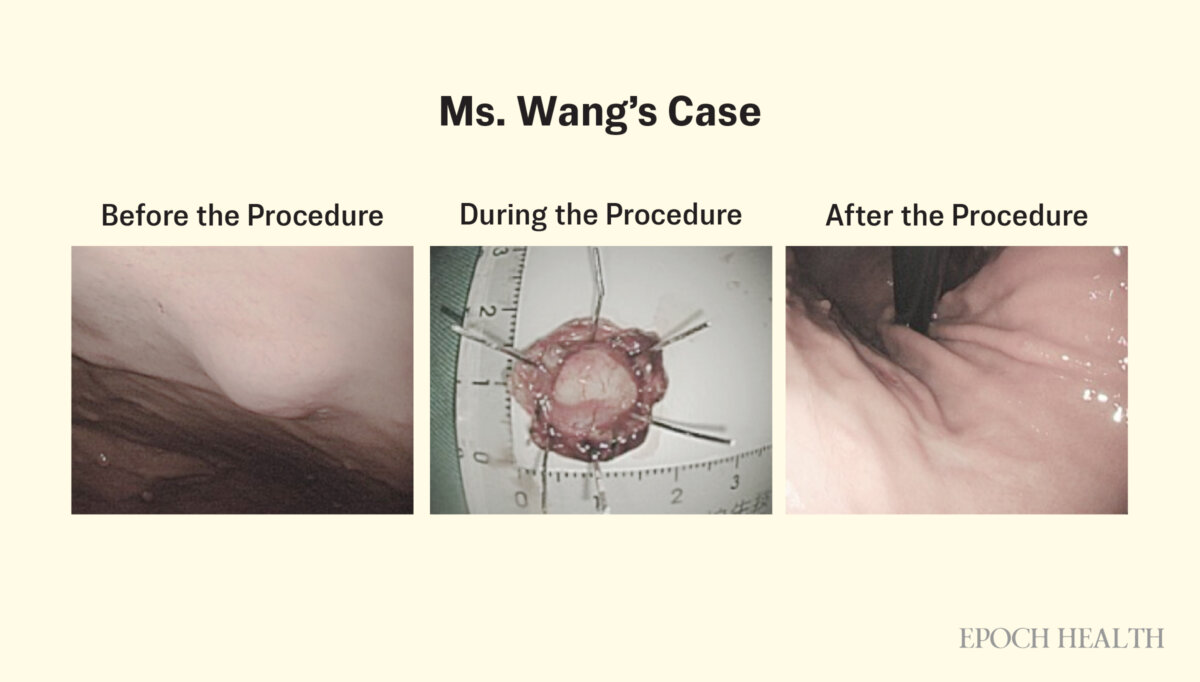
Lab tests later confirmed that the tumor was a gastrointestinal stromal tumor (GIST).
GISTs are a type of tumor that require particular clinical attention. In some cases, they may metastasize or spread early—even before growing to a significant size. This highlights the value of endoscopic surgery in intervening promptly and reducing the risk of malignant transformation.
The Importance of Timely Screening
With advances in medical technology, early-stage cancers have become much easier to detect, Chen said. He recommends that people begin undergoing both upper endoscopy (gastroscopy) and colonoscopy in their 40s, with follow-up screenings every 10 years.
For those at higher risk of stomach cancer—such as people of Chinese descent—he suggests shortening the interval for gastroscopy to once every five to 10 years. Those with a history of polyps should consult their doctor to determine the appropriate screening schedule. People with a family history of gastrointestinal cancers are advised to begin screening a few years earlier than the age at which their parent was diagnosed.
“Most cancer begins as benign cells and gradually progresses to malignancy—a process that takes time, sometimes as long as 10 years,” Chen said. “That means we actually have ample time to intervene and prevent it from developing into cancer.”
Conditions That Increase the Risk of Gastrointestinal Cancer
In addition to timely screening, Chen noted that certain risk factors for gastrointestinal cancers are modifiable. For example, chronic acid reflux can increase the risk of esophageal cancer, while infection with Helicobacter pylori (H. pylori) is linked to a higher risk of gastric cancer. These conditions should be diagnosed and treated promptly.
H. pylori is primarily transmitted through food and close personal contact. It can cause cancer by molecular changes, oxidative stress, DNA damage, and cell death.
“If someone is found to be infected with H. pylori, close family members or others in frequent contact should also be tested and treated,” Chen said. “Otherwise, even after successful treatment, reinfection can occur through those in the immediate environment.”