
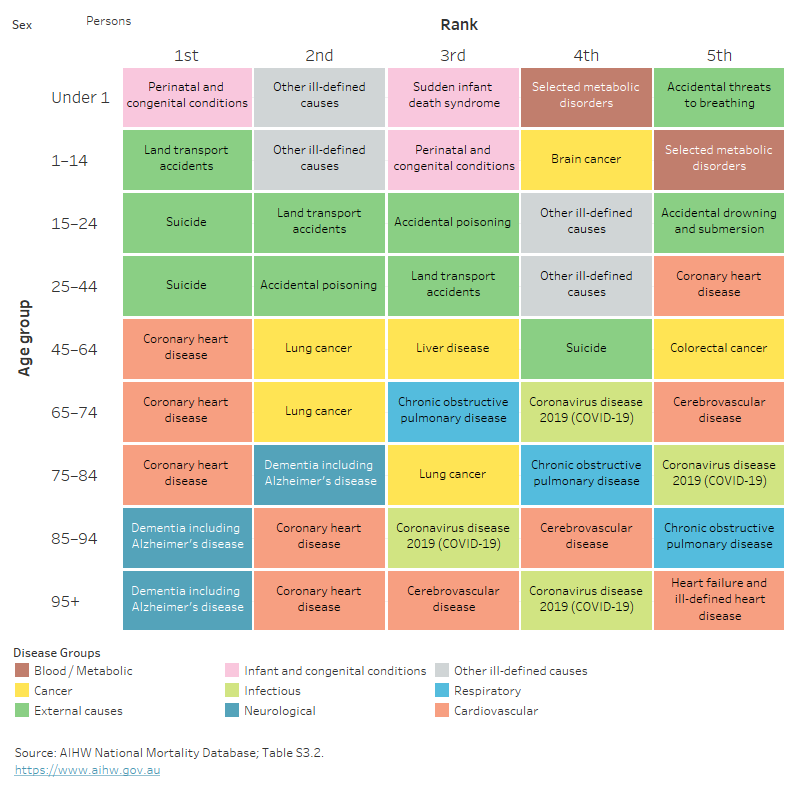
Coronary heart disease remains the most common underlying cause of death in Australia, being the main cause for men and the second most common (behind dementia) for women and, in total, connected with about 20 percent of all deaths.
Dementia was the second highest as it contributed to 18 percent, followed by hypertension, cerebrovascular diseases, and diabetes.
But new data from the Australian Institute of Health and Welfare paints a far more complex picture, revealing that 81 percent of deaths are due to more than one cause.
The data is from 2022 and it shows there were 190,939 deaths registered that year (99,924 males; 91,015 females).
Less than 1 percent occurred among children aged 0–4 years, while over two-thirds (68 percent) were among people aged 75 and over.
The data also shows that in that year, COVID-19 began to appear as a factor only in patients 65 and above, where it accounts for between 4 and 7 percent of fatalities depending on age bracket.
There were 9,859 deaths due to the coronavirus, accounting for 5.2 percent of total fatalities.
While ischaemic heart diseases (restriction of blood flow to the heart; not a heart attack, though it can lead to one) has retained the top spot in leading causes of death over the years, dementia—now Australia’s second most common killer—didn’t make an appearance in the top five until the 2000s.
Similarly, road accidents no longer figure among the chief causes of mortality thanks to improved roads and vehicle safety standards.
Top 5 Leading Causes of Death Over 1968-2022 (Source: ABS)
| Year | 1st leading cause | 2nd leading cause | 3rd leading cause | 4th leading cause | 5th leading cause |
| 1968 | Ischaemic heart diseases | Cerebrovascular diseases | Chronic lower respiratory diseases | Land transport accidents | Influenza and pneumonia |
| 1977 | Ischaemic heart diseases | Cerebrovascular diseases | Chronic lower respiratory diseases | Cancerous tumour of the respiratory system | Land transport accidents |
| 1986 | Ischaemic heart diseases | Cerebrovascular diseases | Cancerous tumour of the respiratory system | Chronic lower respiratory diseases | Cancerous tumour of the lower bowel area |
| 1996 | Ischaemic heart diseases | Cerebrovascular diseases | Chronic lower respiratory diseases | Cancerous tumour of the respiratory system | Cancerous tumour of the lower bowel area |
| 2006 | Ischaemic heart diseases | Cerebrovascular diseases | Cancerous tumour of the respiratory system | Dementia, including Alzheimer’s disease | Chronic lower respiratory diseases |
| 2015 | Ischaemic heart diseases | Dementia, including Alzheimer’s disease | Cerebrovascular diseases | Cancerous tumour of the respiratory system | Chronic lower respiratory diseases |
| 2022 | Ischaemic heart diseases | Dementia, including Alzheimer’s disease | COVID-19 | Cerebrovascular diseases | Cancerous tumour of the respiratory system |
Multiple Causes of Death
Around two-thirds of Australians (almost 16.5 million people) are estimated to have two or more long-term health conditions.
Those long-term conditions may not be what eventually kills the patient, but they contribute to the underlying cause (for example, high blood pressure contributing to a heart attack).
The leading specific contributory causes of death in Australia in 2022 were:
- hypertension (contributing to 8 percent of deaths)
- diabetes (7 percent)
- coronary heart disease (6.4 percent)
- dementia (5.9 percent)
- atrial fibrillation (5.4 percent)
The AIHW explains that examining all the factors leading up to a person’s death is important for developing health programs and policies and monitoring population health.
For example, it notes that while coronary heart disease was the leading underlying cause for almost one in 10 deaths, that increases to one in five when multiple causes were considered, while the proportion of deaths in which dementia and cerebrovascular disease were involved was twice as high as the number in which they were the underlying cause.
Depressive disorders, hypertension, and alcohol use disorders were factors involved in death at rates 58, 35, and 10 times respectively, more than if they are looked at only as the underlying cause.
The most common causes contributing to the deaths of people up to 54 years of age included substance abuse and depression, while chronic diseases emerged as contributory factors from age 55 upwards, with diabetes being the leading issue for those aged between 55 and 84.
“This pattern is consistent with what we see for common underlying causes at these ages; that is, deaths at younger ages are due mainly to external causes, and deaths in the older ages due to chronic diseases,” the AIHW says in its report.
The Four Risk Factors in 44 Percent of Deaths
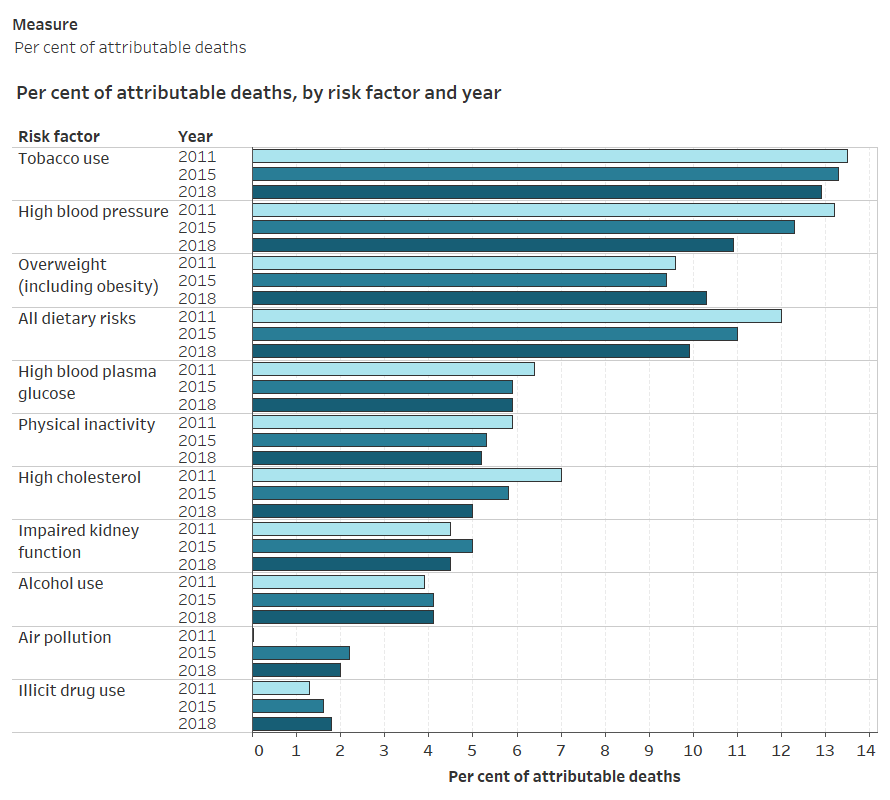
Tobacco use was the risk factor responsible for the most deaths, equivalent to 13 percent of the total in 2018. This was followed by high blood pressure, overweight (including obesity) and dietary risks. Together, 44 percent of all deaths in that year were attributable to these four factors.
In 2022, 4,007 deaths involved at least one psychosocial factor, most commonly support systems (in 25 percent of deaths), issues related to intimate partners (24 percent), suicide ideation (23 percent) and personal history of self-harm (21 percent).