
Some people seem to have lungs of steel, while others huff and puff after a short climb, even if they train just as hard. Some research claims the difference varies by genetics. However, if you asked a traditional Chinese medicine (TCM) practitioner, they’d give you a different but equally intriguing explanation for the difference: yuan qi—your inherited reservoir of life energy.
TCM views this primordial energy as the foundation of your vitality, gifted to you by your parents at birth. While you can’t rewind your genetics, you can support your yuan qi. That’s where Great Abyss (Tai Yuan, LU9), an acupoint on your wrist, comes in.
Ancient View on Tai Yuan
Tai Yuan was first documented in the “Ling Shu” (“Spiritual Pivot”), one of the foundational texts of TCM. It is categorized as an 8 Hui Influential Point of the Lung meridian. Also known as Gathering Points, these energetic centers go beyond local influence—they affect entire systems. Tai Yuan’s dual role is significant: it not only supports the Lung meridian but also influences blood circulation throughout the body. To top it off, it’s a Yuan-Source point, meaning it’s closely linked to that deep, inherited energy—your constitutional vitality.
By stimulating Tai Yuan, you’re not just addressing surface symptoms—you’re tapping into your deeper health architecture.
Lung Support for the Long Haul
Tai Yuan is a common choice in treatment protocols for chronic lung issues. If you tend to catch colds easily and struggle to recover, or if you deal with a chronic cough or a perpetually runny nose, especially with clear, watery mucus, this acupoint may offer consistent support.
It’s also helpful for people who experience shortness of breath, particularly after physical exertion, making it not just a reactive tool for when you’re already sick, but a preventative one.
What Modern Research Is Saying
Acupuncture is steadily gaining traction in clinical circles, and the research around Tai Yuan is both fascinating and promising.
One study investigated how acupuncture at Tai Yuan affects attention. Researchers measured brain waves in ten healthy young adults and discovered that stimulating Tai Yuan changed certain neural responses related to focus. Although another acupoint (HT7) had a greater effect, Tai Yuan still made a noticeable difference in cognitive processing. These results highlight the potential of Tai Yuan and suggest that more large-scale research is needed to understand its full therapeutic potential.
In another study, Tai Yuan was part of a trio of points used to help patients recovering from COVID-19. The group treated with real thumb-tack needles at Tai Yuan alongside Guanyuan (CV4) and Zusanli (ST36) experienced better lung function, reduced anxiety and depression, and clearer lung imaging results compared to those given fake treatment. This suggests that Tai Yuan may play a meaningful role in both physical and emotional recovery after respiratory illnesses.
How to Locate and Activate the Great Abyss
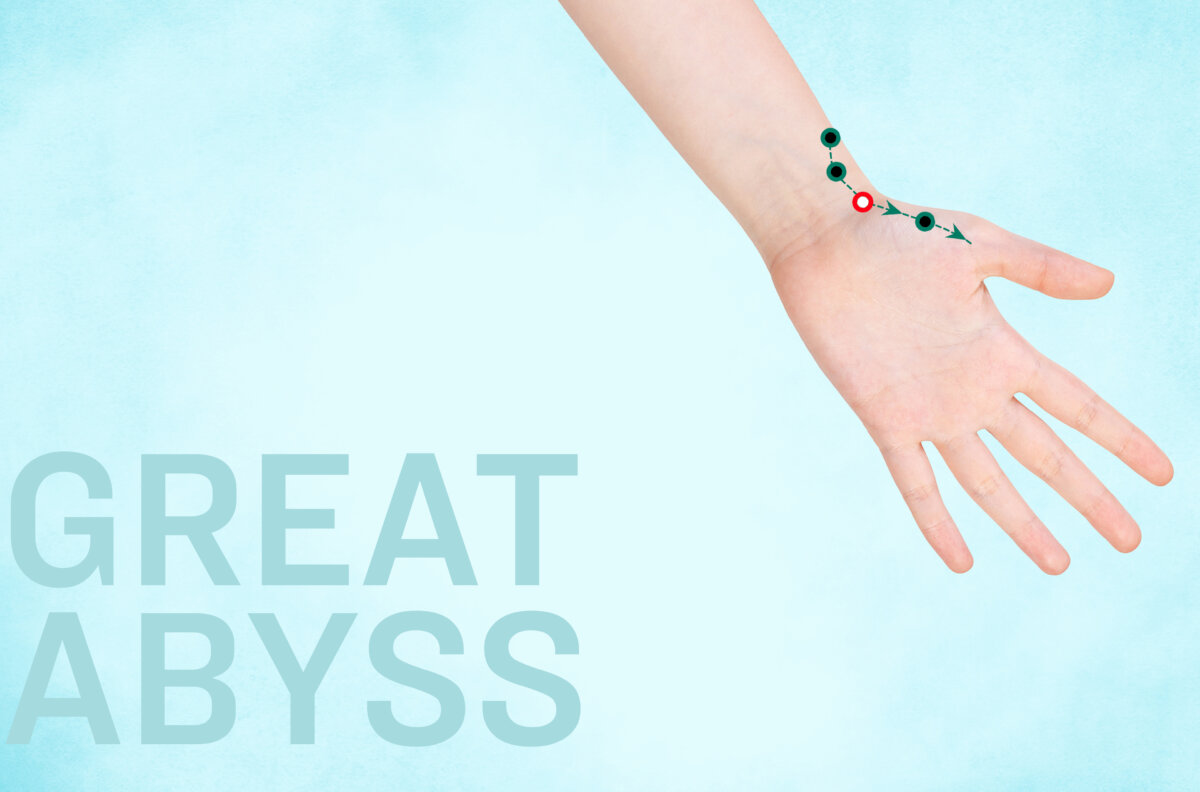
To find Tai Yuan, turn your palm upward. Feel for the crease at the base of your wrist, and move your finger to the thumb-side edge near the radial artery—that’s your spot. The area may feel sore or tender. These sensations are a cue that you’ve successfully located the acupoint.
Ways to Activate the Great Abyss
- Firm pressure: Press firmly for three to five seconds, then relax for three seconds. Repeat for one to three minutes on each side.
- Circular massage: Massage in small circles with your index finger or thumb for one to three minutes on each side.
- Herbal patch: Apply an herbal patch overnight for longer activation.
- Advanced methods: Acupuncture or moxibustion (a gentle heat therapy using dried mugwort) by a trained professional can deepen the therapeutic effects.
Precautions
Tai Yuan is located near an artery. Never attempt acupuncture on this point yourself—always seek help from a licensed professional to avoid the risk of injuring the artery, which can be extremely dangerous. Do not stimulate Tai Yuan if you have any injuries in the area. When using herbal patches, carefully check the ingredients and opt for those without harsh synthetic chemicals that could irritate sensitive skin.
A Gentle Nod to Your Epigenetics
We can’t rewrite our genetic code, but we can influence how it expresses itself. That’s the essence of epigenetics—the science of how your environment and habits shape your health. Whether you see Tai Yuan as a gateway to your lung qi or just as a daily nudge toward better respiratory resilience, it’s a small, thoughtful gesture to your body. No need to believe in ancient energy channels to reap the benefits. Think of it as another smart way to support your lungs, which activates the healing powers of your own body.