
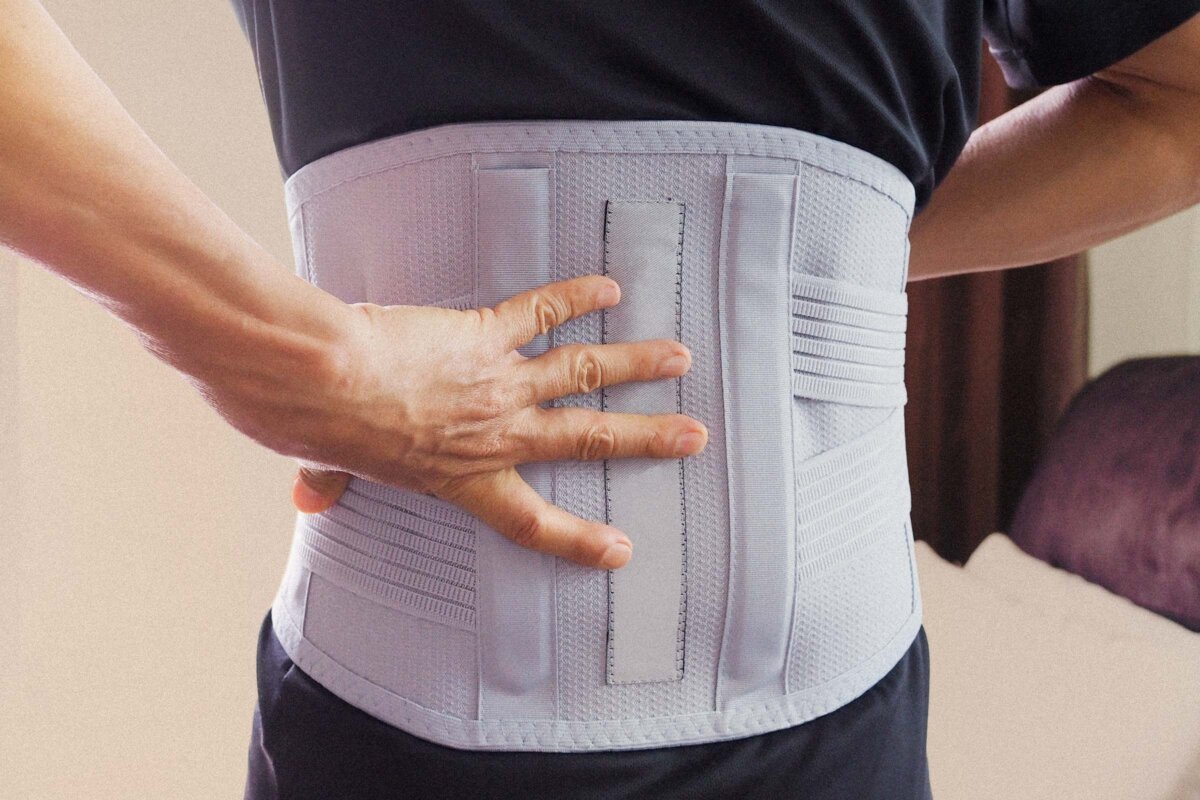
When your lower back hurts, even ordinary pleasures—a walk around the neighborhood, an afternoon in the garden—can feel out of reach. A back brace promises something appealing: a little extra support to help you get on with your day.
But how much can it really help? Spine specialists say the answer depends on why you are wearing it and what you hope it will do. Knowing where a brace fits—and where other approaches may help more—can help you understand what your back really needs.
Do Back Braces Work?
Major guidelines do not recommend back braces as a routine treatment for chronic low-back pain because evidence of any benefit remains unclear.
A recent Cochrane review, a type of study that pools results from multiple trials to get a clearer overall picture, reflects the uncertainties. Across eight trials involving more than 500 adults with chronic low-back pain, researchers found little to no clear benefit for pain or disability.
One possible exception is a small, short-term reduction in pain when braces were used alongside NSAIDs (over-the-counter anti-inflammatory painkillers such as ibuprofen). The review did not explain why, but one possibility is that the two treatments work differently, with NSAIDs reducing inflammation and pain while braces provide physical support and limit movement.
Personal experiences are similarly mixed. Some people have found that braces helped during flare-ups, physically demanding work, or long drives. Amelia from Killingworth, Connecticut, started wearing a back brace at the suggestion of her orthopedic surgeon. Worn higher, around her waist, it worked mostly as a reminder to move carefully. Worn lower and cinched tight, it eased pain from her sacroiliac joint, the joint connecting the spine to the pelvis. Others found braces uncomfortable or useless.
Stefano Negrini, co-author of the Cochrane review, told The Epoch Times that the evidence is still too weak to say when braces genuinely help. There is a need for more research, particularly in lower-resource settings, where braces may be used more often because active treatments are less accessible, he said.
What Back Braces Can Do
Braces have a narrow, specific job. They can provide external stability when the muscles cannot adequately support the lower back on their own, Dr. Rahul Shah, a board-certified orthopedic spine surgeon at Premier Orthopaedic Associates, told The Epoch Times. This may include people with certain muscle disorders or fractures, as well as those whose muscles have been injured by a strain, sprain, or surgery.
“Braces earn their keep when there is a structure that needs protecting for a defined window of time. They mostly do not when there is not,” Andrew Gorecki, a physical therapist and CEO of MovementRx, told The Epoch Times.
That distinction—a defined reason, for a defined window—is the difference between a brace prescribed by a doctor and one grabbed off a shelf, Dr. Jonathan Rasouli, a spinal neurosurgeon at Neurospine Plus, told The Epoch Times. What patients may miss is that when a doctor prescribes a brace, there is a specific reason for it, based on imaging of what is wrong, with a plan for when to stop, he said.
“In contrast, a brace purchased at the pharmacy has nothing of that sort; it’s a solution looking for a problem,” he said.
Even medical-grade orthoses, fitted to individual patients, are reserved for specific circumstances, and Rasouli does not recommend buying a brace off the shelf.
There is one short-term exception. A brace can help during an acute flare-up by providing sensory feedback that may make movement feel less threatening, Gorecki said. For some people, wearing one for a week or two after a bad episode may help—not because the brace is “holding anything together” but because “it gets someone walking, sleeping, and back to work while we build the capacity that actually resolves the problem.”
What a Brace Cannot Do
A store-bought brace does not hold your spine in place. It is neither strong enough nor designed to, Shah said, so it will not protect you if you load your back beyond what it can handle.
One common concern is that wearing a brace will weaken your core.
“A brace is trying to do a job your own muscles are supposed to do,” Turner Osler, emeritus professor of surgery at the University of Vermont and founder of Qor360, told The Epoch Times.
Osler pointed to research showing that lumbar orthoses can reduce activity in some muscles that stabilize the spine, possibly because the brace provides some of the support those muscles would otherwise supply. But reduced muscle activity does not necessarily mean muscle weakness. A separate review found no conclusive evidence that short-term use actually weakens them long-term.
“But we do know that the deep spinal stabilizers don’t recover automatically after an episode of back pain unless you deliberately retrain them,” Osler said. “Anything that lets those muscles stay quiet for months is working against you.”
Reliance is the bigger issue. People who depend on a brace may also become reluctant to bend, lift, or test what their backs can comfortably handle, Gorecki said.
“Three months of avoiding load will decondition anyone, and the brace gets blamed for what avoidance did,” he said.
Nor should a soft brace be confused with a powerlifter’s belt.
“They are close to opposites,” Gorecki said. “A weightlifting belt only works if you push out against it and generate your own intra-abdominal pressure. It demands more from the trunk, not less. A soft neoprene work support does the job for you, passively.”
Why Braces Remain Popular
Negrini attributes braces’ staying power to easy access, patient preference, and clinicians who stick with familiar treatments rather than the latest evidence. Once a treatment becomes standard, it is hard to walk back, as with bed rest for low-back pain, which was once routinely prescribed and is now discouraged.
There may also be a simpler explanation. If an over-the-counter brace does provide some relief, it may be because it reminds someone how to move, provides warmth, or offers emotional comfort rather than because it mechanically supports the spine, Rasouli said.
“It is simply because feeling that something is done provides emotional comfort that reduces anxiety about movement and relieves pain,” he said.
That comfort isn’t nothing—but it can also be misleading.
“A brace addresses where it hurts, not why it hurts,” Gorecki said, and that gap between feeling better and actually being fixed is where the real risk lies.
Braces Are Not a Replacement for Treatment
A brace should not be the first response to unexplained back pain, as this could delay proper assessment, diagnosis, and treatment.
Rasouli has seen patients who relied on braces for a year or two, only for imaging to later reveal problems such as a poorly healed fracture, a slipping vertebra, or a disc pressing on a nerve. The brace did not cause those problems, he said, but may have allowed patients to put off addressing them.
“Before purchasing a back brace, make sure you know why you need it. If not, you don’t need it,” he said.
Back pain, in Rasouli’s view, is less often a problem of insufficient support and more often a problem of insufficient movement, Osler said. Many people already spend much of the day sitting relatively motionless, rather than regularly moving and using the muscles that are supposed to hold the back up in the first place, he said.
“Your skeleton is a perfectly good back brace, which perfectly supports you from the inside,” Osler said. “The job is to keep the muscles that run it strong, healthy, and flexible, which means sitting less, moving more, and skipping the store-bought brace.”