
If on a blazing summer day, someone near you suddenly collapsed from what appeared to be heatstroke, your instinct would be to use basic first aid. You might loosen their clothing, lay them down safely, and call 911. But what if there was no one to call? That was the reality for ancient Chinese doctors, who served as emergency responders without access to ambulances or IV drips.
Instead, they relied on sharp needles, a deep understanding of anatomy, and extensive hands-on experience. One of their main techniques was to prick the side of a person’s finger—specifically at an acupoint called Lesser Metal (Shao Shang, LU11)—to draw blood and help revive them. While you don’t need to use a needle or cause bleeding to benefit from this powerful point, its history demonstrates how seriously it was—and still is—taken.
Ancient Insight
Shao Shang was first documented in the “Ling Shu” (“Spiritual Pivot”), a classic text in traditional Chinese medicine (TCM). It is classified as the Jing-Well point of the Lung meridian—a group of acupoints found at the tips of the fingers and toes. These points are often used in emergencies because they can clear stagnation along the entire meridian or energy pathway. Jing-Well points are also believed to connect to the Shen, or spirit, which allows them to help restore consciousness.
Shao Shang is also one of the rare 13 Ghost Points, a group historically used to treat severe mental disturbances—what ancient texts called “mania” or a disconnection of the Shen (spirit) from reality. These points were believed to help restore balance between the mind and body, especially when someone was experiencing intense physical or mental distress. Shao Shang was pricked to bleed in order to help someone regain their sense of reality, reduce high fevers, or even treat convulsions in children.
What Clinical Studies Say
Although these historical uses may sound dramatic, modern research has not dismissed Shao Shang as an outdated practice. Recent clinical studies have tested Shao Shang in rather extreme medical conditions, too.
In one randomized study on patients undergoing gastrointestinal surgery, researchers evaluated whether electroacupuncture could reduce postoperative sore throat, nausea, and vomiting, common complications from tracheal intubation. Patients in the treatment group received manual acupuncture at Shao Shang 30 minutes before anesthesia.
During surgery, they also received electroacupuncture at other points. Results showed that the acupuncture significantly reduced the targeted discomfort at 12 and 24 hours post-surgery, with less overall pain. In this case, Shao Shang served as a priming point. Its activation likely prepared the Lung system to better handle the upcoming strain on the throat and respiratory tract.
In another study, Shao Shang was used in bloodletting therapy for elderly patients with severe community-acquired pneumonia. Along with LI1 (Shangyang), Shao Shang was pricked to draw a small amount of blood for three consecutive days. The treatment group experienced noticeably better outcomes, with significantly reduced respiratory rate, heart rate, body temperature, and inflammatory markers. Most remarkably, the 28-day mortality dropped from 45.2 percent in the control group to just 12.9 percent in the treatment group.
How to Locate and Stimulate Shao Shang
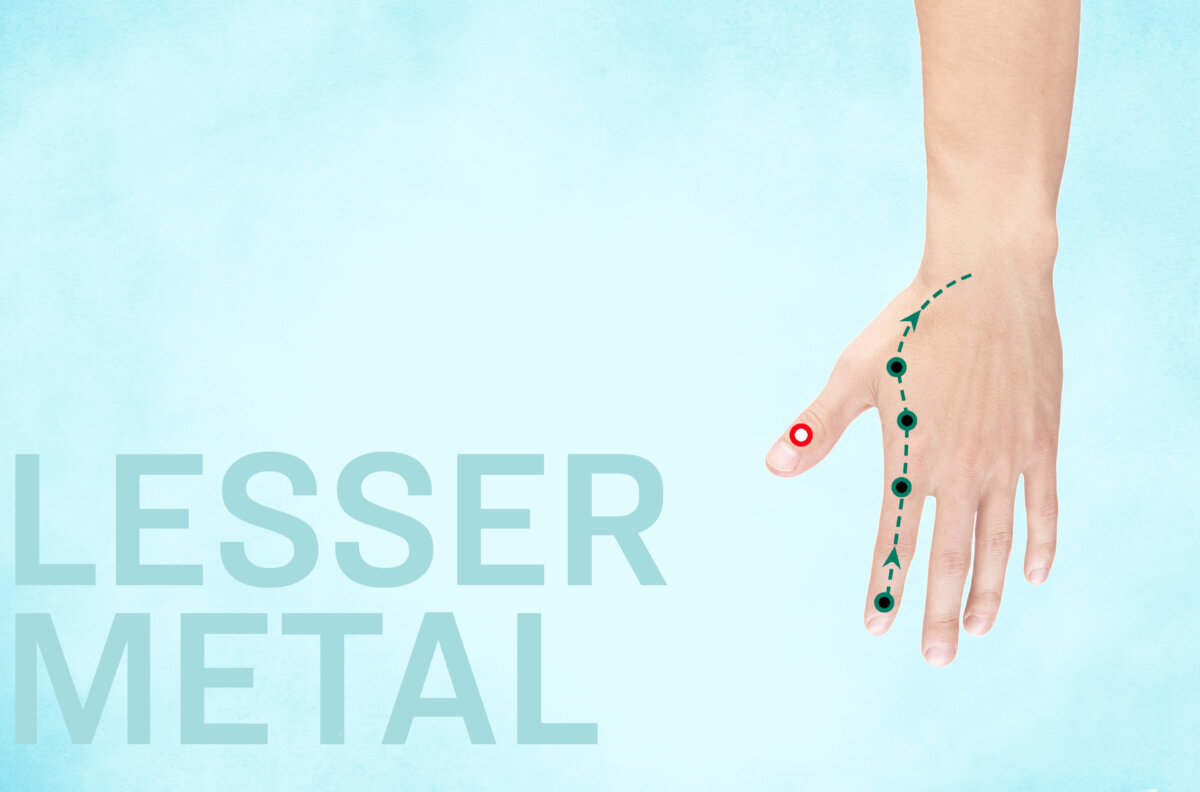
Shao Shang is located just a few millimeters behind the corner of your thumbnail on the outer side. Feel around the outer corner until you find a slightly tender spot. A sensation—whether it’s sore, tingly, or sensitive—is your cue that you’ve successfully found the acupoint.
Ways to Stimulate Shao Shang Safely
- Firm pressure: Press firmly for three to five seconds, then relax for three seconds. Repeat for one to three minutes on each hand.
- Circular massage: Massage in small circles with your index finger or thumb for one to three minutes on each side.
- Toothpick Method: For a more active sensation, press the blunt end of a toothpick into the point—no puncture needed—to mimic light needle stimulation. Repeat for one to three minutes on each thumb.
- Advanced Methods: Acupuncture or bloodletting should only be performed by a licensed TCM professional.
Precautions
Moxibustion, a gentle heat therapy using dried mugwort, is contraindicated for Shao Shang. Jing-well points can be particularly sensitive, so start with gentle pressure and increase it only if you are comfortable. If you have any open wounds or broken skin around the point, wait until you’re fully healed. Bloodletting should only be performed by trained practitioners and should not be used for self-treatment.
A Useful Point for Moments That Matter
Whether you’re supporting someone through a serious fever or using it to ground yourself during emotional overload, Shao Shang is a helpful and accessible tool that is always there for you. You don’t need a crisis to benefit from Shao Shang, but if one arises, you might be glad you know how to use this acupoint.
TCM expert Shihhsiang Hung reviewed this article for accuracy and clarity.