
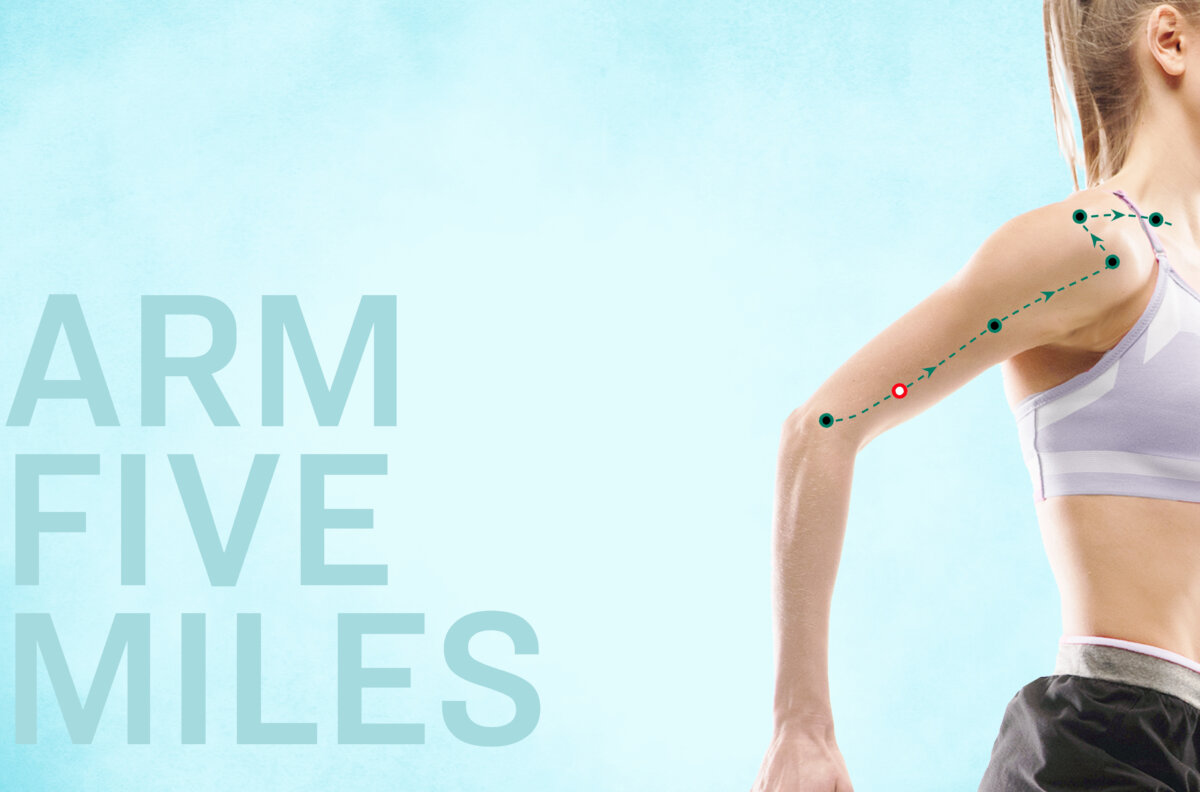
What do you usually do when muscle cramps show up? Most people try a quick rub and move on, assuming the pain will pass. Some use topical anesthetic cream if needed. This hands-off approach to care is understandable—scheduling a massage session takes time and effort. However, with basic acupressure knowledge, a simple rub can become truly therapeutic. Today’s acupoint, Arm Five Miles (“Shou Wu Li,” LI13), is valuable for those with arm strain or posture concerns.
Classic Role
First recorded in the “Zhen Jiu Jia Yi Jing” (“The A-B Classic of Acupuncture and Moxibustion”), Shou Wu Li belongs to the Large Intestine meridian, which travels from the tip of the index finger toward the head. Many points on this meridian help release muscular tension, but Shou Wu Li is known for one specific application.
Following the traditional Chinese medicine (TCM) principle that acupoints treat issues in their immediate vicinity, Shou Wu Li is often used to address pain in the arms and shoulders. Its specialty lies in relieving cramping in the upper limbs, which may be triggered by exposure to cold wind or by prolonged muscle tension. If you pictured such common activities as biking in cold weather, sitting directly under an air conditioner, or carrying heavy grocery bags, you’re on the right track. These scenarios create localized stagnation of “qi,” and Shou Wu Li can relax the tendons to resolve this stagnation.
Its role extends beyond relieving muscle cramps, though. By helping release built-up tension, Shou Wu Li promotes the smooth flow of qi along the Large Intestine meridian. Although it does not directly treat digestive problems, clearing the meridian supports the acupoints that do, by ensuring they receive sufficient qi and blood to carry out their functions.
Clinical Research
In clinical practice, Shou Wu Li frequently appears in treatment protocols that aim to restore upper-body mobility.
One study explored recovery strategies for stroke patients with upper-limb weakness. Researchers compared four groups: one received routine care, another received acupoint tapping, a third underwent thunder-fire moxibustion (a gentle heat therapy using dried mugwort), and the last group received both therapies. All groups improved, but the combination group showed the greatest progress, especially in joint mobility and the ability to perform daily tasks. Shou Wu Li was included in the tapping therapy protocol, underscoring its contribution to improving muscle strength and motor function.
Another study compared two treatments for infants with birth brachial plexus injury, a condition often caused by difficult births that affects the nerves controlling the shoulder, arm, and hand. One group received acupuncture and Tuina massage (a massage therapy that focuses on stimulating the body’s natural healing mechanisms), while the other received injections aimed at restoring nerve function. The acupuncture group had better results across multiple measures, such as overall effectiveness, nerve recovery measured by electromyogram, and symptom scores. Shou Wu Li was among the acupoints used, supporting improvement in nerve function and upper limb mobility.
How to Locate and Stimulate Shou Wu Li
Shou Wu Li is located along the outer upper arm. To locate it, first find another acupoint, “Jian Yu” (LI15). Extend your arm to the side so it’s parallel to the floor and find the small depression on the front upper side of the shoulder roughly along the line where the arm connects to the torso. Next, identify “Qu Chi” (LI11), an acupoint that sits halfway between the elbow crease and the bony prominence on the side of the elbow. From there, measure four finger widths upward along the line that connects Qu Chi to Jian Yu. Press around the area to find a sore or tender spot—that sensitivity often signals the acupoint.
Ways to Stimulate Shou Wu Li
- Firm pressure: Press firmly for three to five seconds, then release for three seconds. Repeat for up to three minutes per side.
- Circular massage: Massage in small circles with your thumb or index finger for one to three minutes on each arm.
- Herbal patch: Apply an herbal patch overnight if desired.
- Advanced methods: Consult a trained TCM practitioner for acupuncture, scraping or gua sha (a technique that uses a smooth-edged tool to stroke the skin to increase circulation), or moxibustion (a gentle heat therapy using dried mugwort).
Precautions
Avoid using Shou Wu Li if the area is injured or inflamed. When applying herbal patches, choose products that are free from harsh artificial additives, especially if you have sensitive skin.
Keeping Arm Strain at Bay
The arms are subject to far more strain than we often realize. Even without heavy lifting, repetitive or awkward use can cause tension to build up. Shou Wu Li is accessible and practical, suitable for both preventative care and recovery from physical strain. Consider it as a way to check in with the flow along the meridian and keep discomfort at bay.
TCM expert Shihhsiang Hung reviewed this article for accuracy and clarity.