
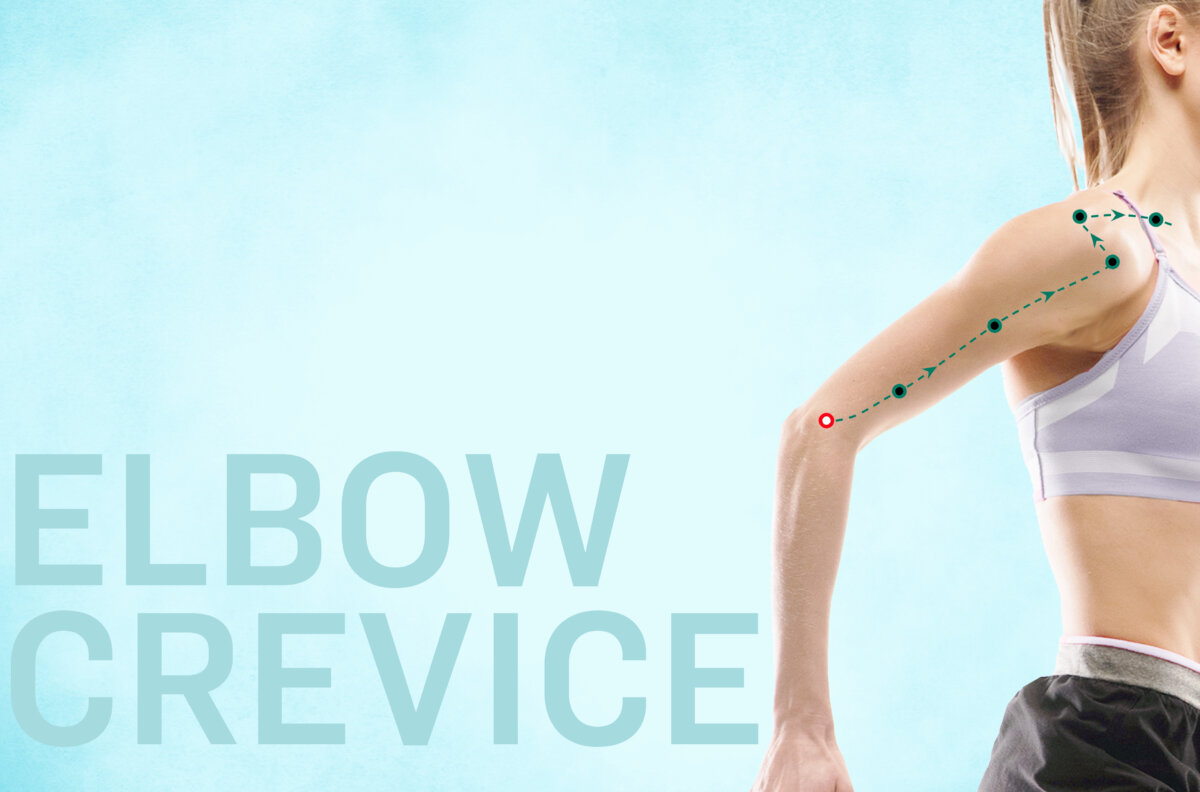
Some tools are made for everyone; others exist for a very specific purpose. Think of the difference between a Swiss Army knife and a sushikiri, the knife your chef uses to slice sushi rolls. Both have value, but the latter is built for someone with a particular need or interest. In the world of acupuncture, Elbow Crevice (“Zhou Liao,” LI12) fits the second category. This acupoint doesn’t promise to solve everything, but if you’re dealing with elbow issues, it’s exactly what you’re looking for.
Classic Role
Zhou Liao was first documented in the “Zhen Jiu Jia Yi Jing” (“The A-B Classic of Acupuncture and Moxibustion”). This acupoint stands out from other points on the Large Intestine meridian, which usually have multiple roles in the body. Zhou Liao is distinct for its singular and specialized function: relaxing the tendons around the elbow.
Its anatomical position explains this focused action. In traditional Chinese medicine (TCM), acupoints most strongly influence their local area. Thus, Zhou Liao is the go-to choice for conditions such as tennis elbow, where pain is concentrated on the outside of the elbow from repetitive strain.
It is also relied upon in severe contracture cases, often occurring due to trauma, where mobility becomes extremely limited and patients may consider multiple surgeries. Over centuries, Zhou Liao has played a unique role in supporting recovery even before surgeries became routine in China.
Clinical Research
Mainstream medicine continues to explore the use of acupuncture in addressing motor impairments and localized pain. Two recent studies demonstrate that Zhou Liao can be included in various TCM modalities.
One study focused on post-stroke spasticity in the upper limbs, where muscles become stiff or tight, limiting movement. Researchers compared two groups: one received electroacupuncture only on muscles that produce the opposite movement to a main muscle (antagonistic muscles), with Zhou Liao included in the treatment protocol. The other group underwent acupuncture at both antagonistic and agonistic muscles, which are responsible for the main movement. After four weeks, both groups improved, but the dual-muscle-targeting group showed significantly better recovery in motor function and daily activity.
Another study evaluated treatments for tennis elbow with protocols including Zhou Liao. Patients either received a combination of electroacupuncture, massage, and blocking therapy or blocking therapy alone. Results showed that both groups improved in pain, grip strength, and elbow function during the first six months. However, at the 12-month mark, the group that received only blocking therapy experienced a strong relapse. The group that also received acupuncture and massage maintained better long-term outcomes. This supports the role of Zhou Liao in sustained pain relief and functional recovery.
How to Locate and Stimulate Zhou Liao
To find Zhou Liao, bend your elbow and look for the bony bump on the outer side. Find the midpoint between the crease of the elbow and the bone. The acupoint lies one thumb’s width above this midpoint. Press around the area gently. A sore or tender sensation often indicates the correct location.
Ways to Stimulate Zhou Liao
- Firm pressure: Press firmly for three to five seconds, then release for three seconds. Repeat for up to three minutes on each arm.
- Circular massage: Massage in small circles for one to three minutes per side.
- Herbal patch: Apply an herbal patch overnight if desired.
- Advanced methods: Consult a trained TCM practitioner for acupuncture, cupping (a therapy that uses suction to ease tension and improve circulation), or moxibustion (a gentle heat therapy using dried mugwort).
Precautions
Avoid using Zhou Liao if there is an unhealed injury in the region. When using herbal patches, choose gentle formulations, especially if your skin is sensitive.
Passing Along Practical Knowledge
Zhou Liao isn’t a point most people will need every day. But for athletes, post-injury patients, or those with chronic elbow tension, it can make a measurable difference. If you know someone who fits that description, share what you’ve learned. Sometimes, knowledge is the most powerful support you can offer.
TCM expert Shihhsiang Hung reviewed this article for accuracy and clarity.