
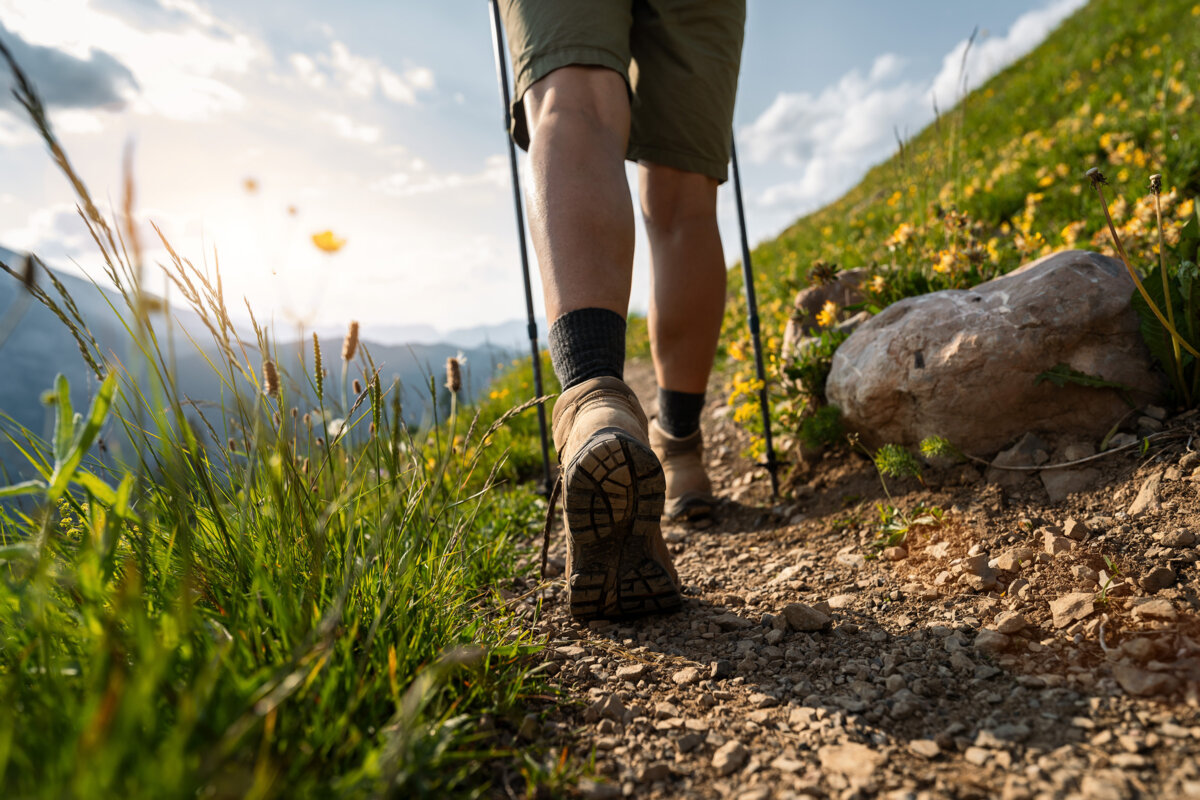
For millions facing knee arthritis, the usual choices aren’t great: Live with pain or face surgery. However, researchers say there’s another way—just by changing how you walk.
Adjusting how your feet hit the ground could relieve knee pain and help slow joint damage in people with early osteoarthritis, according to a recent study.
The study, published in The Lancet Rheumatology, found that slightly adjusting a person’s foot angle—roughly the width of a thumb inward or outward—led to nearly twice the pain relief seen in a placebo group. For some, the benefit was comparable to that of strong prescription painkillers.
Co-lead author Scott Uhlrich, a mechanical engineering professor at the University of Utah, said in a statement that the improvement was similar to the improvement from taking ibuprofen and, in some cases, closer to the effect of a prescription opioid such as OxyContin compared with the placebo group.
However, the benefits extended beyond pain relief. MRI scans also showed less cartilage breakdown in those who learned to walk with their optimal foot angle, suggesting that the method may do more than relieve pain.
“Helping patients find their best foot angle to reduce stress on their knees may offer an easy and fairly inexpensive way to address early-stage osteoarthritis,” co-lead author Valentina Mazzoli, a professor in the department of Radiology at NYU Grossman School of Medicine, told The Epoch Times. “This could help delay surgery.”
A Personalized Prescription
The research tackled a significant gap in treatment options for the 25 percent of adults older than 40 affected by osteoarthritis. As joint-cushioning cartilage wears away, patients typically face limited choices—usually pain management with medications that mask the damage until joint replacement becomes necessary.
“This intervention could help fill that large treatment gap,” Uhlrich said, particularly for those diagnosed in their 30s to 50s, who often face decades of pain management.
In the year-long trial, researchers studied 68 adults with an average age of 64 who had mild to moderate medial knee osteoarthritis—the most common form of knee arthritis, characterized by damage on the inner part of the knee. All participants were not yet candidates for surgery.
Each participant’s walking pattern was assessed using motion capture and computer simulations to determine whether a five- or 10-degree toe-in or toe-out adjustment could reduce joint stress.
[epoch_component type=”photo_gallery” position=”center” section_title=”Researchers used motion capture and computer simulation to determine participants’ optimal foot angle for walking to reduce knee pain. Participants adjusted their walking angle by 5 to 10 degrees, either toeing in or toeing out. (The Epoch Times/Shutterstock)” width=”600″ items=”5909316,” image_stays=”false” stays_for_paragraphs=””][/epoch_component]
Half of the participants received “sham” training to preserve their natural gait. The other half were trained over six sessions to adopt their optimal angle using real-time feedback, including a wearable sensor that vibrated if their foot deviated from the target by 2 degrees.
About nine out of 10 people who received personalized gait retraining reported an average pain reduction of 2.5 points on a 10-point scale, and about two-thirds reported improvement in the placebo group.
In addition to greater pain relief, those in the personalized group put less pressure on the inner part of the knee, where damage typically occurs. This resulted in a 7.5 percent reduction in joint stress, and MRI scans showed that their cartilage held up better over time.
By contrast, the control group showed more signs of cartilage breakdown. These differences stemmed from small, tailored changes in how each person walked.
Science Behind Each Step
How you walk affects how body weight is distributed across the knee joint. Each step sends force through the joint, and even small variations in how much your toes point in or out can shift pressure to different areas of cartilage. Over time, that pressure can either protect or strain the knee.
“Previous studies used the same foot angle for everyone,” Mazzoli said. “But some people didn’t improve—and some got worse. What we showed is that personalization really matters.”
Unlike medications that only mask symptoms, gait retraining aims to reduce the mechanical stress that contributes to cartilage breakdown. That means that it could potentially slow the progression of osteoarthritis, not just relieve discomfort.
“We’re not just seeing pain relief,” Mazzoli said. “There’s real evidence of positive changes in the cartilage itself—which could mean better long-term outcomes.”
The idea builds on what many physical therapists have long noted: Changing how force moves through the knee joint can make a big difference in pain and long-term joint health.
“The biomechanical rationale of the intervention is solid,” Anat Lubetzky, an associate professor of physical therapy at New York University, told The Epoch Times in an email. “We’ve known for years that biomechanical interventions that reduce loads from certain areas of the knee joint, if done early, can delay [osteoarthritis] progression and reduce symptoms.”
From Lab to Real Life
A key factor in the study’s success was personalization.
“It’s very easy to identify the best angle—and very easy to learn,” Mazzoli said. “But it has to be the right angle for you.”
Currently, making a personalized prescription requires motion-capture systems and pressure-sensitive treadmills to analyze each participant’s gait—equipment typically found in a research lab.
However, the research team envisions a future in which physical therapists could offer personalized gait retraining using video-based apps and smart footwear.
“Maybe not today, probably not in every clinic,” Lubetzky said. “But the sensing technology has already advanced so much and keeps developing. I can see how this study may drive inquiry with simpler tools—maybe inertial motion units or even video analysis instead of motion capture systems. There are already apps that do a decent job and biofeedback devices.”
Still, Mazzoli said that guidance from a trained professional is important. Choosing the wrong angle could worsen symptoms by increasing joint stress.
What Comes Next
The researchers plan to expand future trials to include people with obesity, a group often affected by knee osteoarthritis but excluded from this study because they require different treatment protocols.
“Obesity plays a big role in osteoarthritis, and this population really needs effective, noninvasive options,” Mazzoli said.
For those already experiencing early knee pain or stiffness, the message is simple:
“With the right evaluation, small, personalized changes can make a meaningful difference,” she said. “It’s definitely worth trying.”
One study participant captured the appeal of this drug-free approach: “I don’t have to take a drug or wear a device. It’s just a part of my body now that will be with me for the rest of my days, so I’m thrilled with it.”