
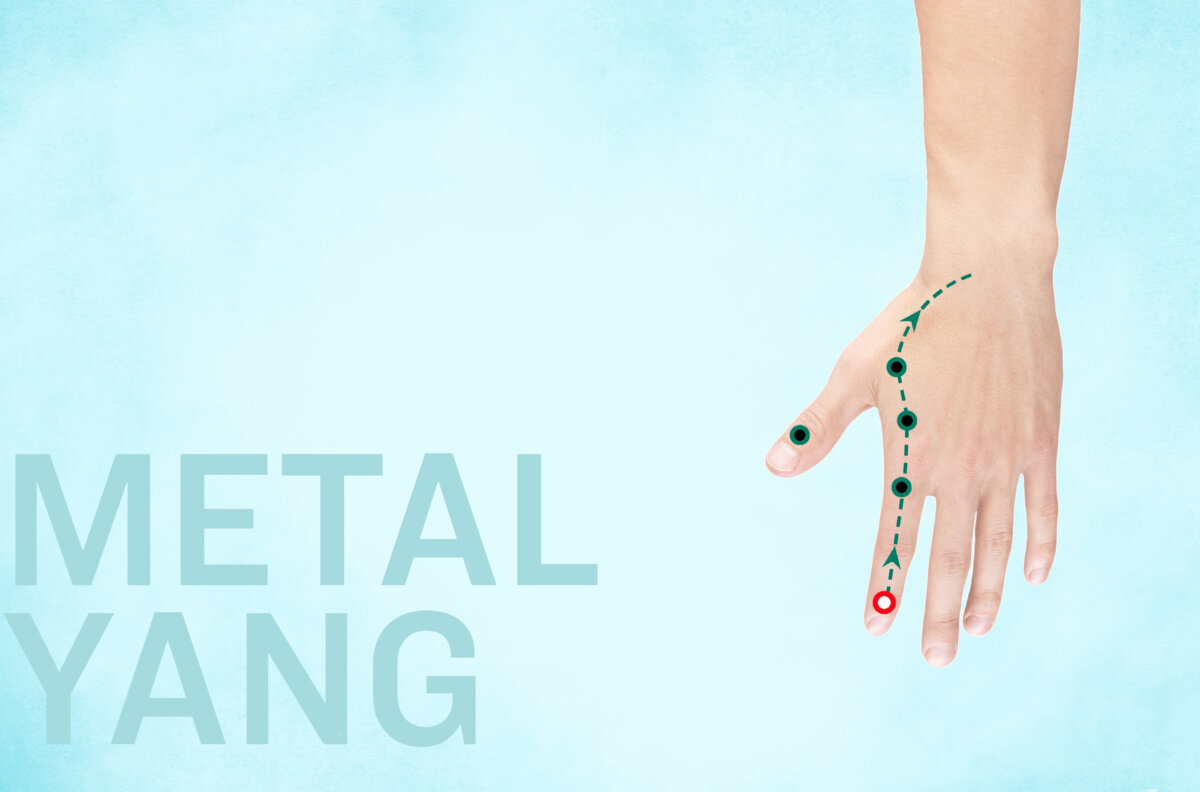
In traditional Chinese medicine (TCM), the health of one organ affects its corresponding partner, so they are often treated as a unified system. An exploration of the Large Intestine meridian is an ideal time to discuss meridian pairings.
“The Yellow Emperor’s Canon” teaches that meridians are coupled as yin and yang counterparts, supporting and influencing each other. The Large Intestine meridian is crucial for clearing both physical and metabolic waste. Its pairing with the Lung meridian allows it to influence digestion, respiratory function, and skin clarity. Metal Yang (Shang Yang, LI1), at the tip of the index finger, offers a direct reset for this meridian. It’s the first and one of the most dynamic points along the path.
A Point With Power to Reset
Shang Yang is first mentioned in the “Ling Shu” (“Spiritual Pivot”) and is known as the Jing-Well point of the Large Intestine meridian. Jing-Well points are considered energetic wells—small in size but powerful in effect. They are commonly used to reset the function of the entire meridian and its associated organ.
For Shang Yang, this means it can help regulate the Large Intestine and clear blockages. Jing-Well points also influence the opposite end of the meridian, which is why Shang Yang can be used for head-related issues. Because they work quickly and precisely, Jing-Well points are chosen for situations needing immediate attention. Historically, practitioners used Jing-Well points to help restore consciousness, though Shang Yang is rarely used for this purpose alone.
Clinically, Shang Yang is most often used to restore bowel function in cases of severe or persistent constipation, particularly when discomfort is significant. It also treats head-related problems like toothaches, jaw swelling, and sore throat, thanks to its influence over the meridian’s far end. For broader benefits, it’s often paired with its Lung meridian counterpart.
Scientific Data Highlights Physiological Changes
Modern research shows that acupoints like Shang Yang are biologically active and responsive. In one study, researchers investigated how stimulating another point on the Large Intestine meridian (Hegu, LI4) influenced skin temperature along the meridian.
Thirty healthy participants received acupuncture at Hegu, and researchers measured skin temperatures before, during, and after the needling at several points, including Shang Yang. Following stimulation, the temperature at Shang Yang increased significantly on both sides of the body. The result demonstrates that specific acupoints along the same meridian can interact and influence each other in a coordinated way.
Another clinical trial examined the effectiveness of bloodletting—a traditional technique of pricking or lancing the skin to draw a small amount of blood—at Shang Yang and Shao Shang, the Jing-Well point on the Lung meridian, in elderly patients with severe community-acquired pneumonia. Patients who received bloodletting at both points, along with standard medical treatment, experienced significantly better results, including lower body temperature, reduced respiratory and heart rates, and improved illness severity scores.
Most notably, the 28-day mortality rate was far lower in the treatment group—12.9 percent—compared to 45.2 percent in the control group. This study demonstrates the therapeutic potential of Shang Yang, especially when combined with its Lung meridian counterpart, in treating serious illnesses.
How to Locate and Stimulate Shang Yang
Shang Yang is located just behind the corner of the nail on the thumb-side edge of your index finger. Gently press around this area until you feel a slightly sore or tender spot—this is often the precise location of the point. The sensitivity may increase if there’s energetic congestion or a history of injury in the region.
Simple Ways to Activate Shang Yang
- Firm pressure: Press firmly for three to five seconds, then relax for three seconds. Repeat for one to three minutes on each hand.
- Toothpick method: Use the dull end of a toothpick to simulate the effect of acupuncture without piercing the skin.
- Circular massage: Massage in small circles with your index finger or thumb for one to three minutes on each side.
- Advanced Methods: Acupuncture or bloodletting should only be performed by a licensed TCM professional.
Precautions
Jing-Well points are often very sensitive. Begin by applying light pressure, and only increase it if you feel comfortable. If you have any open cuts or broken skin near the point, wait until the area has fully healed before stimulating it. Bloodletting must always be performed by a trained professional and should never be attempted on your own.
Everyday Uses
Constipation is a common and uncomfortable issue. While medical treatments are sometimes required, holistic approaches like stimulating Shang Yang provide an additional way to support your health. Shang Yang does more than just relieve symptoms—it helps restore the body’s natural waste-clearing functions and maintain healthy internal rhythms.
TCM expert Shihhsiang Hung reviewed this article for accuracy and clarity.