
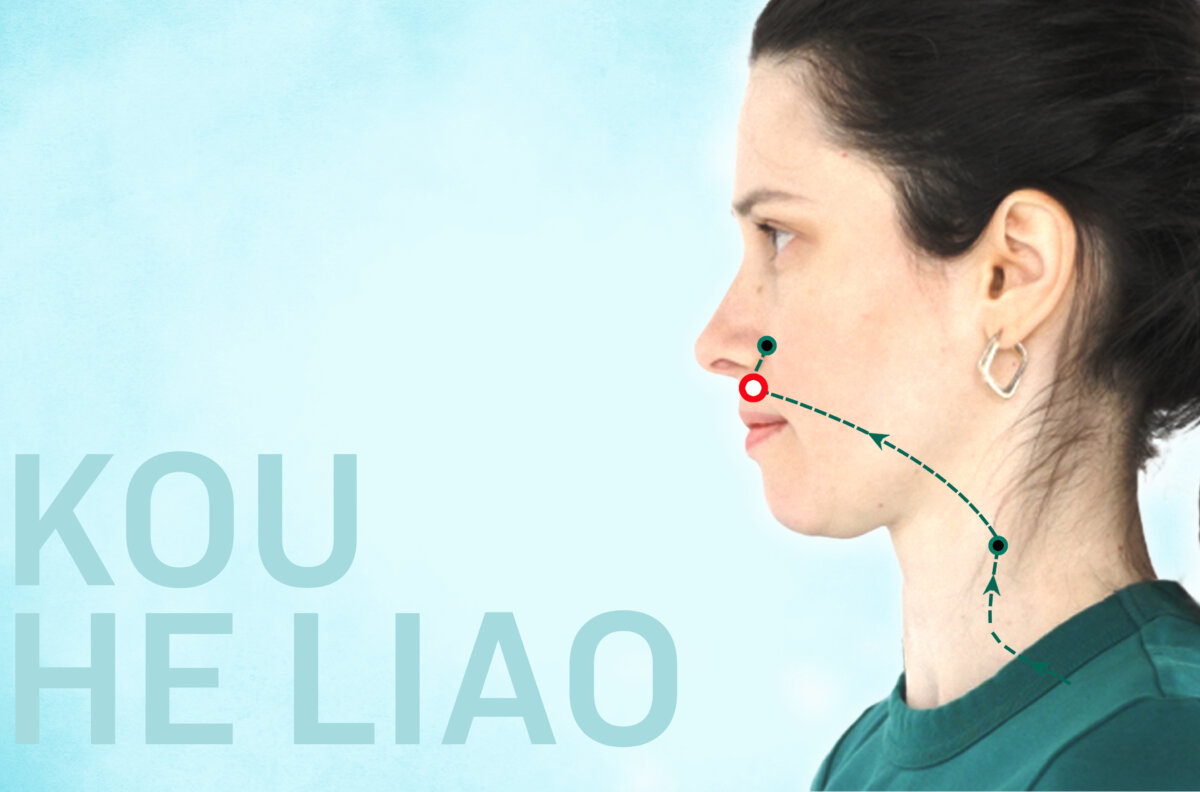
As the colder months roll in, so do the sniffles, sneezes, and endless boxes of tissues. For many people, seasonal colds and flus hit the nose the hardest. While over-the-counter solutions have their place, some people explore holistic, budget-friendly ways to get through the tough season. That’s where the acupoint, Mouth Grain Crevice (Kou He Liao, LI19), located just under the nose, steps in. It’s a helpful point to remember when everyone around you seems to be catching colds, and it offers more than just relief from a runny nose.
From Classic Roots to Practical Use
Kou He Liao was first mentioned in “The A-B Classic of Acupuncture and Moxibustion,” the earliest surviving text on treatment methods of traditional Chinese medicine (TCM). Despite being part of the Large Intestine meridian, its purpose is closely tied not to the large intestine itself but to its precise location.
Kou He Liao is recognized as a common supportive acupoint in protocols for addressing various nasal issues. It is used to manage inflammation in and around the nose. It is applied in cases of rhinitis, a common condition when the mucous membrane of the nose becomes swollen and irritated. It can help stop nosebleeds and is also used for nasal polyps. Additionally, this point can be incorporated into broader treatment plans for facial nerve paralysis and involuntary facial twitching.
Scientific Studies on a Facial Acupoint
Modern research continues to examine the physiological changes associated with Kou He Liao. In one study, researchers assessed facial blood flow using laser Doppler imaging before and after stimulating another acupoint, Hegu (LI4), in 30 healthy volunteers. Kou He Liao was among the facial points with the highest baseline blood perfusion. After acupuncture at LI4, blood flow increased across the face, including at Kou He Liao, highlighting its key role in facial circulation.
Another study involved 45 healthy college students and examined changes in facial energy activity—specifically, metabolic intensity—before and after needling Hegu (LI4) points on both hands. The results showed a widespread increase in activity across the face, with the largest increase observed at Kou He Liao. This pattern matched the pathway of the Large Intestine meridian and supported Kou He Liao’s relevance to mouth and facial function.
Finding the Point With Precision
Kou He Liao is located several millimeters below the outer edge of the nostril. To find it, use your finger to feel around the area. A tender or sore spot typically indicates the correct location. The intensity of this sensation may increase if you are actively recovering from a relevant illness. Kou He Liao is a bilateral acupoint, meaning you have one on each side.
Ways to Activate Kou He Liao
- Firm pressure: Press firmly for three to five seconds, then relax for three seconds. Repeat for one to three minutes on each side.
- Circular massage: Massage in small circles with your index finger or thumb for one to three minutes on each side.
- Herbal patch: Apply an herbal patch overnight for longer activation.
- Advanced methods: Acupuncture by a trained professional can deepen the therapeutic effects.
Precautions
Do not use Kou He Liao if there are injuries in the area. If using herbal patches, opt for products without harsh synthetic ingredients, especially if your skin is sensitive. Moxibustion is contraindicated at this acupoint.
Support for Your Nose—No Tissues Required
If your nose is the first to react to cold weather or changing seasons, remember Kou He Liao. It may offer relief when inflammation or irritation strikes. Using this point might even cut down on tissue waste, offering an eco-friendly and cost-free method of care. Kou He Liao is a simple yet effective tool to support nasal comfort when it matters most.
TCM expert Shihhsiang Hung reviewed this article for accuracy and clarity.