SEARCH


Advent Sunday, the Sunday nearest Nov. 30, marks the start of the Advent season and a new church year. The four Sundays of Advent leading up to Christmas celebrate Christ’s first coming and anticipate his return.
In past centuries, storytelling pictures of Advent on stained-glass windows, monumental altarpieces, and private devotional works helped the largely illiterate population. These narrative works focused on one biblical scene, or several sequential scenes leading up to a sacred event. In her book “Illustrated Dictionary of Narrative Painting,” art historian Anabel Thomas wrote:
“In the sixth century. Pope Gregory I described the benefits of harnessing an image in the service of the text. … ‘For a picture is introduced into a church so that those who are ignorant of letters may at least read by looking at the walls and seeing there what they cannot read in books.’ The Renaissance theorist [Leon Battista] Alberti took up Pope Gregory’s theme. According to Alberti, the best kind of image was one that ‘captures the eye of whatever learned or unlearned person is looking at it and moves his soul.’”
Centuries on, the soul-stirring power of great visual storytelling continues to spark spiritual awakenings or deepen a viewer’s faith, perhaps more than words. Let’s reflect on this Advent season, traditional for some Christians, with Italian, Flemish, German, and Russian art from the 14th century to the 20th century that complements the four Advent candle themes.
The Prophecy Candle
Many church congregations light a candle in the Advent wreath on the four consecutive Sundays leading up to Christmas. Typically purple, the four candles each represent a different aspect of Christ’s coming: hope, peace, joy, and love. Sometimes the wreath contains a white candle in the center that represents Christ.
Christians contemplate hope as they light the prophecy candle on the first Advent Sunday.
Artists often depicted the prophets Isaiah and Ezekiel, who foretold the Messiah’s birth. The Italian Renaissance painter Duccio di Buoninsegna, commonly known as Duccio, depicted the pair flanking the Nativity in the “Maestà” altarpiece. Washington’s National Gallery of Art (NGA) lauds the double-sided, golden altarpiece as “one of the most important monuments of Western painting.”
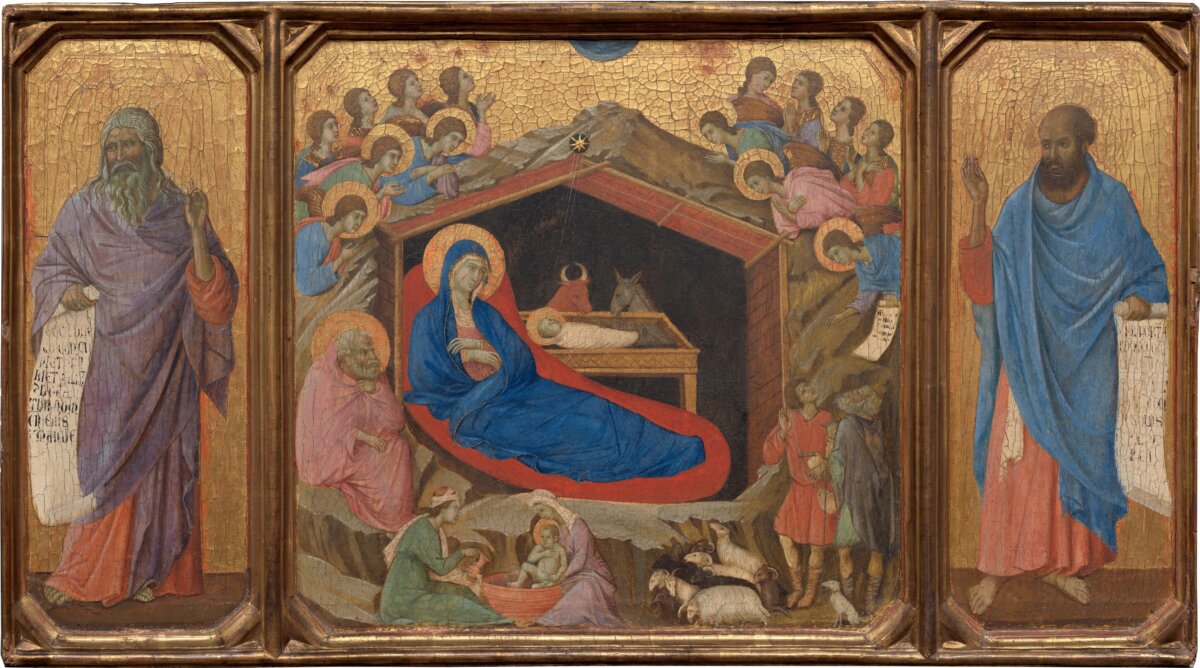
“The Nativity With the Prophets Isaiah and Ezekiel” formed part of its predella, the lowest register of the altarpiece. Duccio depicted the prophets with scrolls detailing their Nativity premonitions. Isaiah in flowing purple robes points heavenward, and Ezekiel in blue robes raises his palm. According to the NGA, Duccio’s Nativity scene contains different art influences, including the ancient Greek East (Byzantine) style cave setting, a Byzantine-style recumbent Mary, and a Northern European gothic-style manger roof.
For some two centuries, the monumental altarpiece hung on the main altar of Siena Cathedral in Italy until it was relocated to a side altar in 1506 and later dismantled in the 1770s. The NGA estimates that the original altarpiece included more than 70 scenes, and was around 15 feet high with around 17-foot-high gables.
The Bethlehem Candle
On the second Sunday of Advent, Christians reflect on peace as they light the Bethlehem candle. In stark contrast to Duccio’s altarpiece painting, Flemish artist Pieter Bruegel the Elder’s work “The Census at Bethlehem” appears as an everyday winter scene in a snow-covered Flemish village.
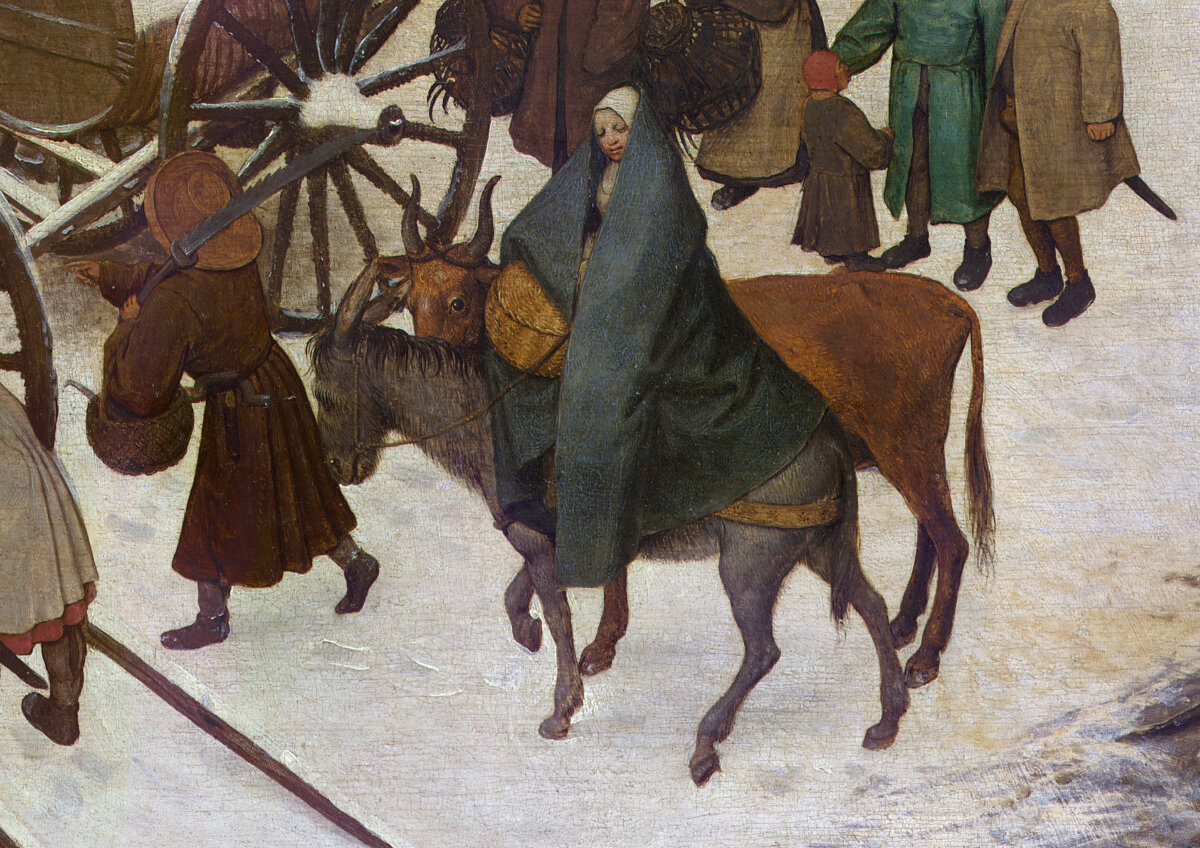
Bruegel’s detailed genre scenes, such as this one with some 200 figures, always demand a closer look. His painting reflects villagers wrapped up warm, working, playing on a frozen pond, or registering at the census and paying tax. Among the crowd in the foreground, Joseph leads Mary on her donkey, accompanied by an ox, to the census outside an overcrowded inn. It’s an ordinary event before an extraordinary birth. A wooden cross on the gable of a dilapidated stable, in the middle ground, hints at the humble birthplace.
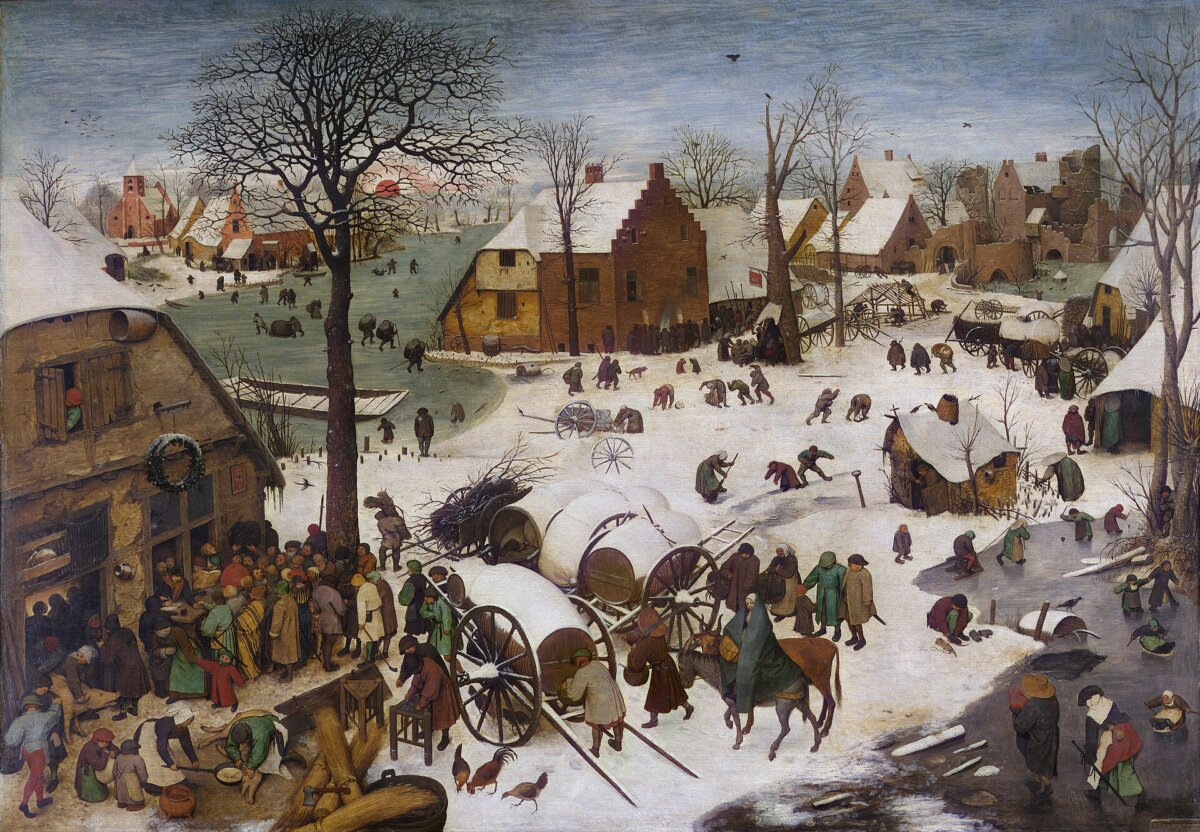
Bruegel painted the work in 1566 during the Little Ice Age of Europe, when subzero temperatures crossed the continent.
The Shepherd’s Candle
Christians contemplate joy on the third Sunday of Advent, as they light the shepherd’s or “gaudete” (Latin for “rejoice”) candle, which is often pink. Artists captured the shepherd’s reverence of baby Jesus in the “Adoration of the Shepherds.” These depictions traditionally include Mary, Joseph, and the three jovial visitors gathered around the Messiah in a manger.
Visitors to Saint Mary of the Assumption Parish Church in Springboro, Ohio, can enjoy a vibrant stained-glass version of the sacred scene created by the eminent Franz Xaver Zettler Studio in Munich. Halos surround the heads of the holy family: Mary, Joseph, and baby Jesus. Mary sits with Jesus upright in her lap. An awe-struck shepherd kneels before the pair, holding his heart in reverence, as he greets the baby. Jesus holds his heart (as does Joseph), while proffering a blessing with his other hand.

In 1918, the Munich studio created the scene as part of a series of stained-glass windows celebrating the 50th anniversary of Saint Mary’s Church in Franklin, Ohio. Nearly one hundred years later, in 2016, the windows were reinstalled in the congregation’s new church in Springboro.
Unlike medieval stained glass, where each piece of colored glass was enclosed in lead, the late 19th- and early 20th-century German stained glass artisans painted large panes of glass, resulting in these more painterly windows. According to the University of Notre Dame: “Despite a 45 per cent tariff imposed on imported stained glass in the United States after 1894, churches kept enthusiastically purchasing German glass until World War II for its quality craftsmanship and distinctive imagery.”
The Angel’s Candle
When Christians light the angel’s candle on the last Sunday of Advent they reflect on love.
Foremost Russian icon maker Andrei Rublev’s “Nativity of Jesus” icon from the Orthodox Church hangs in the Kremlin’s Cathedral of the Annunciation, in Moscow. A recumbent Mary lies in the center beside Jesus in his manger, who is swaddled in burial clothes, foretelling his future martyrdom. Surrounding the central scene are sequential episodes of the Advent.
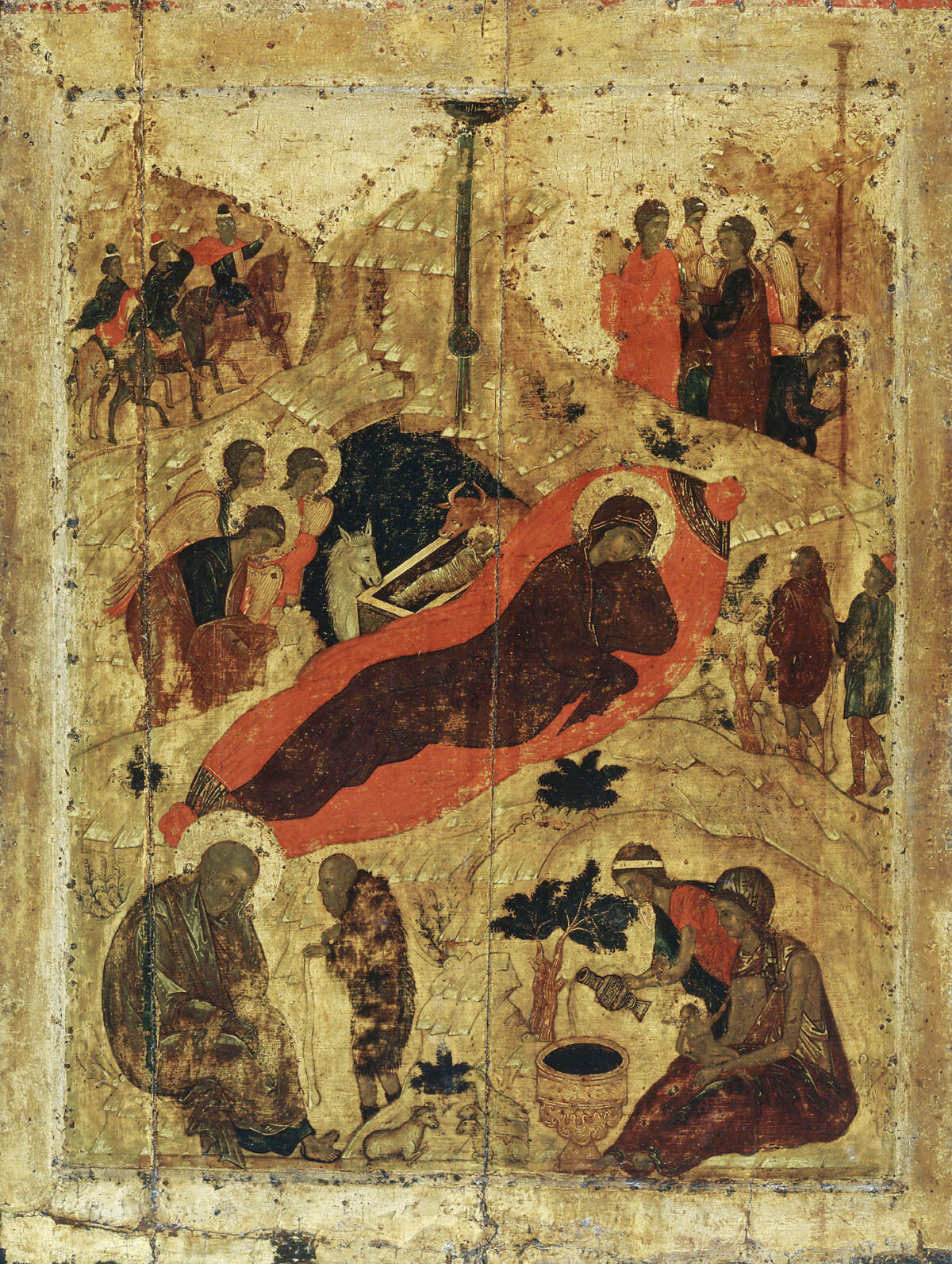
Rublev’s stylized icons were rooted in Byzantine art, which, according to “The Oxford Companion to Art,” “shuns earthly man, the individual, and aspires to the superhuman, the divine, the absolute. By stylization it destroys humanity in art and transfuses forms with the numinous quality of symbols.”
Whether ancient Byzantine icons, Renaissance altarpieces, or 19th-century romantic paintings, the key biblical elements in each regional art style created a visual dialect of sorts rooted in the universal language of Christian art. This resulted in enduring Christian art—regardless of time, language, or culture.
What arts and culture topics would you like us to cover? Please email ideas or feedback to features@epochtimes.nyc.