SEARCH


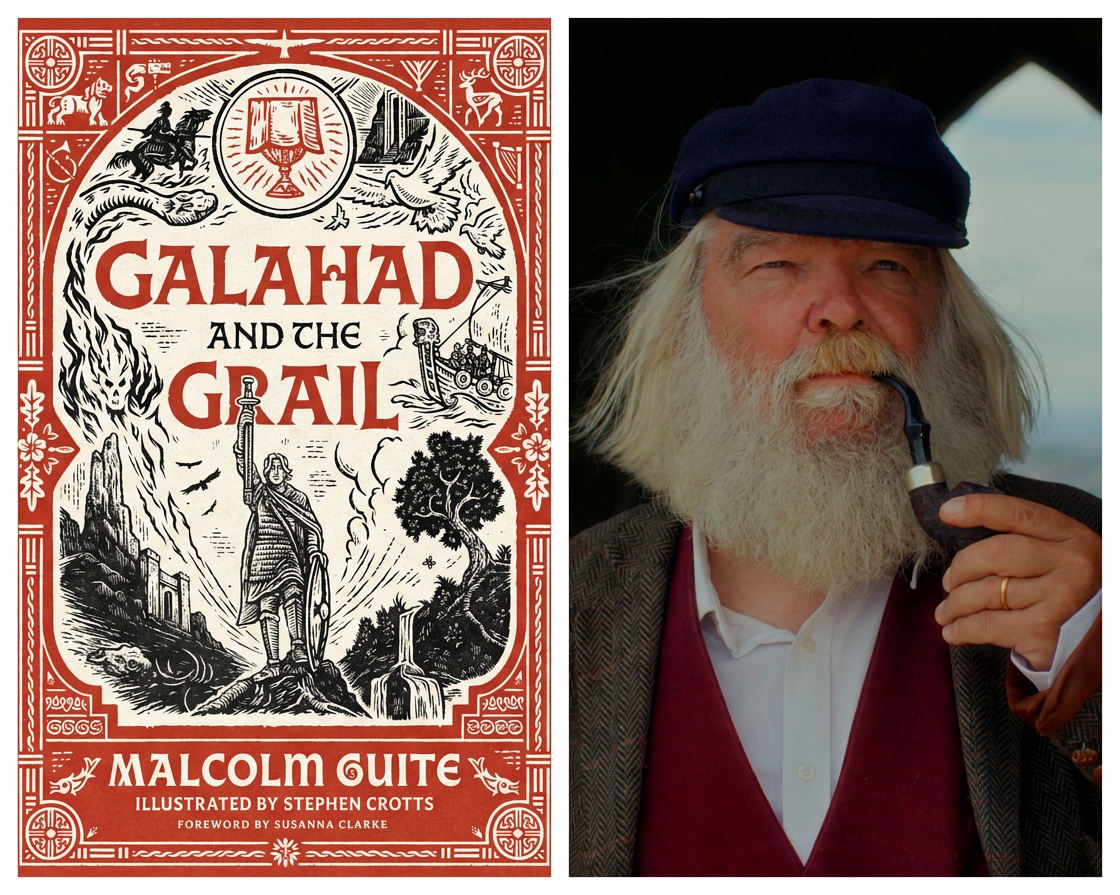
I would venture to say that Malcolm Guite’s “Galahad and the Grail” is the year’s most unusual book, and that is far and away not a bad thing. Indeed, that element is what makes it so fantastic. What makes the 300–plus-page Arthurian tale so unusual is that it is written fully in rhythmic, rhyming verse.
“This poem is written in the ringing, singing, rhythmic form of the English ballad,” Guite wrote in his note to the reader. “It’s when read aloud that a ballad comes to life, and so I suggest that the best experience of this poem is to be had when it is read out loud.”
I accepted Guite’s advice, or challenge, and read “Galahad and the Grail” out loud. And he was right—the ballad did come to life. Fortunately, the story is worthy of a reader breathing life into it by taking on the role of a bard. Indeed, what is a ballad without a bard? Of course, plenty of readers of this review may believe they could never step into such a role. I disagree. It is no difficult task to be swept away by the simple rhythm of the book, and to perform the task in the privacy of one’s own home makes it easier still.
Better yet, reading it to family—specifically one’s children—or, as the book often references, to “kith and kin”—is an opportunity that harks back to the days before smartphones, tablets, and the Internet. Indeed, Guite’s work is a literary effort to hark back to the old days—decades, centuries, even millennia ago.
Recapturing the Arthurian Heart
“Galahad and the Grail” is the first of four volumes the author calls an “Arthuriad.” The long poems retell the legendary tales of King Arthur and his Knights of the Round Table. These retellings, though, are not what the author decries as a “sanitised Hollywood version.” If the title of the book is any indication, it is an effort to recapture “the heart of those early versions of the stories.”
Guite, a Life Fellow of Girton College, Cambridge, and the recipient of the Lanfranc Medal for Education and Scholarship by the Archbishop of Canterbury, has fully embraced and presented to readers the “haunting, numinous, continuously suggestive of the holy and beautiful reality of God and His saints and angels shimmering through the fabric of the stories.”
Certainly Guite has prevailed in his effort. The story of Galahad—the young man knighted by his father, Lancelot—is a fantastical and poetic portrayal of the pursuit of the Holy Grail, the cup belonging to Jesus Christ at the time of the last supper. Galahad and several other knights begin their pursuit facing trials, temptations, and hardships. They must defeat monsters, witches, and demons—and not all of them do. The tale elevates the virtues of courage and faith, as well as pure-heartedness. The idea that one can touch and experience the holy only by being holy themselves is unmistakably a Christian theme (a direct reference to the Bible’s Old and New Testament scriptures).
There are also the fair maidens, like Guinevere, Elaine, and Dindrane, who are prominent in the story. Dindrane demonstrates the example of Christ by sacrificing herself for the good of another. Her role in the story is also pivotal, as she ensures the knights—Galahad, Sir Bors, and Percivale—can reach the castle that houses the Holy Grail.

A Literary Keepsake
Guite demonstrates his grasp of the poetic form throughout, finding ways to describe, in clear yet beautiful fashion, the scenery, the action, and the characters’ emotions. “Galahad and the Grail” is not only a testament to Guite’s gift, but also to the idea that the method of classic storytelling need not be relegated to yesteryear. It is a story told in a way that doesn’t merely capture the imagination, but also advocates for a literary style that has seemingly been lost.
Additionally, it is one of the most beautifully constructed books in my library. The 25 illustrations, not including the designs on the dust jacket, created by Stephen Crotts, are visually captivating and wonderfully complement Guite’s narrative. I believe the publisher, Rabbit Room Press, based in Nashville, Tennesse, has matched Guite’s vision with its fittingly crimson red, cloth-bound book emblazoned with bright gold letters on the covers and binding. It also includes a red ribbon bookmark. Rabbit Room Press has created a special edition for the first volume of this Arthuriad, which I view as an instant keepsake for readers.
Malcolm Guite’s “Galahad and the Grail” captures the spirit of the legendary Arthurian tales with its magic, chivalry, romance, adventure, and Christian iconography. I highly recommend this book for every age. And I think that if one has children or grandchildren, it is a work that should be read aloud to young ears that need to hear these elevating and adventurous stories and be exposed to the poetic style that harkens back to a bygone era.
‘Galahad and the Grail (Merlin’s Isle, an Arthuriad), Vol. 1’
By Malcolm Guite
Rabbit Room Press: April 20, 2026
Hardcover, 372 pages
What arts and culture topics would you like us to cover? Please email ideas or feedback to features@epochtimes.nyc.