SEARCH


The most common cognates or recognizable words across languages include cafe, mama, taxi, and mausoleum. Curiously, the word for the stately, above-ground burial chamber has been preserved linguistically because of the historical figure who conceived such an impressive tomb that his name became synonymous with the concept.
Mausolus (circa 395 B.C.–353 B.C.) had his ashes placed in a monument of such architectural innovation and beauty that it is still regarded 2,300 years later as one of the greatest achievements of the ancient world.
A Cross-Cultural Dynasty
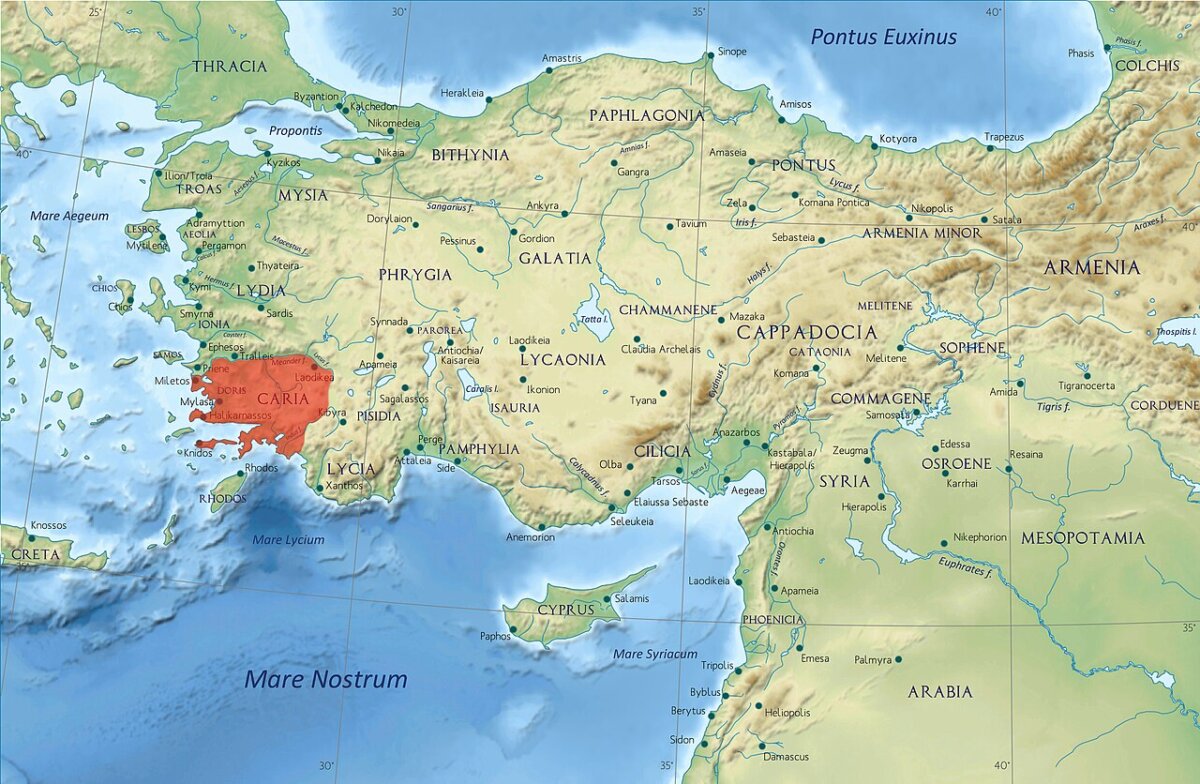
Mausolus was born into an ancient system of governance that eventually informed the political structures of both Rome and the United States. His father, Hecatomnus was the regional governor or “satrap” of the Anatolian region of Caria, which had been under Persian rule since Cyrus the Great’s conquest circa 546 B.C. As one of the 25 to 28 satraps under Artaxerxes II (404 B.C.–358 B.C.), he was required to collect regional taxes and defend Persian rule, but he had considerable autonomy.
Hecatomnus has the distinction of being the first non-Persian official to be appointed as satrap. This appointment provided him the unique opportunity to use his Persian-bestowed authority to promote Greek culture in Caria. Combining Greek worship of the thunder god, Zeus, with Anatolian worship of the storm god, Tarhunz, he built a sanctuary to honor the syncretic deity of Zeus Labraundos.
The coinage and architecture of Caria under his rule likewise reflected a merging of Greek and Anatolian aesthetics. His position naturally bred rumors of revolt and conspiracy, but throughout his entire reign until his death (circa 394 B.C.–377 B.C.) he never lost favor with Artaxerxes.
Mausolus inherited both his father’s love of Greek culture and his political savvy. After only a few years into his reign, a great revolt among uniting satraps against Artaxerxes began to unravel. While initially a co-conspirator, Mausolus realized the lack of unity among the satraps and foresaw a better opportunity in revealing the plot to Artaxerxes.
Mausolus’s betrayal of the rebellion not only preserved his kingdom but also greatly expanded and enriched it. He soon after moved the Carian capital from Mylasa to Halicarnassus and developed it into one of the largest and wealthiest cities in Anatolia. The construction of his own grand tomb was another custom Mausolus inherited from Hecatomnus. However, he did not live to see its construction completed.

Blood Thicker Than Water
Several elite bloodlines in Persia and Egypt consolidated their resources through sibling marriages; a famous example was Cleopatra marrying her brother, Ptolemy, before having him killed by Julius Caesar. The Hecatomnids were one of the few Anatolian dynasties to adopt this custom.
Mausolus, after miraculously surviving an assassination attempt at the Zeus Labraundos sanctuary, died soon after and passed on his reign to his wife and sister, Artemisia II (circa 395 B.C.–351 B.C.). No accounts have survived to offer any clues as to the cause of his death, but multiple accounts describe Artemisia’s grief as being so profound that she drank Mausolus’s ashes to make her body his living tomb. If this gesture was not symbolic enough, she also committed to completing his mausoleum with enough opulence and grandeur to secure her own place in history.
The massive tomb was conceived with multiple objectives, and the spiritual ones did not outrank the political. Artemisia knew the forces gathering against a lone woman on the throne of a wealthy kingdom. The gilded mausoleum would be only one of her awe-inspiring displays of political prowess. The mighty island nation of Rhodes, just off the coast of Halicarnassus, was only a day’s voyage away and preparing an invasion which Artemisia cleverly welcomed into her harbor.
The Rhodians, suspecting nothing, docked their ships and entered the city expecting a peaceful surrender. Artemisia’s fleet, appearing from a second, adjacent and hidden harbor easily commandeered the defenseless ships, decorated them with garlands indicating victory, and sailed back to Rhodes where they were once again welcomed into the harbor without a fight. Believing their ships to be returning in triumph, the Rhodians were horrified to find their city quickly invaded, their officials slaughtered, and their island kingdom now under Artemisia’s rule. It was a loud and cunning gesture from a queen not to be underestimated.
The riches won by this brilliant maneuver would finance six of the best sculptors and architects of the day to carry out Artemisia’s inspired vision for the mausoleum and commit to its completion after her rapid deterioration. Again, no cause of death has been confirmed, but accounts claim she inevitably succumbed to her grief.
A Monument of Many Empires
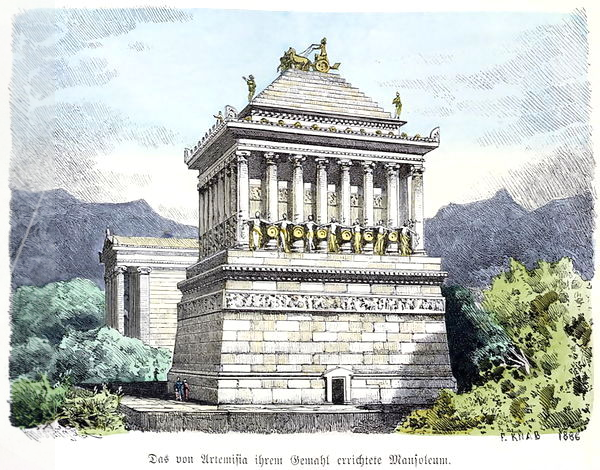
Contemporary scholars agree the mausoleum’s design reflected the more pointed message of the Hecatomnids’ political legacy in its artistic beauty. The most vivid, surviving descriptions come from Vitruvius, writing circa 25 B.C., and Pliny the Elder, writing circa A.D. 50, and both accounts are believed to be taken from a lost treatise written by the mausoleum’s two lead architects. Satyros of Paros and Pythius of Prienne had been charged with producing a design that would not only synthesize the aesthetics and traditions of multiple cultures and eras but do so on an unprecedented scale securing the Hecatomnid dynasty’s rightful place in history.
The base podium stood roughly 60 feet tall in the style of the neighboring Anatolian region, Lycia. Atop this was a Greek-style colonnade reaching 38 feet tall with 36 Ionian columns. Each side featured a different frieze or relief carving across the top of the columns, designed by the four famous sculptors, Bryaxis, Timotheus, Leochares and Scopas who had also worked on the Temple of Artemis at Ephesus, another of the seven ancient wonders.
The roof consisted of a 24-step Egyptian-style pyramid topped with a massive sculpture group of Mausolus, his chariot with four horses, and Artemisia by his side. From the base to the top of the statue, it spanned roughly 148 feet. Built on a hill overlooking the harbor, the mausoleum quickly became the city’s defining image. It immediately signaled to every visitor that Halicarnassus and Caria were not peopled by simple herdsmen, but were part of a kingdom claiming its place among history’s greatest civilizations.
Sixteen years later, Alexander the Great’s conquest of Persia brought his army to the gates of Halicarnassus. Though history remembers his reign as being undefeated, many of his victories were disastrous. The siege of Halicarnassus was a test of how effectively Mausolus had designed the city’s defensive walls. It took Alexander’s army two months to breach the perimeter, and not without significant losses. Though his soldiers ultimately destroyed and burned much of the city to oblivion, they still honored Greek laws, which dictated that religious and funerary monuments be preserved. The mausoleum was left standing, though its city would never again be rebuilt to its previous glory.
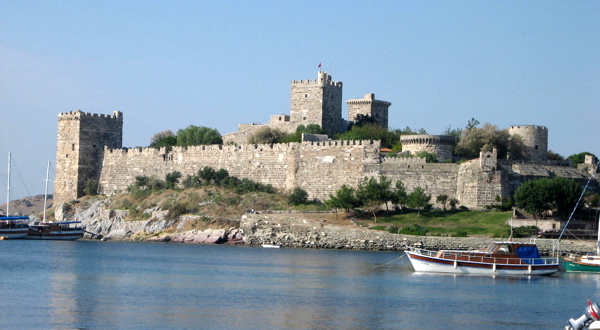
It was not until 1400 years later that a series of earthquakes throughout the 13th and 14th centuries caused the roof and colonnade to collapse. The Knights Hospitaller repurposed what remained of the marble base in 1404 for a fortress that still stands today as Bodrum Castle. Excavations in the mid-19th century retrieved sculptures and large fragments of the friezes, which can be seen today in both the British Museum and Bodrum. Yet, the legacies of the Hecatomnid dynasty, the great city of Halicarnassus, its founder, and his magnificent mausoleum are best preserved in the etymology of that unmistakable word.
What arts and culture topics would you like us to cover? Please email ideas or feedback to features@epochtimes.nyc.