SEARCH


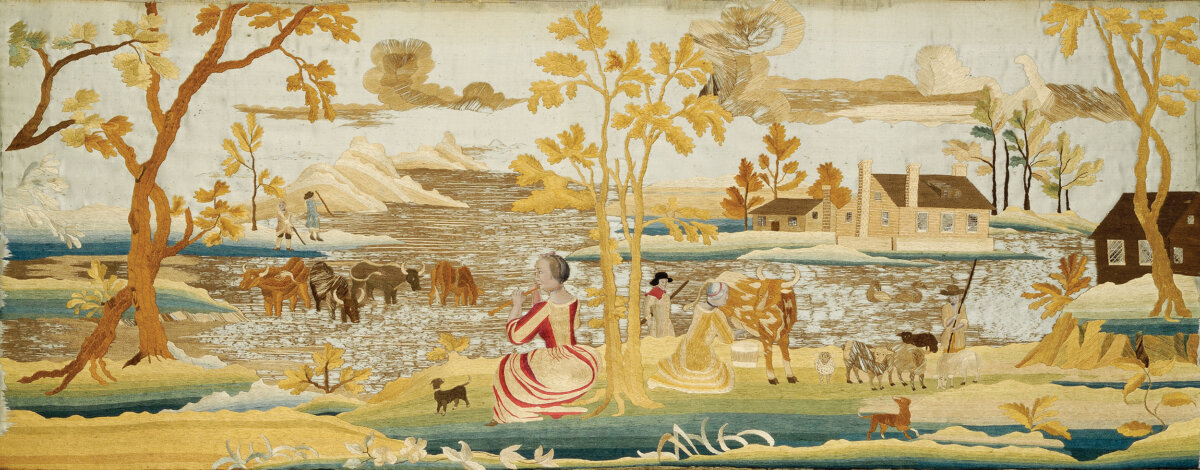
American women captured the country’s vistas long before the nation’s landscape painters. Instead of oil paints, they “painted” landscapes with threads of wool, silk, metal, and cotton.
In the 18th century, Faith Trumbull’s painterly needlework influenced her young brother, John, who became one of America’s foremost painters. According to the website Connecticut History, Trumbull said: “These [needlework] wonders were hung in my mother’s parlor, and were among the first objects that caught my infant eye. I endeavored to imitate them.”
Faith’s embroidery style harked back to British landscape embroidery. Her needlework designs also echoed elements of old-master paintings, such as the milkmaid in a 1754 overmantel embroidery, which she adapted from a 17th-century Dutch print.
Novelist Nathaniel Hawthorne wrote in “The Marble Faun: Or, The Romance of Monte Beni”:
“Women—be they of what earthly rank they may, however gifted with intellect or genius, or endowed with awful beauty—have always some little handiwork ready to fill the tiny gap of every vacant moment. A need is familiar to the fingers. … The slender thread of silk or cotton keeps them united with the small, familiar, gentle interests of life.”
Women developed nimble needlework skills throughout their lives, starting with the humble sampler. Needlework samplers marked the rites of passage from girlhood to womanhood in 18th- and 19th-century America.
From the age of 5 or 6, every girl learned basic numeracy, literacy, and embroidery stitches by creating marking samplers. These samplers included simple motifs, numbers, and two sets of the alphabet: one in uppercase block and the other in uppercase cursive. They also included the girl’s name, age, and the year of the needlework.
Many girls only ever created marking samplers, using their embroidery skills later to mark their household linen and to embellish clothes and household goods.
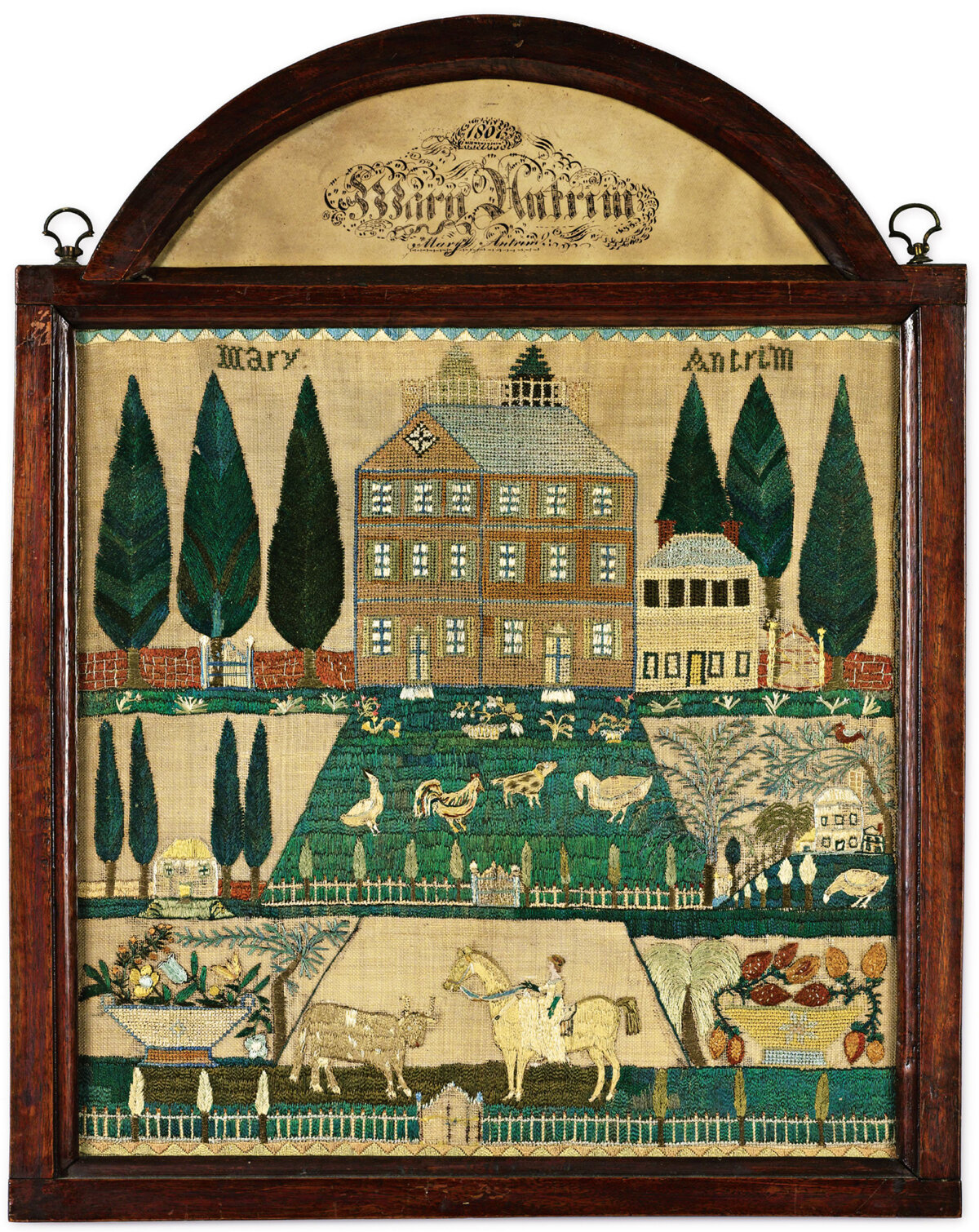
Girls from wealthy families also learned how to embroider pictorial samplers in boarding schools, where they were taught the genteel subjects of music, drawing, painting, dancing, French, and classical studies.
Pictorial Samplers
Pictorial samplers often included pastoral scenes or federal buildings with patriotic motifs, and moral and Bible verses. Aside from pretty pictures, these needlework samplers showcased a woman’s faith, virtue, and genteel education—key attributes of a good wife.
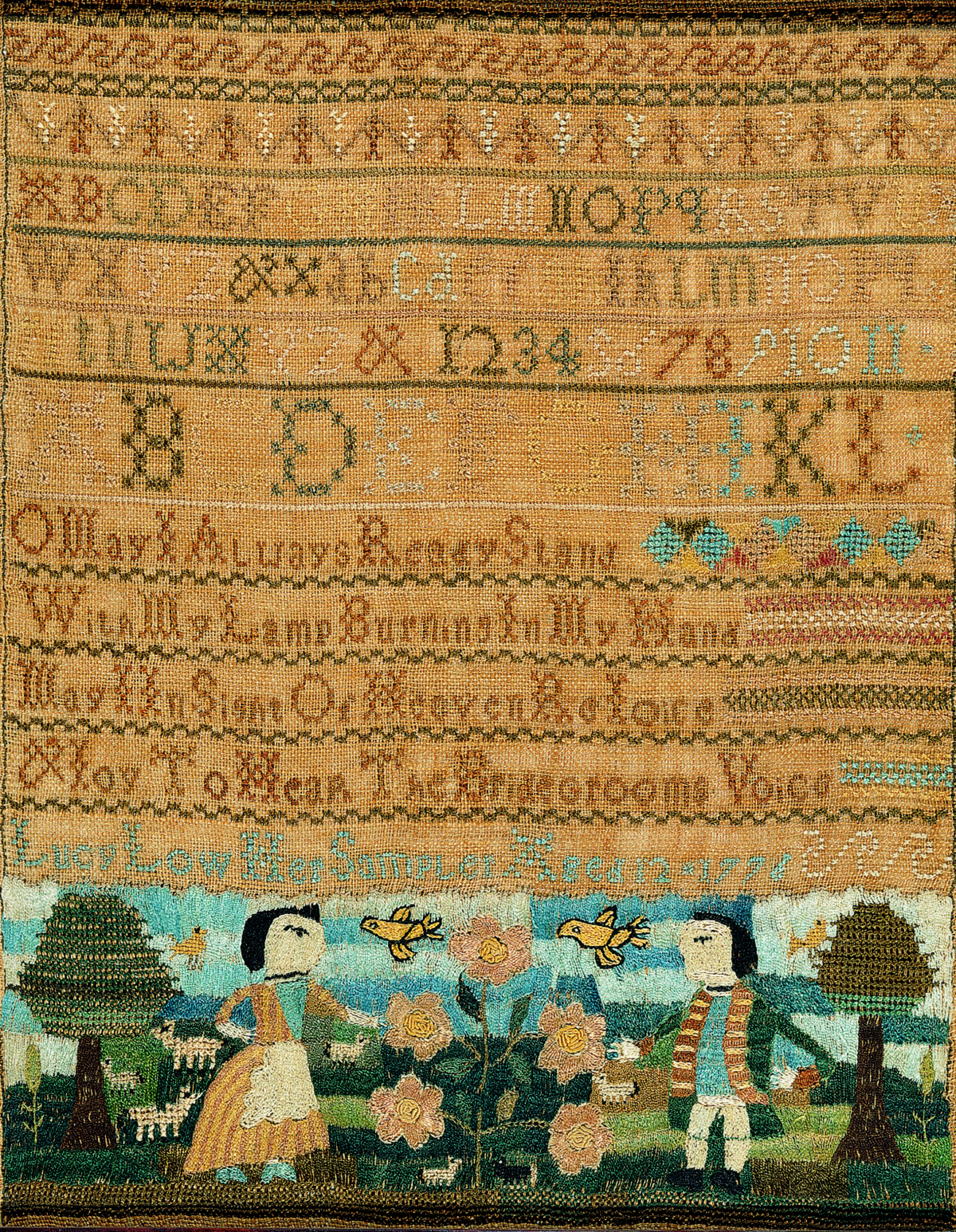
Biblical embroidery themes acted like pictorial prayers. At the bottom of 12-year-old Lucy Low’s 1776 sampler, she embroidered the Garden of Eden with Adam and Eve in contemporary clothes alongside a religious verse, implying Jesus’s marriage to the church.
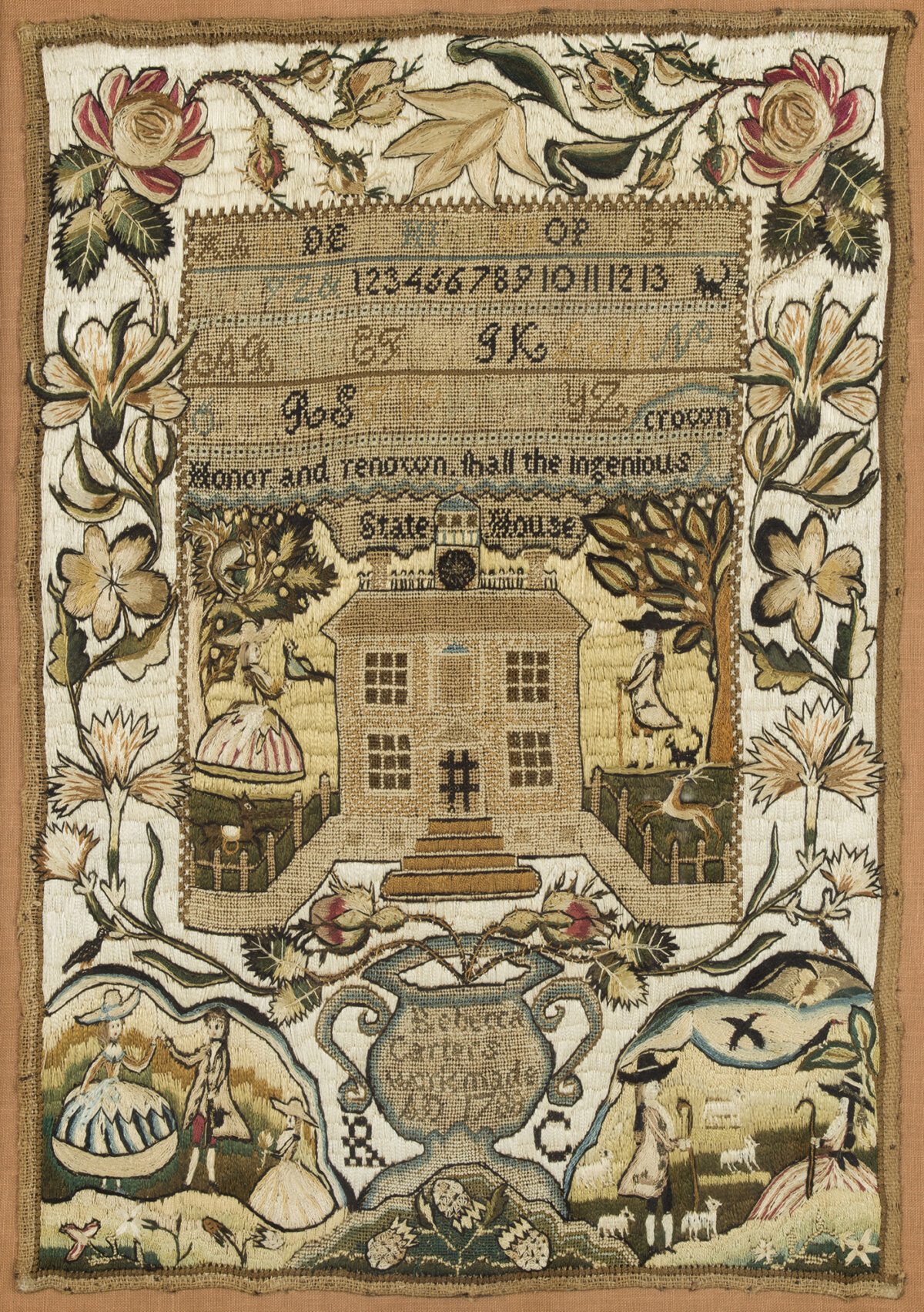
Rebecca Carter completed her sister Ann’s building sampler of the Rhode Island State House in 1788, at the celebrated Miss Mary Balch’s School in Providence. She embroidered the top four rows with uppercase block letters and cursive letters of the alphabet. Under the alphabet, she inscribed: “Honor and renown, shall the ingenious crown.” But she miscalculated the space and squeezed the word “crown” in the row above, almost crowning the word “ingenious.”
Carter rendered simplistic architectural details that aided her geometry. She embroidered a framework of flora and animals, such as a horse, deer, sheep, and squirrel. A man and woman appear in three vignettes, seemingly instilling the virtues of courtship, marriage, and family.
Painting With Needles and Threads
Pictorial needlework featured every aspect of family life, from family trees to memorials. Some needlework pledged the family’s allegiance to the fledgling republic by including portraits of George Washington or other patriotic motifs such as personifications of Liberty.
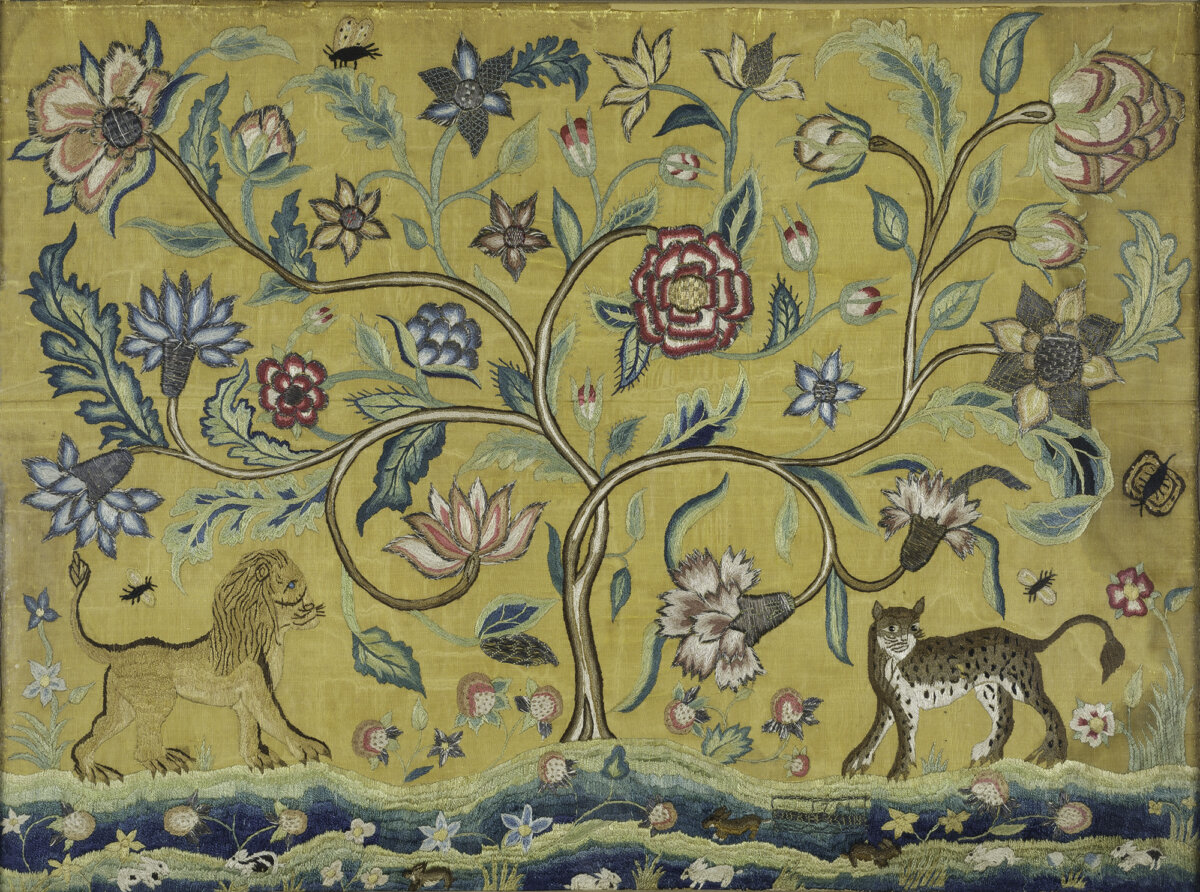
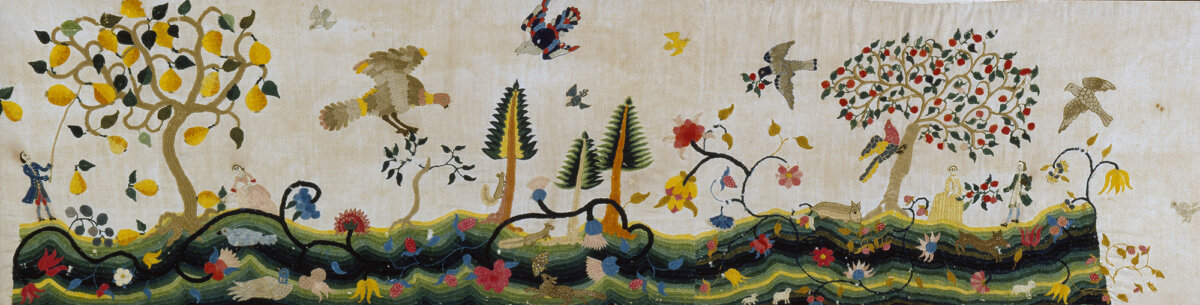
Women always embroidered these pictures with naturalistic elements, sometimes to dramatic effect. Mary King’s early 1754 “Tree of Life” needlework embraces the baroque style with animals and flourishes of flowering branches on a golden piece of silk.
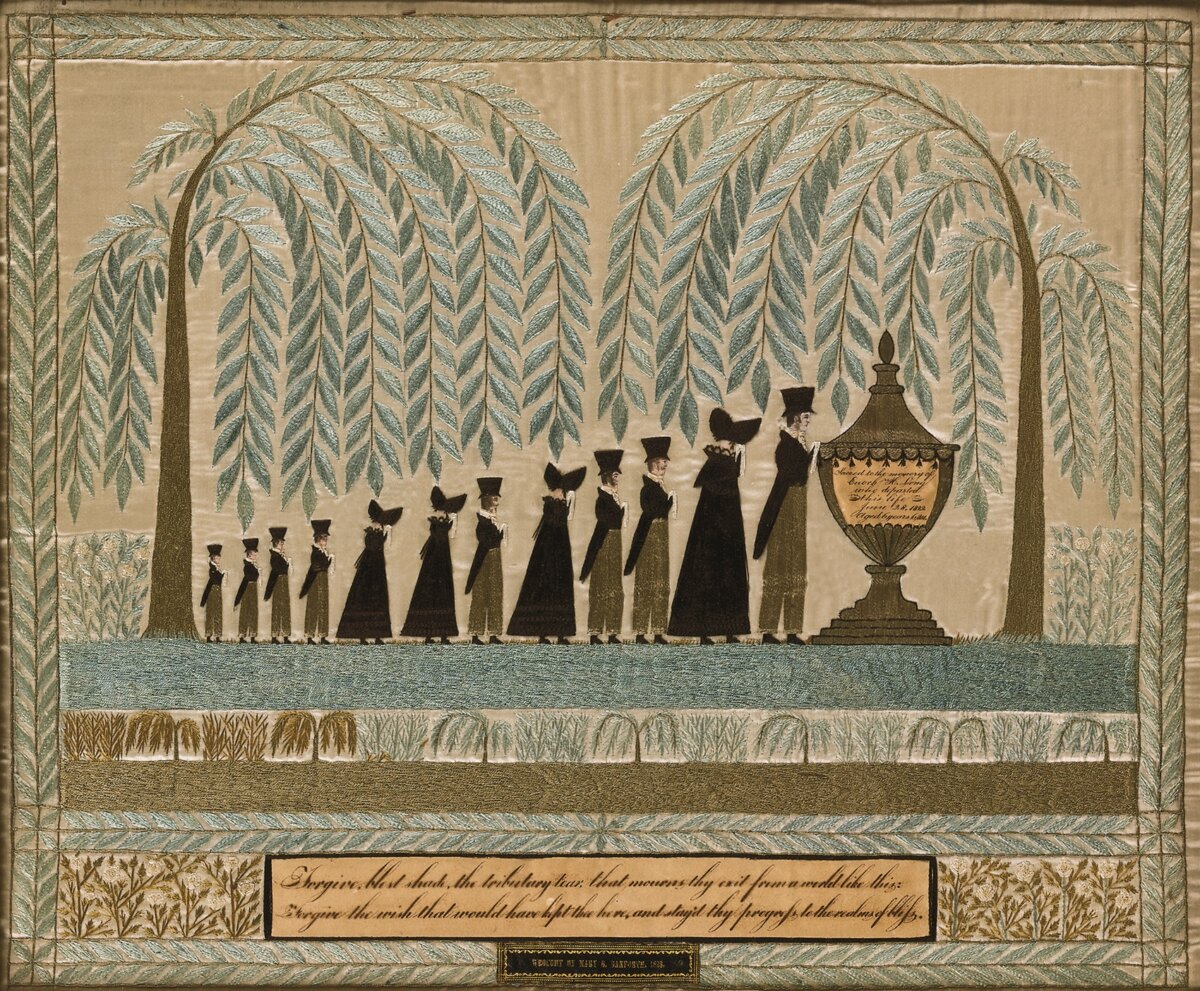
Mary Danforth embroidered a moving memorial to 6-year-old Enoch H. Long in 1823. Two overarching weeping willows highlight the somber procession of mourners, from the youngest family member to the head. An inscription states: “Forgive blest shade, the tribulatory tear, that mourns thy exit from a world like this; Forgive the wish that would have kept thee here, and stay’d thy progress to the realms of bliss.” Danforth later married into the Long family.
Liberty needlework proved popular. In processions and parades, girls and young women often dressed as personifications of Liberty bearing the U.S. flag, a cornucopia, and sometimes a watercolor portrait of Liberty. In 1808, South Hadley’s Abby Wright School student Lucinda Hudson embroidered a pastoral scene of Liberty standing under an oak tree, with a cornucopia of fruit and flowers, holding the U.S. flag as if she’d just claimed the nation.
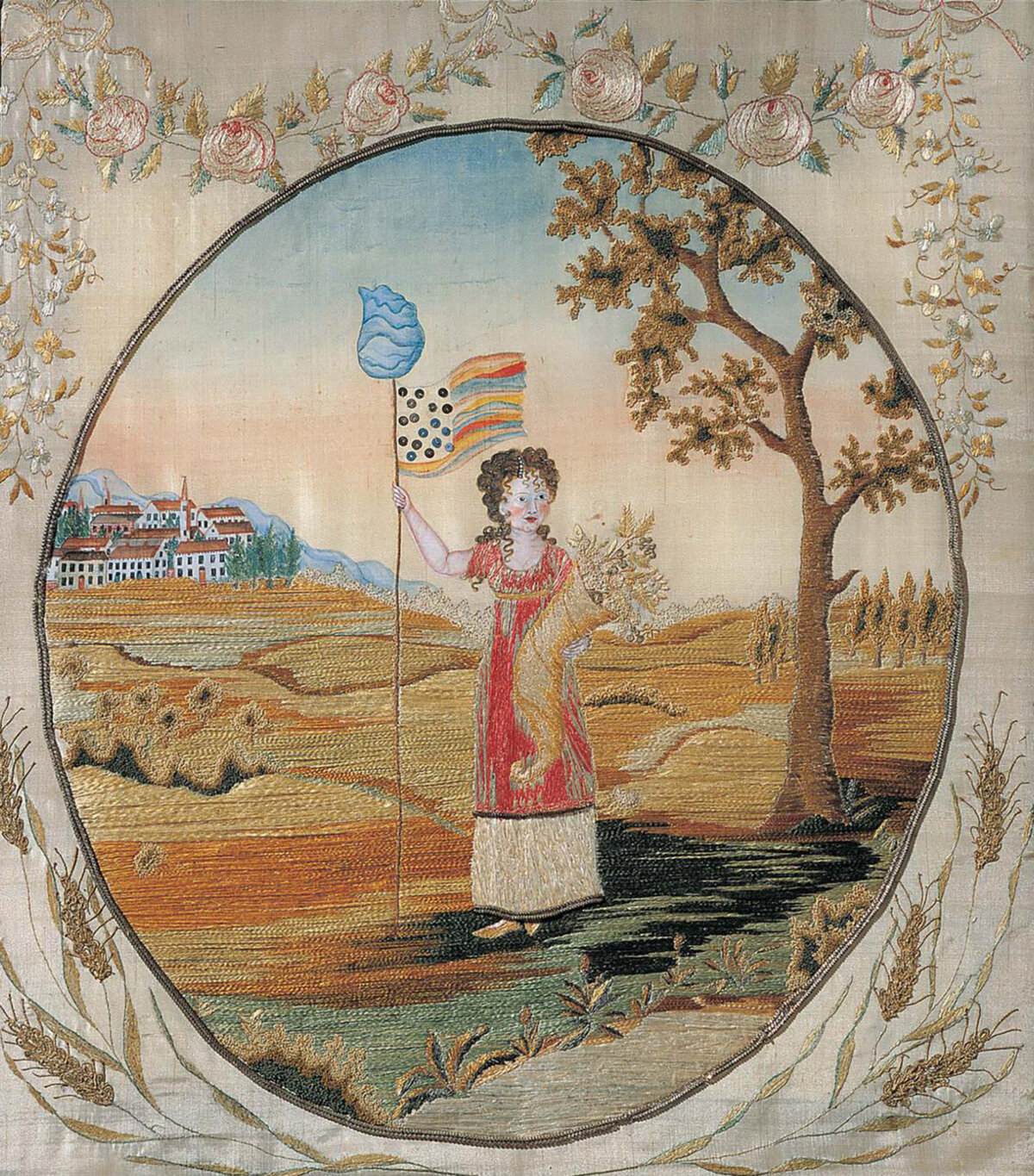
In Hudson’s design, ears of wheat and festoons of roses frame the oval composition. Gold, red, and baby blue stripes replace the flag’s traditional red and white stripes, and dark dots replace the white stars, which represent the 17 states of 1808.
The Moral Fabric of Early America
Many patriotic motifs, such as Liberty, were woven into daily life. On the Liberty bust design on nongold U.S. coins between 1795 and 1808 was American artist Gilbert Stuart’s drawing of Anne Willing Bingham. In a 1788 letter to the socialite, Thomas Jefferson wrote: “Our good ladies … They have the good sense to value domestic happiness above all other, and the art to cultivate it beyond all others. There is no part of the earth where so much of this is enjoyed as in America.”
These varied needlework designs display the sometimes basic but often deft embroidery skills of women from all walks of life. Each needlework once had pride of place in a family home; together they stand as primary visual sources of early Americans and their aspirations of domestic happiness. Remarkably, these fragile textiles survive today as testimonies to the virtues and moral fiber that make a good family and a great nation.
The needlework pieces are among nearly 100 objects, from more than 35 U.S. museums and private collections, on view at New York’s American Folk Art Museum.
“Locating Girlhood: Place and Identity in Early American ‘Schoolgirl’ Art” runs through Feb. 28, 2027. To find out more, visit FolkArtMuseum.org.
What arts and culture topics would you like us to cover? Please email ideas or feedback to features@epochtimes.nyc.