SEARCH



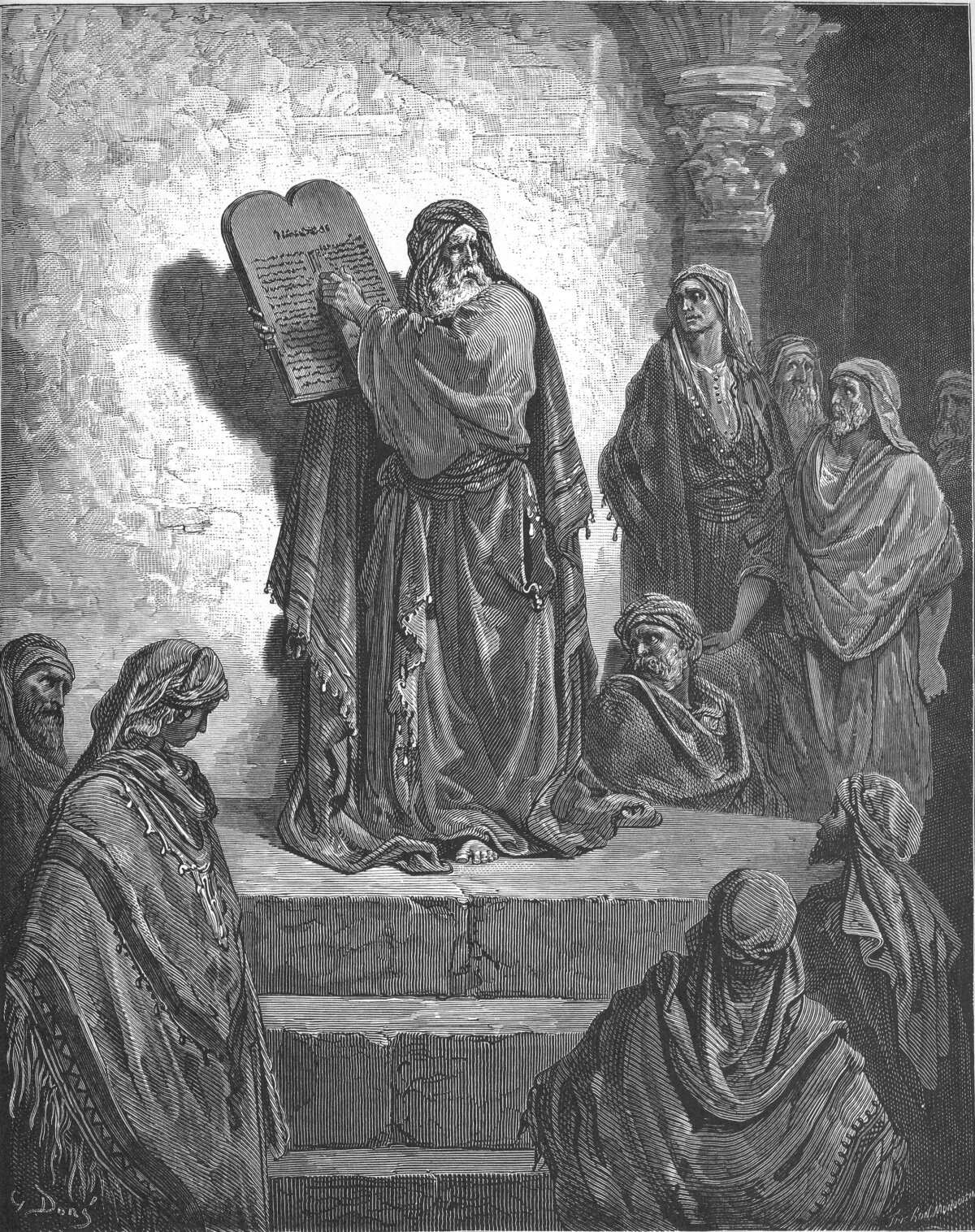
As far as the Hebrew Scriptures are concerned, their single most important human figure is surely Moses. The closing verses of the Pentateuch pronounce the final verdict: “Since that time no prophet has risen in Israel like Moses, whom the Lord knew face to face” (Deuteronomy 34:10).
Later Jewish tradition magnified him still further. As David Lyle Jeffrey observed in “A Dictionary of Biblical Tradition in English Literature,” rabbinic writings portray Moses as excelling all the other great and pious figures of Israel. He becomes almost superhuman: “half terrestrial, half celestial” and even “master of the angels.”
Yet there is a striking contrast between the greatness of the Moses whom history remembers and the unpromising man whom God encounters in the wilderness. Moses had once been raised within Pharaoh’s household, but he was now an exile and a fugitive. After killing an Egyptian who was beating a Hebrew slave, he had fled from Pharaoh into the land of Midian. There he married Zipporah and settled into an obscure existence tending his father-in-law’s sheep.
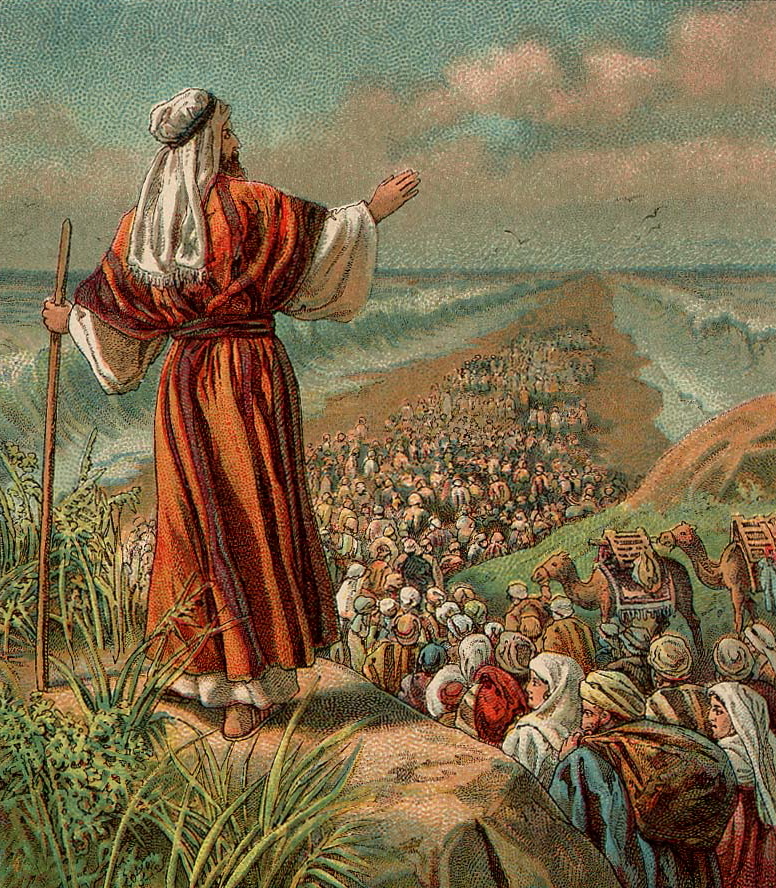
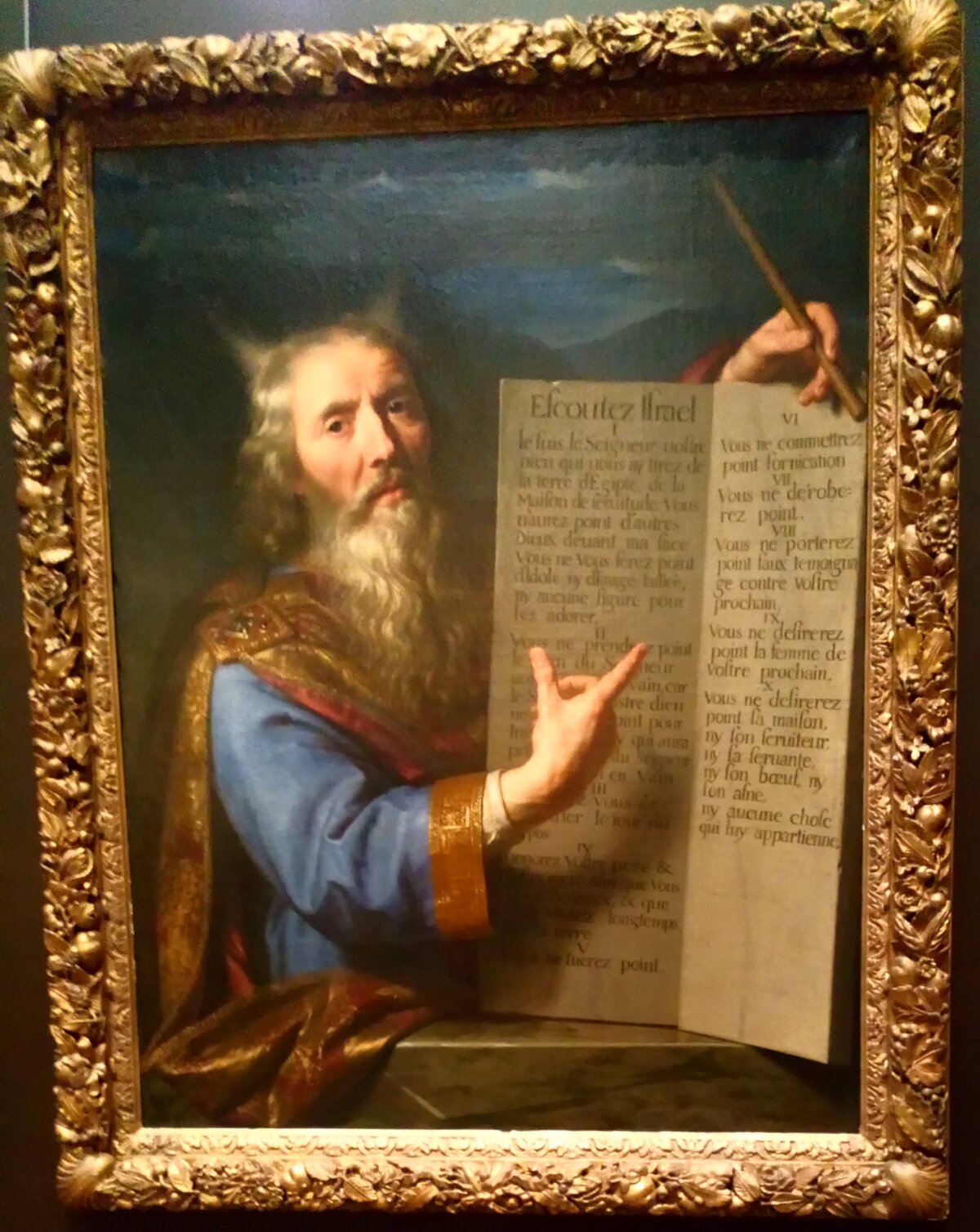
Nothing could have seemed further from political power or historical importance. The man who would confront Pharaoh, liberate Israel, divide the Red Sea, and receive the Ten Commandments was walking behind another man’s flock.
He was also, according to Numbers, “very humble, more than any man who was on the face of the earth” (Numbers 12:3). We might mischievously call him the prince of humility. Certainly, nothing in his circumstances suggested that he considered himself a prince of anything.
The Fire That Does Not Consume
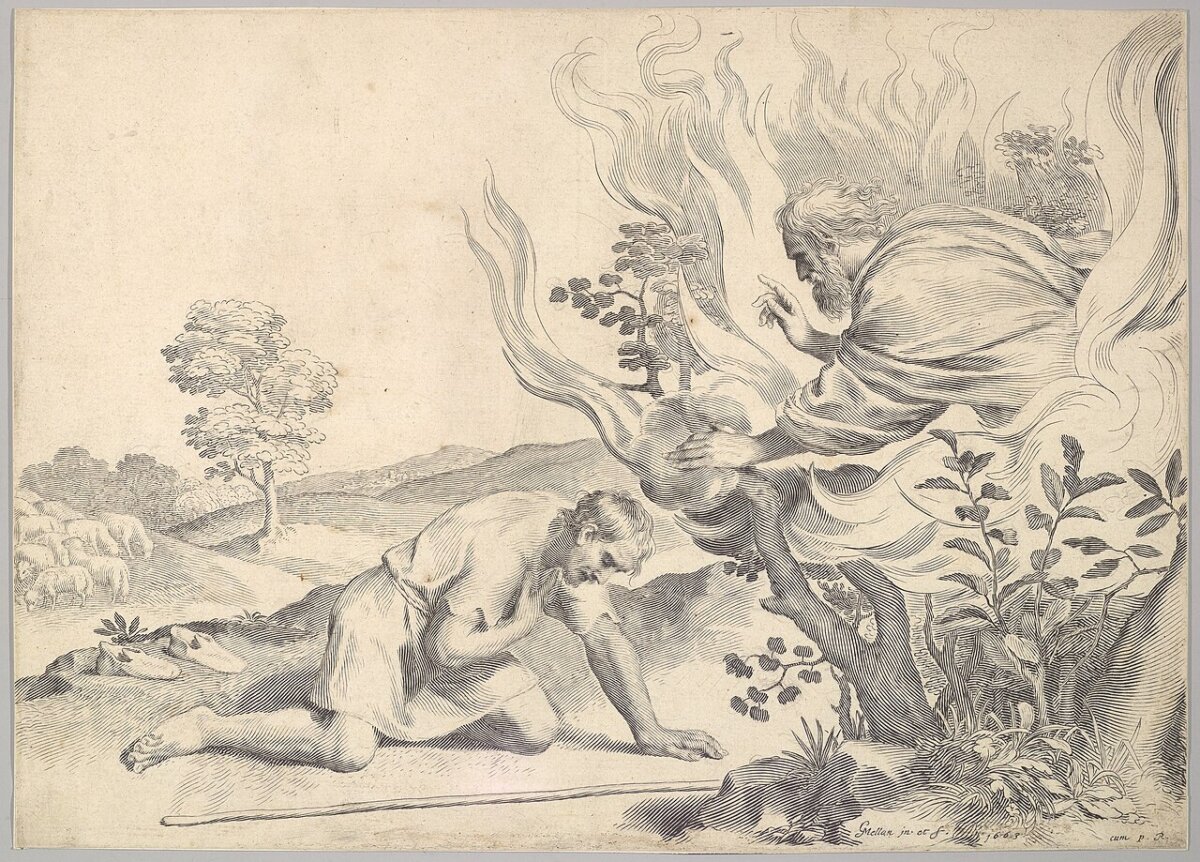
It is in this wilderness that Moses sees the sight that will transform his life: a bush burning with fire, yet remaining unconsumed. The strangeness of the phenomenon arrests him: “I must turn aside now and see this marvelous sight, why the bush is not burned up” (Exodus 3:3).
That turning aside is important, for the burning bush is present, but Moses must interrupt his ordinary activity to attend to it. The beginning of his vocation lies not in speaking, leading, or performing miracles, but in seeing—seeing something wonderful, something that the ordinary logic of nature cannot explain. The sight seizes the shepherd’s imagination and draws him beyond the boundaries of his accustomed world.
Only when God sees that Moses has turned aside does he call to him from the bush: “Moses, Moses.”
And Moses answers, “Here I am.”
The wilderness is often the place where our familiar identity is stripped from us. Moses is no longer protected by the Egyptian court, sustained by status, or surrounded by the symbols of power. He possesses neither army nor office. In worldly terms, he has become nobody—and it is precisely there that God calls him by name.
By name: The ambiguity of Moses’s name reflects the ambiguity of the man himself. He is Hebrew by birth but Egyptian by upbringing: born among the enslaved, yet raised within Pharaoh’s household.
Even his name seems to belong to both worlds. It probably contains the Egyptian “mose,” meaning “child” or “born,” clearly visible in the name of the Pharaoh Thutmose—“born of Thoth.” Yet Exodus links it with the Hebrew verb meaning “to draw out,” because Pharaoh’s daughter drew him from the water. The name becomes prophetic. Moses is himself drawn out of the Nile so that, in time, he may draw an entire people out of Egypt.
This double identity is essential to his vocation. Moses is neither wholly at home among the Egyptians nor initially accepted by the Hebrews. He belongs to both peoples and, in another sense, to neither. Yet this displacement enables him to occupy a genuinely liminal position: between Pharaoh and Israel, slavery and freedom, God and humanity. The fugitive who possesses no settled identity becomes the mediator through whom a nation discovers its identity.
Christian readers may detect a restrained parallel with Christ, whose infancy also passes between Israel and Egypt before he returns to fulfill his mission. But the correspondence need not be pressed. The deeper pattern is already complete within Moses’s own story: The deliverer must first experience exile, danger, and deliverance himself. Before Moses can lead others out, he must be drawn out himself.
This transformation begins at the bush. The bush itself provides a profound image of divine energy. It burns, yet is not destroyed. Natural fire must consume its fuel to continue burning, but this fire depends upon no earthly source. It gives light without exhausting what it inhabits. We might see in it an image of what divine vocation can be. The presence of God does not destroy the person whom it fills. Moses is not required to become somebody else; rather, he must become fully what he was created to be. True calling sets the human soul ablaze without consuming it.
Holy Ground
God then tells Moses: “Do not come near here; remove your sandals from your feet, for the place on which you are standing is holy ground.”
The removal of his sandals signifies reverence, but it may suggest something more. Shoes insulate us from the ground beneath us. They protect us, but they also prevent direct contact—contact with reality, or even with Reality itself. We might recall that the original Adam was naked and unashamed. Only after the Fall did shame make covering necessary, and civilization since then has added ever more layers—physical, social, and psychological—with which we protect ourselves from exposure.
Moses is not being commanded to return literally to Adamic nakedness, but he must relinquish one protective layer before approaching the divine presence. Before he can undertake his mission, he must encounter Reality without the customary defenses through which human beings preserve their comfort, identity, and assumptions. The man who will stand before Pharaoh must first stand barefoot before God.
Significantly, the ground was already holy. Moses had not recognized it as such. He may have passed the place many times while tending the sheep, seeing only another patch of wilderness. Divine revelation does not necessarily create the holiness; it enables us to perceive what was present all along.
This is one reason that genuine calling can be so disturbing. It changes not only our plans but also our perception. The familiar world can no longer be regarded in the familiar way.
Who Am I?
God reveals that he has heard the cry of the enslaved Israelites and has come to deliver them. Then comes the devastating sentence: “Therefore, come now, and I will send you to Pharaoh, so that you may bring My people, the sons of Israel, out of Egypt” (Exodus 3:10).
Moses responds with the question that lies at the heart of nearly every true vocation: “Who am I?”
Who is this fugitive shepherd to appear before the king of Egypt? Who is this killer to become a lawgiver? Who is this displaced man to create a nation? Who is this hesitant speaker to become Israel’s supreme prophet?
God does not answer (as perhaps a modern leadership training course might advocate!) by praising Moses’s talents. He does not remind him of his aristocratic upbringing, his knowledge of Egypt, or his latent leadership abilities. He says simply, “Certainly I will be with you.”
This is the decisive answer. Moses has asked the wrong question. The success of the mission will not finally depend upon who Moses is, but upon who will accompany him. As I observed in my article on classical wisdom in stories, this is also the choice of Arjuna: whether to possess the armies or the divine presence.
Nevertheless, Moses continues to resist. What name shall he give when the Israelites ask who has sent him? What if they do not believe him? What if they refuse to listen? He protests that he is “slow of speech and slow of tongue.” Finally, having exhausted his specific objections, he pleads: “Please, Lord, now send the message by whomever You will”—which is a reverential way of saying, “Please send somebody else!”
Here is the psychology of resistance in all its recognizable humanity. The ego rarely rejects vocation outright at first. It manufactures practical objections. We lack authority. People will not believe us. We do not possess the necessary gifts. Someone else would be better qualified. Some objections may even be true. Moses may indeed have suffered from some impediment of speech. But calling is not the discovery that we are already perfectly equipped for a task. More often, it is the discovery that the task will require us to become more than we presently are. In short, vocation—especially when it is divinely sanctioned—is never only about who we are in the present, but who we are to become.
The Name Beyond Names
When Moses asks who is sending him, God replies, “I am who I am.”
This mysterious name cannot be reduced to an ordinary definition. Human names distinguish one being from another, but God cannot be contained within a category. He is not merely one being among many, but the source and ground of being itself. Or, put another way, God does not “exist” as an object among other objects; he is existence itself. The holy name also implies that God is uncaused: He is the cause of everything, but himself remains uncaused. Here is a conception of divinity radically different from the named deities of the ancient Near East—Marduk, Baal, or Astarte, the goddess often associated with the title “Queen of Heaven.”
Moses wants a name he can carry as a credential. Instead, he receives a revelation. This is perhaps even more incredible—more awe-inspiring—than the burning bush itself. Before Moses receives the law, before the plagues, the Passover, and the crossing of the Red Sea, there is an encounter with divine presence. The lawgiver must first meet the source of the law. The prophet must first hear the voice he will later proclaim.
Horace Bushnell expressed this distinction memorably: “God is the prime necessity of all religious virtue. The necessity is constituent, not penal.”
God is not merely an external judge who attaches punishments to wrongdoing. The divine presence constitutes religious character from within.
“Religious character is God in the soul,” Bushnell said.
This is precisely what the burning bush reveals. The fire comes before the commandments. Presence precedes law.
The subsequent greatness of Moses can make us forget the fearful, reluctant man at the beginning. He would become judge, lawgiver, liberator, and the greatest of Israel’s prophets. He would confront Pharaoh, endure the complaints of his own people, and even offer to have his name blotted from God’s book rather than abandon sinful Israel (Exodus 32:32). But none of that was visible when he stood barefoot before the bush.
Our true calling may frighten us because it exposes the distance between who we currently are and who we must become. Like Moses, we ask, “Who am I?” We list our limitations and imagine that inadequacy disqualifies us. The answer from the fire is not that our weaknesses are imaginary. It is that they are not decisive.
“Certainly I will be with you.”
And with that promise, the fugitive begins his journey toward becoming Moses.
The Bible quotations are from the New American Standard Bible.
What arts and culture topics would you like us to cover? Please email ideas or feedback to features@epochtimes.nyc.