SEARCH



Among self-evident truths and unalienable rights listed in the American Declaration of Independence is the “pursuit of Happiness.” But to the Founders, freedom or independence doesn’t involve some hedonistic hunt to possess happiness as one would pursue and possess some once-in-a-lifetime treasure or asset.
It’s the everyday practice of happiness as one would cultivate a lifelong conscious state of being, like love or hope. That spirit shines through in Chris Gardner’s fearless, deliberate cultivation of competence, confidence, resilience, sacrifice, and excellence, fictionalized in this film based on a true story.
‘The Pursuit of Happyness’
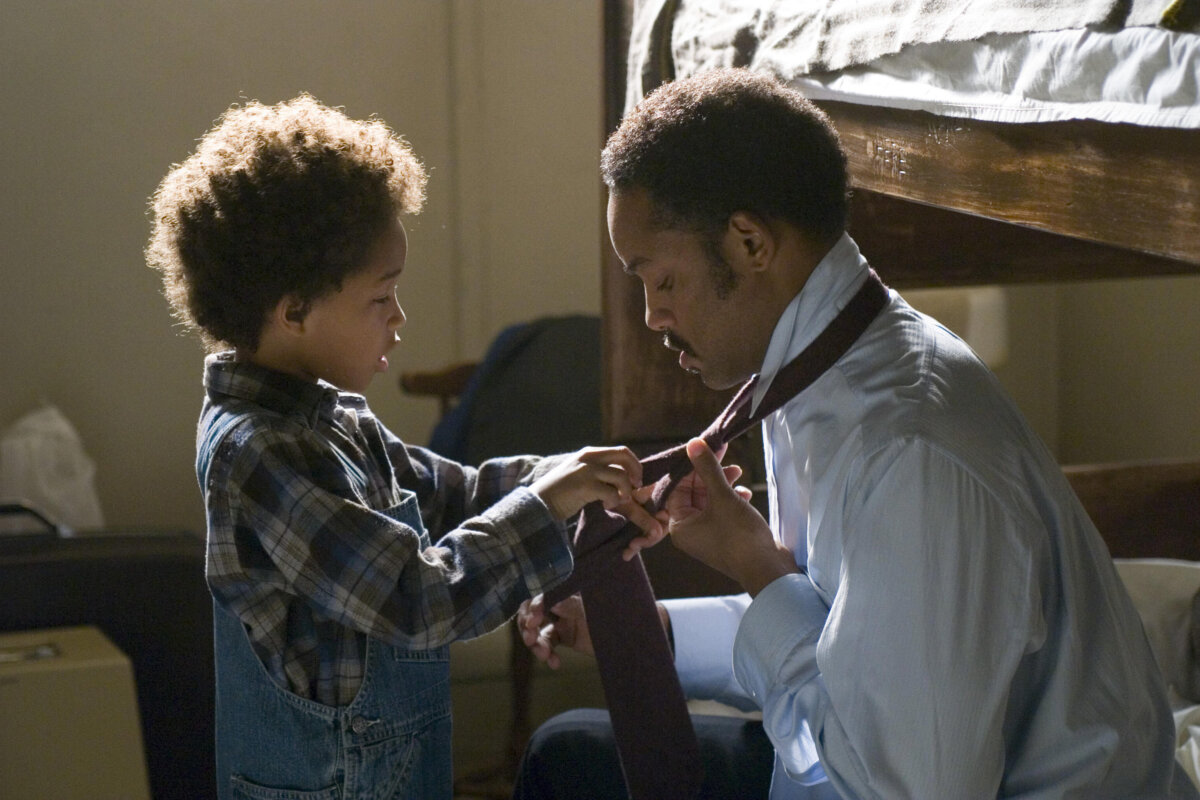
In the film, Chris’s (Will Smith) bitter separation from his disrespectful and irate wife, Linda (Thandiwe Newton), renders him a single parent to his 5-year-old son, Christopher Jr. (Jaden Smith).
In a brutal 1980s job and housing market, Chris pumps his savings into selling bone-density scanners to pay the bills. He puts Christopher in daycare, while dreaming of becoming a stockbroker. His situation worsens when he and his son become homeless.
That’s his ticket out of poverty, into prosperity, and maybe even happiness. Chris’s way with numbers and the Rubik’s Cube land him an internship at a stock brokerage firm. But that isn’t success; it’s merely a shot at it. He must do in six hours a day what other interns can afford to in nine.
Rubik’s Cube
Considered a frivolous pastime, the Rubik’s Cube is a metaphor for life’s seemingly insurmountable, ever-shifting complexities and challenges. Tackling them requires carving each problem into its smallest components.
Chris compartmentalizes his life’s tasks and troubles so rigorously that he sees only one tiny colored subcube at a time; he’s better able to unite it with its adjacent subcubes. To each face of the six-face cube, he brings such intensity and focus that he knows when the whole cube is disturbed and what he needs to do to lend it harmony. He recognizes that even one subcube out of place jeopardizes the whole.
Linda may seem incidental to this story. She’s far from it, representing the no less important flipside of the coin. She complains that she’s been handed a raw deal, that too much is being asked of her, and that her suffering is inherited, unique, and somehow worse than what others face.
But here, Chris and Linda both face suffering. Chris sees it as a problem to be solved, and an opportunity to learn and grow. He sees it as a kind of test and shrugs it off with sheer grit. Linda sees it as a punishment and is doubly bruised by it.

Linda figures that she’s doing more than what’s required of her; Chris, less than what’s required of him. So, nothing he does is ever good enough. Left to his own devices, Chris keeps asking himself what he can be doing more or better, to improve his lot.
Excellence is not a hobby; it’s a habit. Linda can’t find it in her to strive harder for her husband’s happiness or her son’s. She believes she has barely enough energy to secure hers. Chris gives up considerable short-term ease and happiness to secure both in the long term for himself and his son.

Responsibility
Like the Founders, the real Gardner, who appears fleetingly in the film, knows that freedom doesn’t just include responsibility; it’s founded on it. He doesn’t get to live the good life without working hard and paying his bills, taxes, Christopher’s education fees, and parking tickets.
The opening scene shows little Christopher having to take several strides just to keep up with one of his father’s. That captures Chris’s vision of work ethic. The first steps in any endeavor are always going to seem tiny, too many, hurried, and even hopeless. But as he builds competence, then confidence, those same strides, given time and practice, cover greater ground with ease.
Chris realizes that he can’t get Christopher to be responsible and caring if he isn’t so himself. It’s not that he doesn’t make mistakes; it’s that he learns from them and moves heaven and earth to not repeat them. Importantly, he doesn’t allow circumstances to dictate his self-worth. Success doesn’t flow from what he’s given but from what he makes of what he’s given.
In interviews, Gardner admits that if he’d let his environment shape him, he’d have become another “alcoholic, wife-beating, child-abusing, illiterate loser.” Instead, he let the fine values acquired in childhood shape his adult choices and habits, and, eventually, his environment.
These reflective articles may interest parents, caretakers, or educators of teenagers and young adults, seeking great movies to watch together or recommend. They’re about films that, when viewed thoughtfully, nudge young people to be better versions of themselves.
Check the Internet Movie Database website for plot summary, cast, reviews, and ratings.
You can watch “The Pursuit of Happyness” on Prime Video, Apple TV, and Spectrum.
What arts and culture topics would you like us to cover? Please email ideas or feedback to features@epochtimes.nyc