
Southeast Asian nations and China will carry negotiations on rules for the disputed South China Sea into 2027, leaving an agreement they had aimed to complete this year unfinished despite reaching a provisional agreement on about 80 percent of its draft.
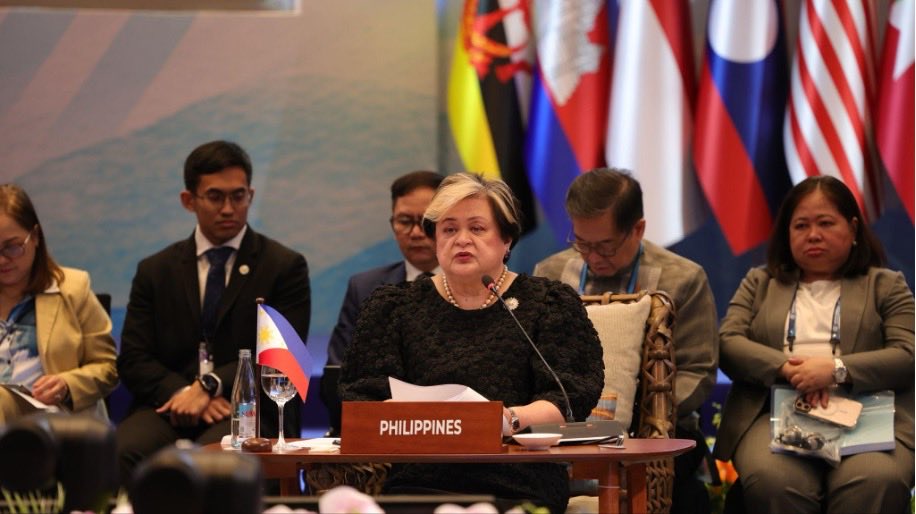
Philippine Foreign Secretary Theresa Lazaro confirmed the outcome on Nov. 15 during a regional summit in Manila. Talks will continue under the chairmanship of Singapore, which takes over the rotating chairmanship of the Association of Southeast Asian Nations (ASEAN) next year.
The proposed Code of Conduct is intended to establish rules for behavior at sea and help prevent dangerous encounters in waters where Beijing’s sweeping maritime claims overlap with those of the Philippines and other Southeast Asian countries.
On Sept. 24, eight Chinese navy and coast guard vessels interfered with a Philippine mission to resupply troops stationed at Second Thomas Shoal, forcing Manila to suspend the operation because of safety concerns. The incident followed a July confrontation near the same shoal in which a Philippine sailor were injured, according to Manila.
The September encounter also disrupted a provisional arrangement reached by Manila and Beijing in 2024 to avoid confrontations during resupply missions.
Talks Continue Past Target
ASEAN and China adopted guidelines in 2023 setting a goal of concluding negotiations within three years. ASEAN foreign ministers reaffirmed the 2026 target in January.
Under the Philippines’ chairmanship, negotiators held nine rounds of talks and two senior officials’ meetings in 2026.
The Philippine statement described the negotiations as substantially complete. However, the about 80 percent figure refers to paragraphs that have received provisional agreement, not a finalized code.
Major questions remain unresolved, including which areas of the South China Sea the code would cover, how certain terms would be defined, and whether the agreement would be legally binding, according to Lazaro.
At a Nov. 15 press briefing, Lazaro said some ASEAN members were concerned about the legal implications of a binding agreement, particularly the requirement for domestic ratification. The parties have agreed to continue negotiations but have not set a new completion deadline.
Chinese Foreign Minister Wang Yi had expressed confidence in reaching an agreement. In March, Wang noted all relevant parties wanted to complete negotiations in 2026 and that China was confident it could “bridge differences” and reach an agreement “as soon as possible.”
He also urged the Philippines, as ASEAN chair, to “resist the pull of self-interest” and play a “positive role for peace and stability in the region.”
Rules for Conduct, Not Ownership
One issue on which negotiators reached provisional agreement was how the proposed code would relate to a declaration ASEAN and China adopted in 2002.
Under that understanding, the earlier declaration would provide the foundation for the new code, which would establish more detailed rules governing conduct at sea.
The code would also serve as a framework for voluntary maritime cooperation, but would not settle competing territorial or maritime claims.
In 2016, an international arbitration tribunal ruled that China’s claims to historic rights over resources across much of the South China Sea exceeded what is permitted under the United Nations Convention on the Law of the Sea. Beijing rejected the ruling. The tribunal did not decide which country owns the disputed islands.
The negotiations also concern the rights of countries outside ASEAN and China, including the United States, whose military and commercial vessels operate in the waterway.
In its Nov. 15 statement, the Philippine chair said the eventual code must not diminish the rights and obligations of any country concerning the South China Sea, including countries that are not parties to the agreement.
The statement also reaffirmed the parties’ commitment to freedom of navigation and overflight—the rights of ships and aircraft to travel through areas where international law permits—and to preventing and managing incidents at sea.