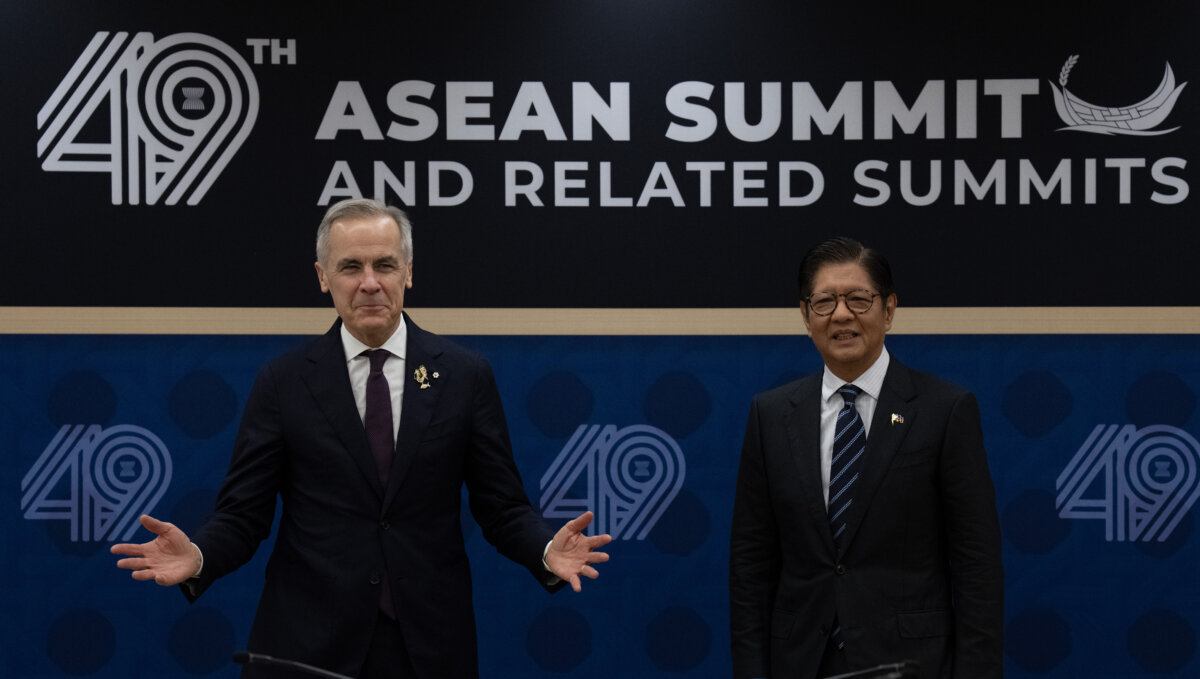

Prime Minister Mark Carney and his Philippine counterpart concluded talks for a free-trade agreement in Manila, with the deal expected to be formally signed next year.
The news came on the sidelines of the Association of Southeast Asian Nations summit, which Philippine President Ferdinand Marcos Jr. is hosting in Manila.
“This is good news for Canadians in the agriculture sector, in the aerospace sector, even in AI,” Carney said at a news conference, saying forestry, mining and energy sectors would benefit from the deal.
“In each of these sectors, Canadian supply is meeting Philippine demand. And with our agreement, our producers (and) our companies have a bigger competitive advantage.”
Marco and Carney signed a document that formally ends negotiations for the Philippines-Canada Free Trade Agreement, which had started just over a year ago. Ottawa aims to have the actual deal signed next year.
The event took place Saturday in Manila’s time zone, which was Friday evening in Canada.
“A ship that stays in the harbour is safe, but that’s not what a ship is for. And it takes a leader to take the ship out of the harbour into choppy waters and reach a destination,” Carney told Marcos. “In terms of our relationship, you’ve been able to do that.”
Carney’s office said in a news release the agreement with the Philippines could increase exports by up to three times by 2035 and boost Canadian exports of agriculture and forest products.
The prime minister also announced $26 million to strengthen ties between the two countries on nuclear security and safety, climate-resilient agriculture, community resilience and food security and infrastructure.
His office said there’s also agreement to launch formal discussions on security, a possible agreement on customs and “the protection of sensitive information.”
Canada is also extending its dark-vessel detection program, which uses satellites to detect and track fishing boats that have turned off location-transmitting devices. The extension doubles the program’s initial five-year period, with its end now slated for spring 2033.
Carney’s office said his visit coincides with various investments on Canadian drone and ocean technologies, as well as renewable energy projects for Philippine industries and data centres.
The ASEAN summit involves 20 heads of government, including guests from outside the region such as U.S. President Donald Trump and Brazilian President Luiz Inacio Lula da Silva.
Southeast Asia is one of the world’s fastest growing economic regions and the ASEAN bloc includes nearly 700 million people.
Canada is also pursuing a broader trade agreement with the ASEAN bloc, which includes the Philippines and 10 other countries such as Thailand.
Carney said the ASEAN deal would give access to smaller markets that Canada doesn’t already have trade agreements with, while also easing trade in goods that are produced across regional borders.
Ottawa says trade between Canada and ASEAN countries amounted to $52.3 billion last year, a fifth larger than the previous year. The group is key to Carney’s goal of doubling exports to countries other than the U.S. by 2035.
Vina Nadjibulla, co-founder of the Centre for Strategic Statecraft, said the ASEAN summit—along with two others in the region this week—is a chance for Carney to reinforce the importance of Asia to Canadians.
“So much of his diplomacy over the last few months has been focused on Europe, understandably so. But we also need to remind everyone that Canada is a Pacific nation, we have an Indo-Pacific strategy, and the region is really critical to Canada’s prosperity,” she said.
Carney signed a trade deal with Indonesia last autumn. This summer, he signed a strategic partnership agreement with the Philippines. It called for more labour mobility and climate resilience projects between Canada and the Philippines, a country with more than 110 million people.
In 2025, bilateral merchandise trade between the two countries totalled $3.4 billion, with Canada exporting mineral ores, meat, cereals, fertilizers and aircraft, while importing cooking oils, leather and rubber products from the Philippines.
Canada and the Philippines have been in talks on a bilateral trade deal since 2015. Carney and Marcos restarted those efforts a year ago.
During consultations, corporations were broadly supportive of the deal to increase trade, but civil society raised concerns about the Philippines’ track record on the environment, labour and human rights.
The trade deals stem from the Indo-Pacific strategy the government released four years ago.
Foreign Affairs Minister Anita Anand said a year ago that she had asked her officials to update the strategy to better align with Carney’s priorities, such as doubling non-U.S. exports by 2035 and making Canada an energy superpower.
Queen’s University professor Stéphanie Martel, who studies ASEAN and international diplomacy, said Carney has a narrower policy approach to the region than his predecessor Justin Trudeau, who she said tended to offer “lofty, general commitments.”
Carney has focused on strategic sectors, she said, particularly trade and military collaboration—such as naval exercises in the Taiwan Strait and efforts to help countries like the Philippines detect Chinese boats used in territorial disputes.
Canada also has appointed a defence attaché for the Indo-Pacific region who has one of the highest military ranks.