SEARCH


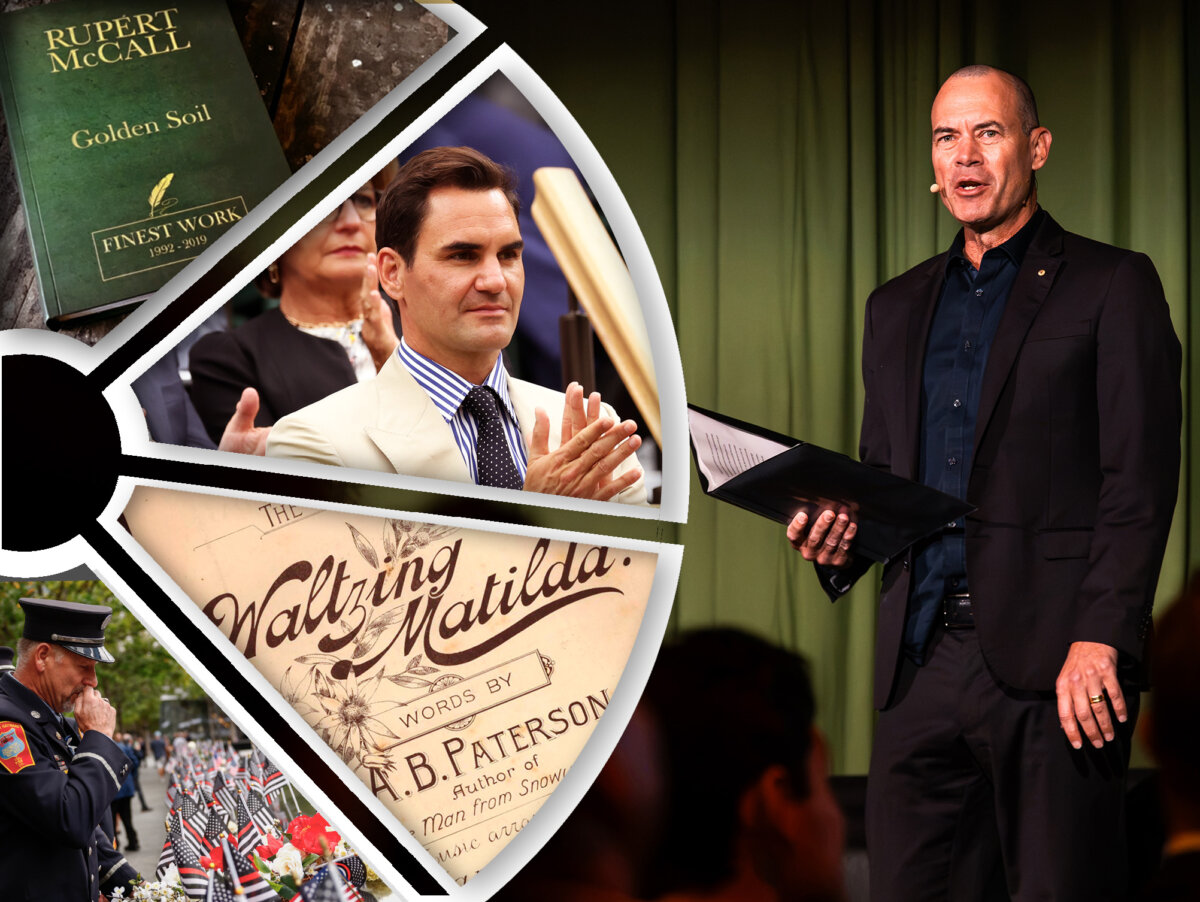
As the final notes of Amazing Grace faded, Australian poet Rupert McCall walked onstage to deliver his second tribute to the victims of Sept. 11.
With the Hudson River and Statue of Liberty behind him, McCall recited “A Firefighter’s Dream,” a poem shaped by the distinctly Australian tradition of bush poetry, which has its roots more than 200 years ago.
It was another step in an artistic journey that has taken him from writing odes to local sporting heroes in Queensland to performing to some of the world’s most recognisable figures, like tennis champions Roger Federer and Andre Agassi, as well as Microsoft co-founder Bill Gates.
Bush poetry, with its plain-speaking language, strong rhythms, and vivid storytelling, may be out of favour with literary and academic circles. Yet McCall’s journey suggests its appeal is far from confined, and that sometimes it’s the most traditional art forms that can cross oceans, cultures, and generations.
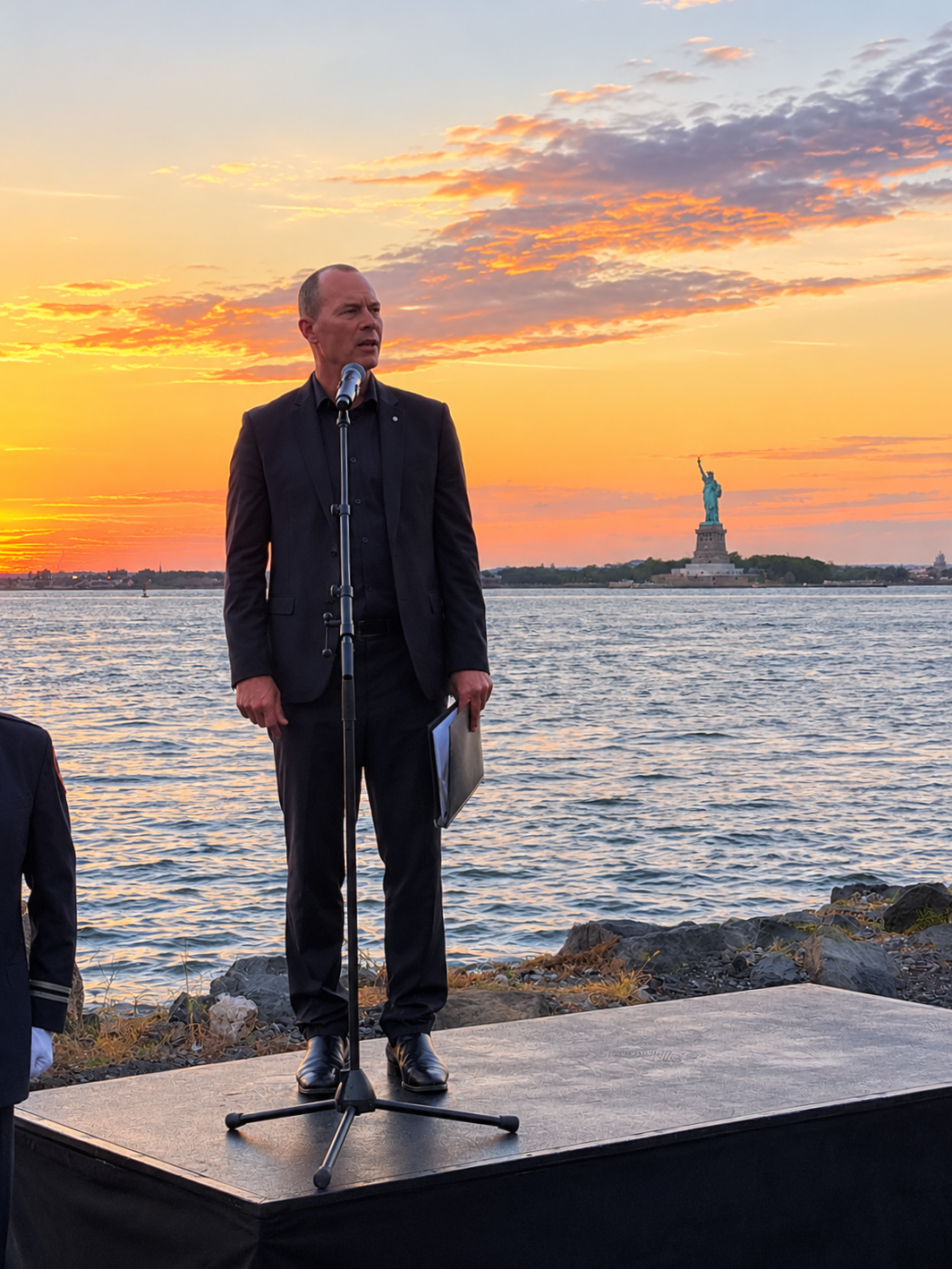 Australian “bush poet” Rupert McCall reciting his composition “A Firefighter’s Dream” next to the Hudson River with the Statue of Liberty in the background in New York City on Sept. 11, 2026. (Courtesy of Rupert McCall)
A Collision of ‘Wonderful Forces’
The Epoch Times interviewed McCall in Paddington, Brisbane, a leafy suburb known for its sweeping hillscape and Queenslander architecture.
Curiously, McCall is not the only major export from the area.
Global cartoon sensation “Bluey” also hails from Paddington and is now the most streamed program in the United States.
While McCall’s journey has been more understated, it’s no less impressive, starting from a small peninsula to Brisbane’s north called Redcliffe—a one-time home for the Bee Gees and named literally for the red hue of its cliff faces.
“We had parent-teacher night [at primary school], and every grade had to put on some kind of performance for the parents, and my grade five teacher was a fan of Australian poetry,” McCall said.
That was his introduction to Australia’s Banjo Paterson (1864–1941), a national figure who epitomised the “bush poetry” style and whose works “Waltzing Matilda” and “A Man from Snowy River” shaped the nation’s identity.
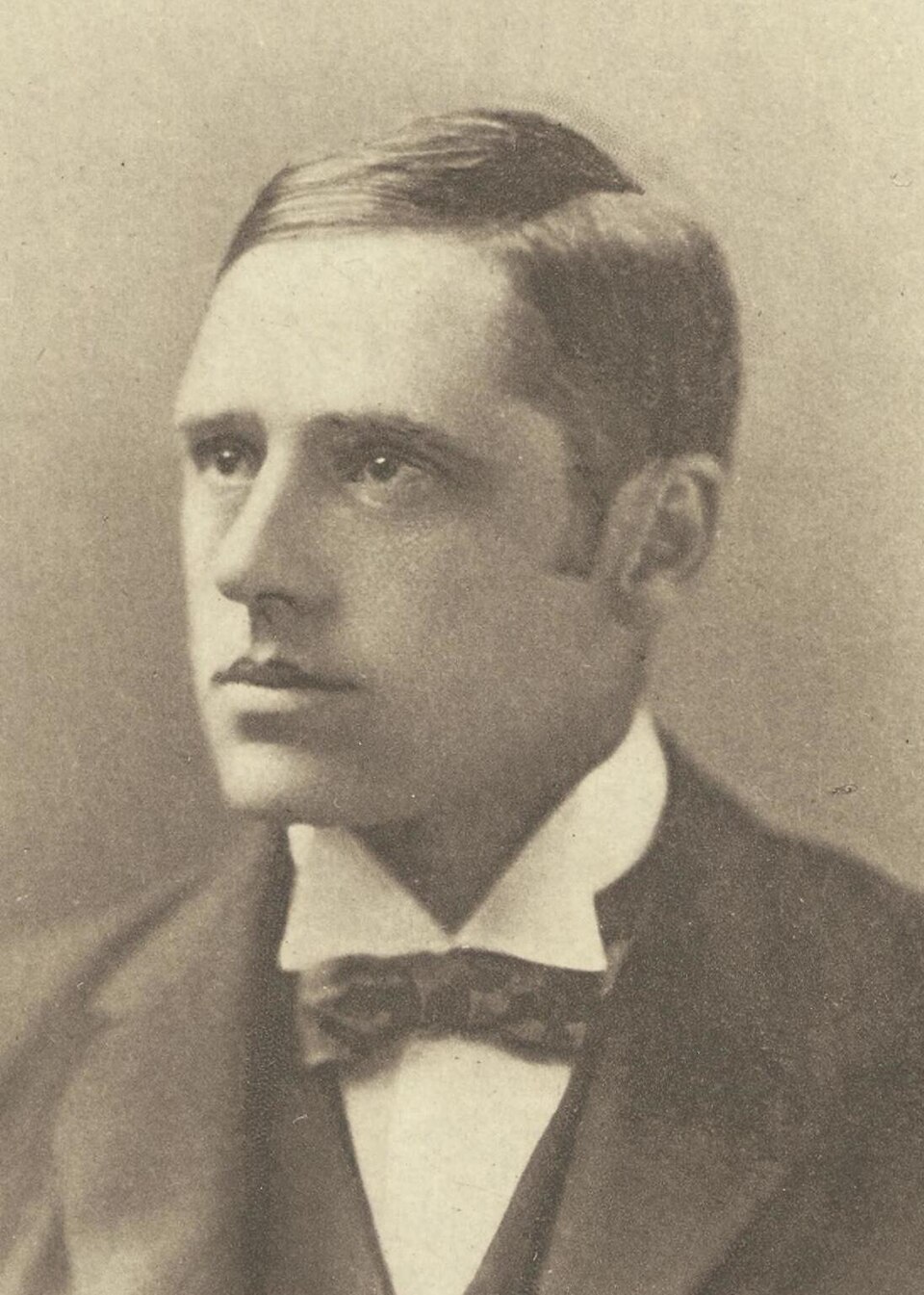 Portrait of Andrew “Banjo” Paterson taken around 1890. (Public Domain/Courtesy of the National Library of Australia)
“It was smart, and it preserved the emotions, characters, and the qualities of Australia back then,” the poet says of Paterson’s works.
Yet Paterson wasn’t the only source of inspiration to strike the young McCall in 1980, who called that moment of time a “collision of wonderful forces.”
“When I was introduced to Banjo Paterson, something else happened just down the road [at Lang Park in Brisbane], and that was Arthur Beetson captaining Queensland in the first State of Origin game,” McCall said, regarding the literal birth of Australia’s greatest sporting rivalry.
“That combination was really a part of my destiny, and so that’s where it all began.”
To further cement this “destiny,” McCall made the inspired decision at the age of 23—one of many throughout his poetic journey—to quit his family law career and embark on writing traditional bush poetry full time, a decision he said left his parents questioning his sanity.
A Purveyor of Sporting Folklore
McCall’s résumé steadily grew as the years passed, composing and reciting for sporting icons like the Queensland Maroons, the Australian Wallabies, the Melbourne Cup, racehorses like Winx, and cricketing legend Shane Warne.
He never drew from taxpayer-funded grants either, making a living from private events and corporate work, while managing to support four children through private school—a decision he does not regret, McCall says.
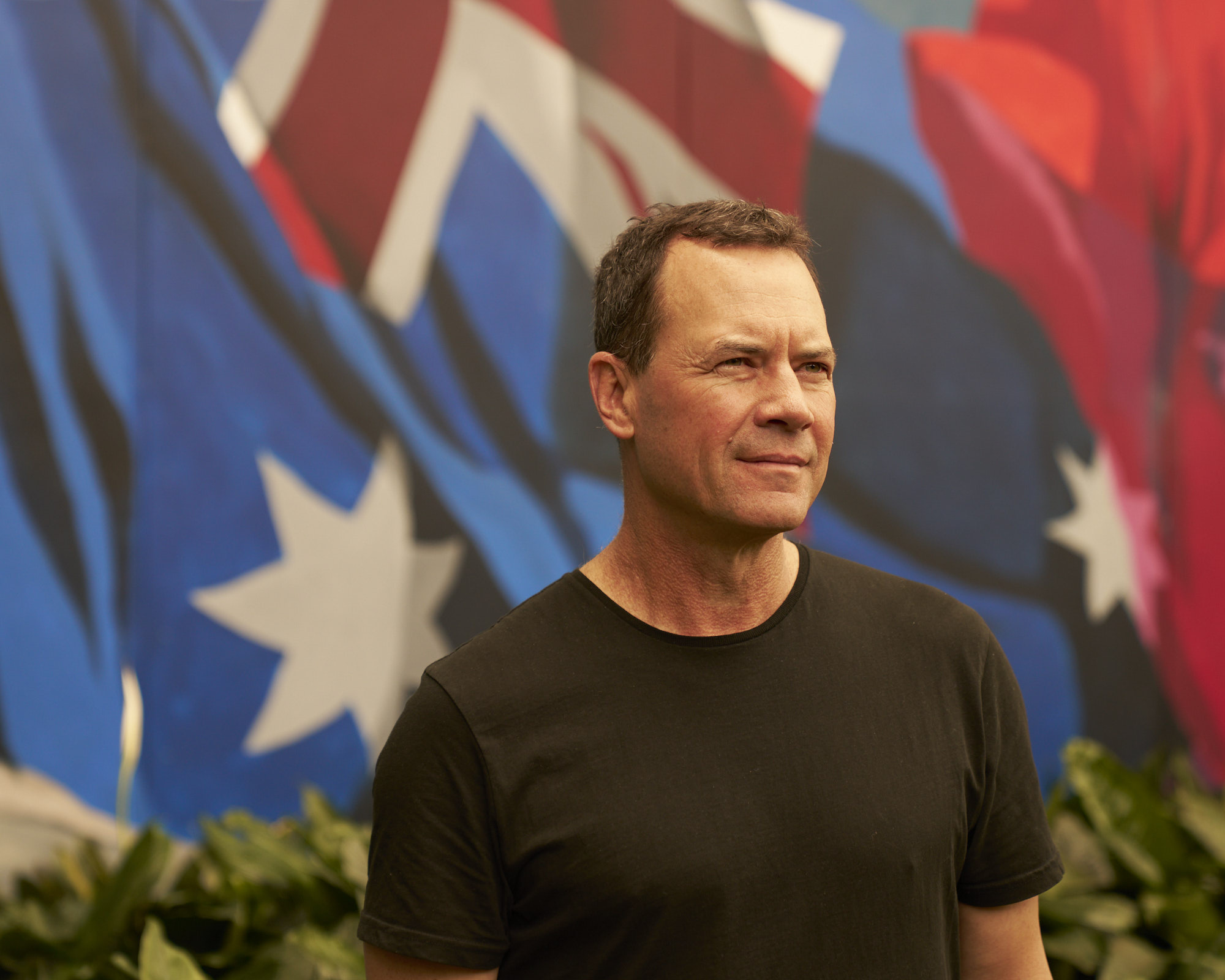 A photo of Australian poet Rupert McCall in front of the national flag taken in 2024. (Courtesy of Rupert McCall)
McCall will meet with the person commissioning his work to understand the story, before taking it home to ruminate on.
“It’s like a jigsaw puzzle on steroids,” McCall said. “You throw all the pieces on the table and stare at them for a long time, and hope that you can just get the first two corner pieces in, and then once you’ve broken through that you want to get on a roll and ride that wave of creativity.”
One particularly challenging moment was writing “The Masterpiece” for tennis legends Federer and Australia’s Rod Laver at the Brisbane International tournament.
“It was like the proverbial kid in the lolly shop. That was the Holy Grail for sporting tributes,” McCall said. At first, he was only supposed to write about the Fed Express, but organisers soon threw a spanner into the creative works.
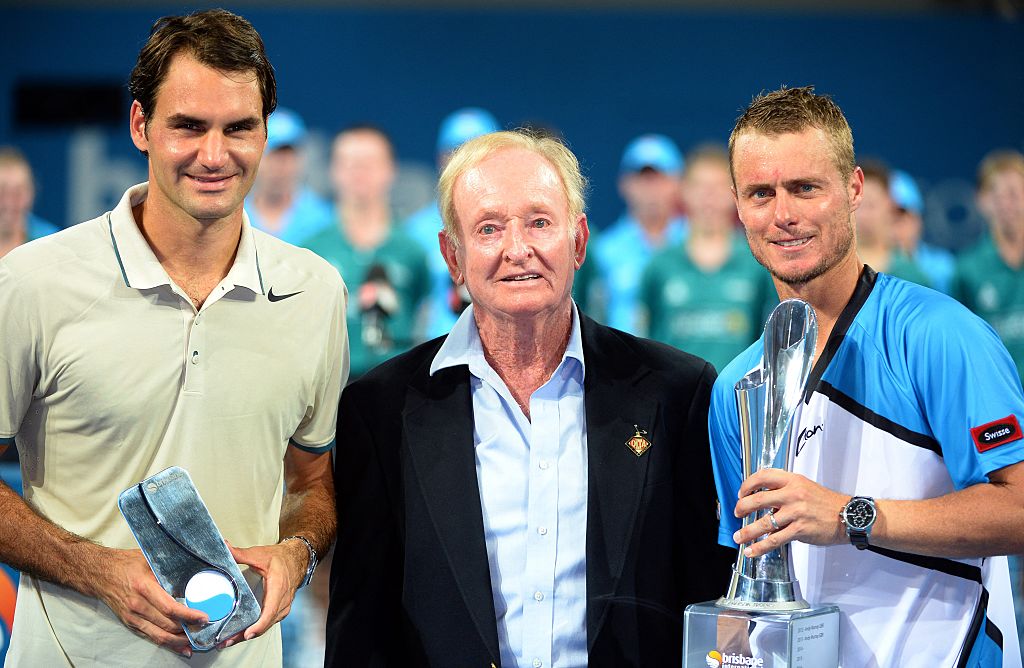 Lleyton Hewitt of Australia (R) poses with Australian tennis legend Rod Laver (C) after defeating Roger Federer of Switzerland (L) in the men’s final at the Brisbane International tennis tournament, in Brisbane, Australia on Jan. 5, 2014. (William West/AFP via Getty Images)
McCall was left to work out how to weave the stories of two tennis titans into one poem.
“And I had this lightbulb moment … an imaginary tennis match called ‘The Masterpiece’ played between two champions from two different eras,” McCall says.
“Roger Federer takes on Rod Laver on a cloud where the gods of tennis preside, and so that was my idea, and it worked,” the poet said. “And the most rewarding moment was bringing Roger to tears invoking that emotion.”
Incidentally, in the crowd was Darren Cahill, a former Australian tennis player and now-coach, who would recommend McCall to tennis legend Agassi.
This would lead to McCall being offered a chance to perform at Indian Wells in front of a large crowd that included business luminaries Gates, Greg Renker, and Dennis Washington.
McCall remembers Gates tapping him on the shoulder afterwards asking how he managed to recite his poems from memory.
“That was a real spin out,” McCall remarks.
The Audience in the ‘Palm of Your Hand’
While writing presents its challenges, reciting can be its own art.
“I don’t take it lightly … it’s a responsibility that goes with that,” McCall said. “You feel this massive weight, and it’s scary. It’s frightening how nervous you can be at times, mostly before you take the stage.”
He’s speaking about his recital of “90 Years Ago” at the Anzac Dawn Service at Anzac Cove in Gallipoli, Turkey in 2005.
“I felt like something warmed my blood at Anzac Cove. I like to think it’s my grandfather, who was a ‘Rat of Tobruk’ in World War II, just calming me down, giving me a sense of perspective … So when I stood up, my blood was warm.”
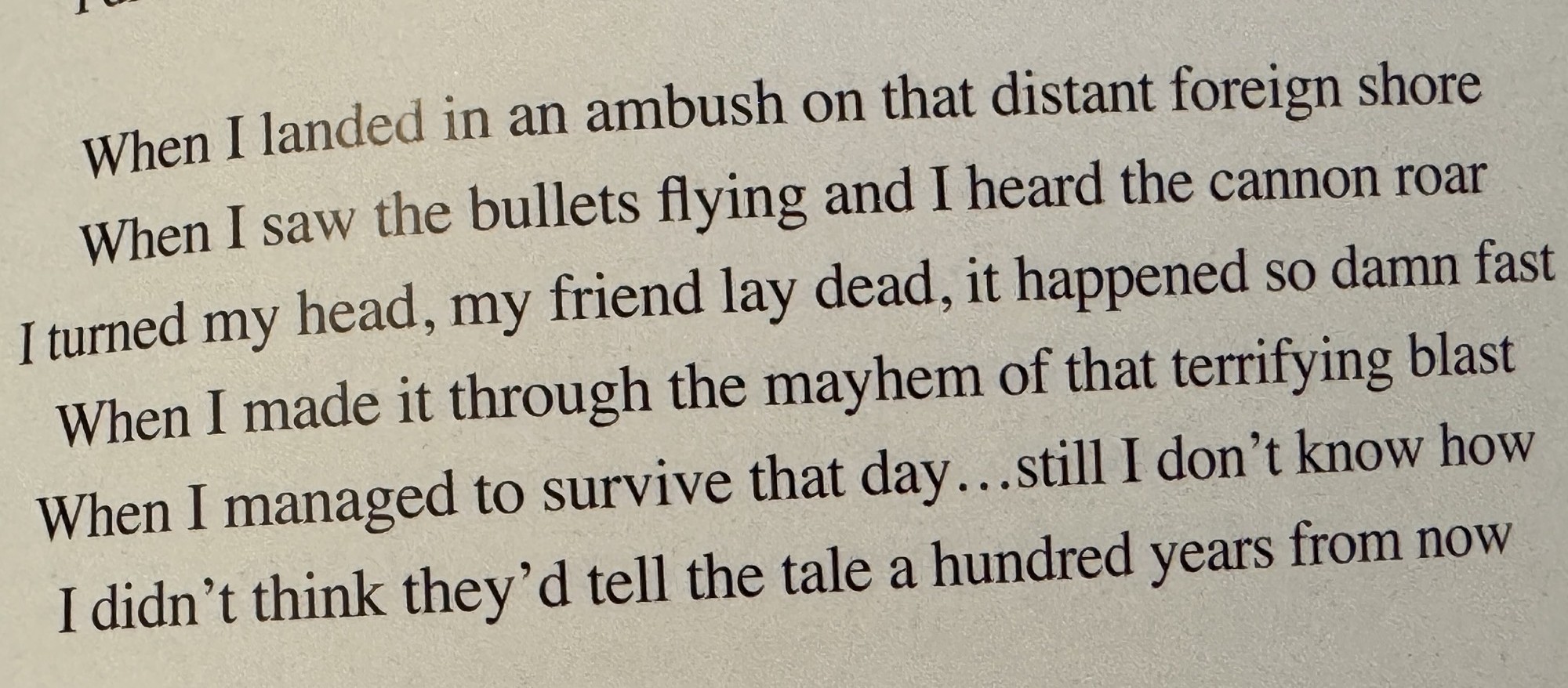 A passage from Rupert McCall’s “A Hundred Years From Now,” written to commemorate the ANZACs and published in his anthology Golden Soil. (Daniel Y. Teng/The Epoch Times)
“You feel the audience in the palm of your hand. You can pause and feel the audience breathe in, and then continue with the ride that you know you’re taking them on,” McCall.
Serendipity From Sydney to LA to NY
On two occasions McCall has performed “A Firefighter’s Dream” at Ground Zero to commemorate the near-3,000 Americans killed during Sept. 11.
Like so many moments in McCall’s career, that opportunity came from an unexpected series of encounters.
He first performed the poem in 2010 in Sydney at the send-off for a group of Australian firefighters embarking on a charitable run from Los Angeles to New York, called the “Tour of Duty.”
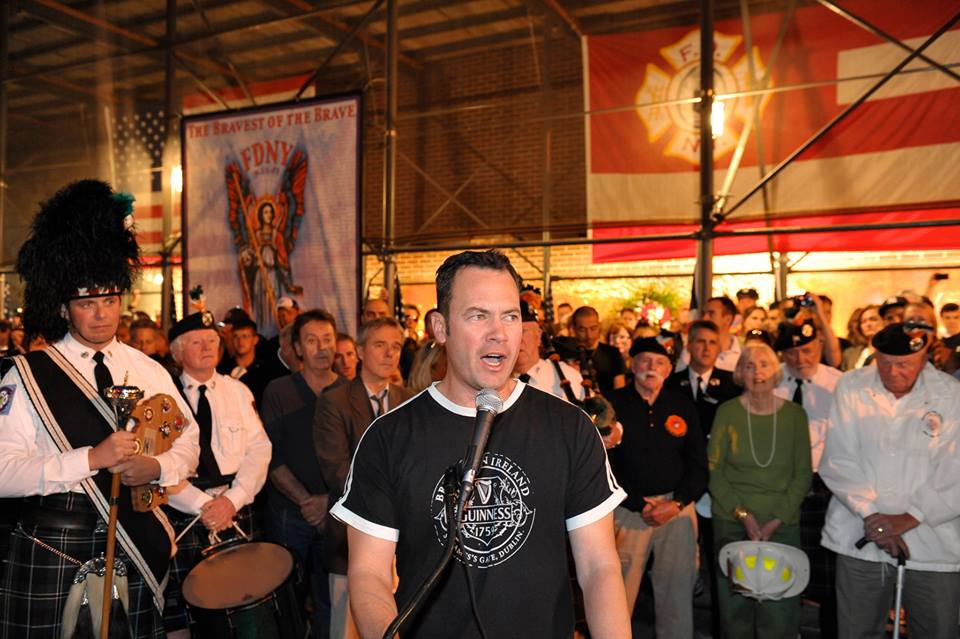 Australian poet Rupert McCall delivering his poem, A Firefigher’s Dream, at Ground Zero in New York City on Sept. 11, 2010. (Courtesy of Rupert McCall)
“They had an official reception in the Australian consulate in Los Angeles with the American firefighters. They played a recording of my poem, and you know, I will never forget it, I get a phone call from Liam Flaherty,” he said.
McCall says he answered while driving and nearly “ran off the road.”
Flaherty is captain of the Fire Department of New York’s Rescue Company 2, and he personally invited McCall to perform at the ninth year anniversary of 9/11 in 2010. McCall would perform again this year at the 25th anniversary.
Flaherty’s response to the work was beyond flattering.
“In the years since 9/11, I have witnessed speeches, songs, poems, and sermons from poets, priests, and politicians alike. I have literally heard it all. Rupert’s piece was head and shoulders above all of that,” Flaherty wrote in a glowing recommendation.
“I could not believe that a person half a world away—someone I had never met—could strike a chord so closely with our experience in New York.”
Far Flung From Poetic Circles
Despite McCall’s successes, Australia’s bush poetry tradition occupies a small space in the modern literary scene.
In 2027, Australia will soon appoint its first Poet Laureate, in the same vein as the United States and UK.
McCall reveals his application was “knocked out at the first hurdle.”
“I guess there is a prevailing style of poetry favoured by the the academics and perhaps it’s a bit more abstract?” McCall said. “I think perhaps that world doesn’t let me in too often.”
Modern poetic forms emphasise experimental structures, irregular rhythms, and a lack of rhyming. They also seek to “challenge the viewer”—an ideology that underpins other 20th-century movements like the French New Wave, where film directors like François Truffaut use jarring editing techniques and nonsensical plot lines.
McCall’s disconnect from academic or critic circles is not isolated with painters like Gordon Hanley and the former head of Opera Australia Lyndon Terracini pointing to how divorced arts funding bodies have become from traditional artists.
“Most artists believe there’s a serious problem with Creative Australia—that specific agendas are being funded above what many people would consider genuine art,” Terracini told The Epoch Times previously. “And once things become ideologically or gender driven—that’s not what art is about.”
In addition, Hanley warns arts movements derived from strong left-wing or Marxist ideology now rule the roost.
“Starting in the early 1900s, before photography more or less took over, the neo-Marxists gained control of the universities and this gives rise to postmodernism. This is a belief that there is no objective truth,” Hanley previously told The Epoch Times.
“If you’re an up-and-coming artist and you want a career, then you’re not going to hit the kind of monetary return for your work that, say, an artist my age does,” Hanley says.
“So they chase a grant, but to get a grant, what have you got to do? Well, produce the government-approved work. Then, if you have a firm left-wing or socialist-leaning government in, you can just imagine what the ideology is.”
The decades-long process of distorting traditional arts forms is outlined in The Epoch Times’ series, The Spectre of Communism.
On a more personal note, McCall says his lack of connection with the literary world could be partly attributed to making a commercial career out of poetry, as well as a historical precedent of poets becoming famous only after they die.
“There’s this notion that the artist or the poet should not be prospering from the corporate world. [But] I’ve had to survive with a family of four children, and so I don’t take any shame, whatsoever, in being a poet who could connect with lots of different audiences,” McCall said.
“It’s the journey that I embarked upon and I wouldn’t swap it. I have no regrets for the way that I’ve been able to embark upon this adventure.”
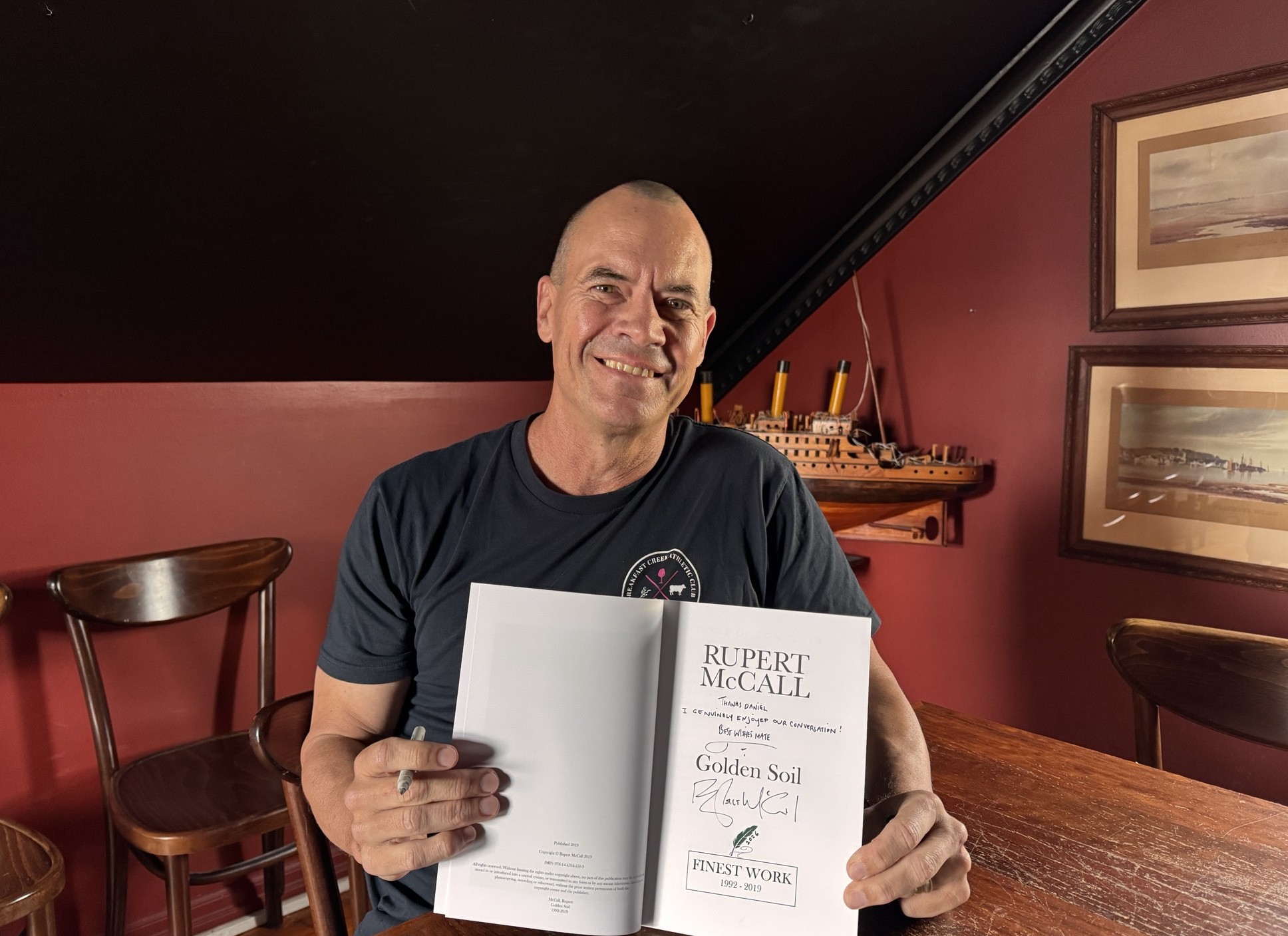 Australian poet Rupert McCall in Paddington, Brisbane of Australia on Oct. 15, 2026. (Daniel Y. Teng/The Epoch Times)