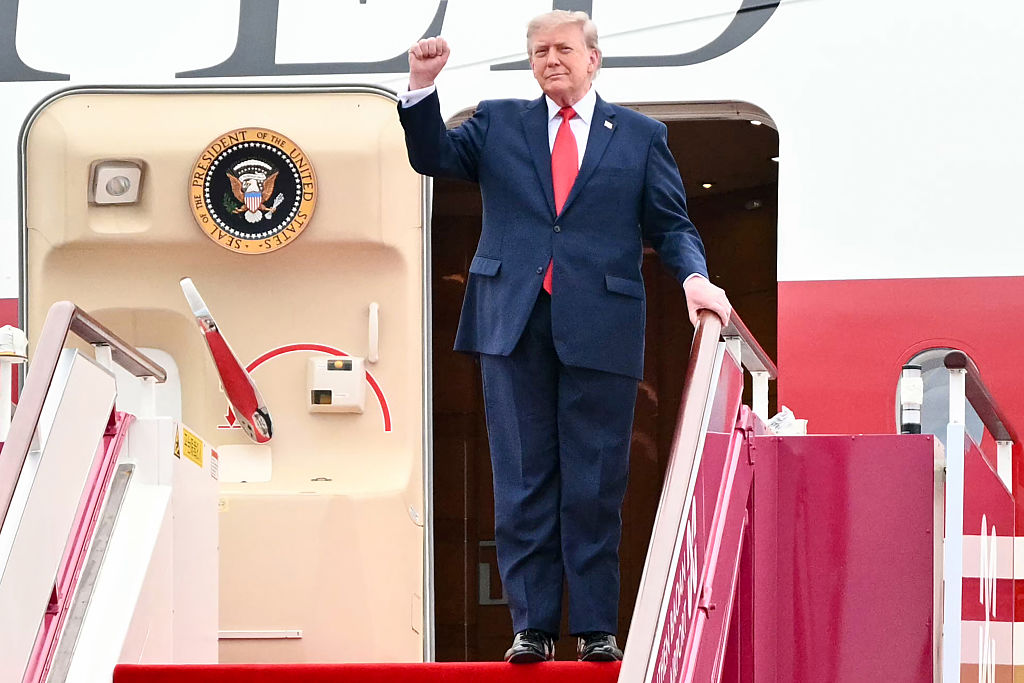
MANILA, Philippines—President Donald Trump wrapped up a three-day Asian trip that included stops in the Philippines and China and numerous discussions with world leaders.
The brief excursion included a packed itinerary with negotiations.
First US–China–Russia Leaders’ Meeting
For the first time, the leaders of the United States, Russia, and China met for trilateral talks on Nov. 19, with arms reduction and denuclearization on the agenda.
Chinese leader Xi Jinping, who hosted the meeting, said more than 60 regional conflicts were still dragging on around the world. He said history showed that the world stays at peace when major powers cooperate and descends into chaos when they clash, and that the three countries, as permanent members of the U.N. Security Council, should set an example by working together on global challenges.
Russian President Vladimir Putin thanked Xi for organizing the first meeting held in this format and said the three countries, as permanent members of the U.N. Security Council and victors in World War II, shared responsibility for maintaining international peace and security and for strengthening the system of international law built around the United Nations.
He said they had common interests in settling regional conflicts, including the war in Ukraine, and in fighting terrorism and organized crime, and that they could contribute significantly to world peace and stability if they cooperated on the basis of mutual respect, equality, and a balance of interests.
Trump said that as leaders of three of the world’s largest countries and its three largest nuclear powers, they had a special responsibility to keep an open and respectful dialogue on issues affecting the entire planet. He said past leaders had too often avoided talking with nations they disagreed with, and that refusing to engage had never produced peace.
He added that the three were uniquely positioned to discuss reducing the number of nuclear weapons, though he acknowledged that leaders find it very hard to give them up.
The leaders met for nearly 90 minutes behind closed doors after the media was ushered out of the room.
Trump also met with Xi and Putin separately earlier in the day.
During his approximately hour-long talk with Xi, Trump suggested China buy more agricultural products from the United States.
“I’ll be asking you to do some more for our farmers,” he said in his opening remarks. “China has an insatiable appetite.”
The bilateral meeting with Putin included brief remarks in front of the press before the leaders chatted behind closed doors.
“We’ve had a great relationship for many years,” Trump said. “We know each other for a long time, and I think a lot of wonderful things can come out of this, or at least start.”
Trump had floated a face-to-face meeting in China with North Korean leader Kim Jong Un, but Kim did not attend. Trump also said he wanted to meet Kim during his October 2025 trip to Malaysia, Japan, and South Korea, but no meeting took place. The two have not met since June 2019, when Trump briefly stepped into North Korea at the demilitarized zone during his first term.
Quad Leaders Meet for 1st Time Since 2024
Trump arrived in the Philippine capital on Nov. 17 and met first with the Quad, including Australian Prime Minister Anthony Albanese, Japanese Prime Minister Sanae Takaichi, and Indian Prime Minister Narendra Modi.
Trump said the leaders discussed anti-submarine warfare and joint maritime training, and he announced a joint military exercise involving maritime patrol aircraft. He also said the four countries were working together on artificial intelligence and had jointly contributed at least $85 million to the effort.
“Our countries are the four corners of a free, open, stable, and prosperous Indo-Pacific,” Trump said during the gathering. “We have outstanding relationships and coordinate closely on matters of regional security, economic security, and diplomacy.”
Additionally, the group announced its first-ever business leaders’ forum scheduled for 2027.
The meeting was the Quad’s first leaders’ gathering since 2024. Holding it just before Trump’s visit to China would send Xi a message that the United States has “some very significant relationships” in the region, Edgard Kagan, a senior adviser at the Center for Strategic and International Studies and former U.S. ambassador to Malaysia, said at a Nov. 9 briefing.
Trade Pacts With Thailand, Philippines
Trump and Thai Prime Minister Anutin Charnvirakul signed a joint statement on Nov. 17 saying negotiations on a reciprocal trade agreement had reached a substantial conclusion, with the final agreement still to be signed.
Once signed, the deal would eliminate tariffs on 99 percent of goods and remove nontariff barriers on American vehicles, medical devices, pharmaceuticals, ethanol, and poultry, according to the White House. It would also protect U.S. intellectual property and strengthen enforcement of Thailand’s labor and environmental laws.
Separately, Thailand intended to commit up to $123 million toward the purchase of U.S. High Mobility Artillery Rocket Systems, the White House said.
Trump also announced “the biggest trade deal we’ve ever made, by far” with the Philippines, though details remain limited.
Agreements totaling more than $17 billion in contracts and investments were made during the trip, including a $12 billion sale of up to 20 Boeing 787 aircraft with GE engines. The deal will support 47,000 U.S. jobs, according to the White House.
The two countries also said they would pursue a Foreign Military Financing loan package of more than $2 billion to provide the Philippines with defense and security capabilities from U.S. suppliers, according to the White House. Separately, the United States will use $400 million in Foreign Military Financing to expand the Philippine military’s operational reach and deterrence capabilities in the South China Sea.
Trump Addresses APEC Summit in Shenzhen
The president then flew to Shenzhen, China, for the 33rd Asia-Pacific Economic Cooperation (APEC) Leaders’ Summit.
He addressed representatives of APEC’s 20 other member economies. Together with the United States, they account for more than 60 percent of the world’s economic activity and about 40 percent of its population.
“The United States has been a Pacific power for hundreds of years, and we continue to work to promote growth and stability, sovereignty, prosperity, and peace throughout this region,” Trump said during the meeting.
Several speakers, including Trump, discussed the role of artificial intelligence (AI), which Trump has dubbed “super intelligence.” Trump said the technology was “almost completely good, but it’s got some bad elements.”
“AI is forever the most significant factor for medium-term competitiveness, productivity, and growth,” said Kristalina Georgieva, managing director of the International Monetary Fund.
Special ASEAN–US Summit
Trump arrived in Manila on Nov. 17, after the 49th Association of Southeast Asian Nations (ASEAN) Summit concluded, and attended a special ASEAN–U.S. summit with the bloc’s leaders.
Trump reaffirmed U.S. commitment to the bloc. Marcos announced that ASEAN and U.S. officials had adopted principles to combat online scams, along with 10 public-private partnership principles and a regional work plan.
Protesters lined the streets near the presidential palace before Trump’s arrival ceremony on Nov. 18. Many carried signs reading “Trump Out,” and others opposed Pax Silica, a State Department initiative launched in December 2025 to secure supply chains for critical minerals and other materials needed for advanced computing.
Officials told reporters after Trump’s meeting with Marcos that Pax Silica was not on the agenda for the trip.
Trump’s Conundrum With China
The Nvidia scandal created tension between two U.S. Cabinet members ahead of the president’s visit to communist China.
Nvidia’s co-founder and former CEO, Jensen Huang, admitted to an extramarital affair, and the company confirmed his resignation. Though he did not name the woman, The New York Times first reported on the Nvidia CEO’s relationship with Alice Huang and alleged U.S. intelligence agencies’ concerns that she passed information to Beijing.
Treasury Secretary Scott Bessent blamed Commerce Secretary Howard Lutnick’s department for failing to put export restrictions on Megaspeed, the Singapore-based cloud computing firm for whom Alice Huang was an executive.
Megaspeed, which described itself as a “core business partner” for Nvidia on its website, has confirmed that Alice Huang left Megaspeed on Aug. 30, 2025, and “currently has no role with the company.”
“Megaspeed does not comment on Ms. Huang’s personal and private matters,” the company said in a statement to The Epoch Times on Nov. 15.
Trump told reporters on Nov. 16 that he understood both sides.
“It’s a different approach,” he said. “We’re heading to China—I don’t think you want to insult China just before you get there.”
It was unclear whether Trump raised the spying allegations or other issues with Xi. He said on Nov. 16 that he might bring up the Nvidia matter and Chinese spying concerns, and in Manila on Nov. 17, he said he expected Xi to raise Taiwan.
As of publication time, no transcripts of the private discussions had been released, and statements from the White House and the Chinese regime offered few details.