
The U.S. Department of Labor proposed sweeping new changes to green card rules for foreign workers that would require companies to give Americans a chance to fill open positions.
The comprehensive rule changes—the first in nearly 20 years—were issued on Nov. 16 and would change the Permanent Labor Certification program’s recruitment standards. The certification is issued to DHS or DOS for immigrant visas and is a required step that allows foreign employees to live and work in the United States.
“American workers are the best in the world, and they deserve the first and best job opportunities. Existing regulations have instead allowed companies to sponsor foreign workers without fully considering American workers first,” said Labor Secretary Keith Sonderling.
If approved, the administration expects the changes to remove any loopholes some companies use to target foreign workers for H-1B visas.
The H-1B visa program allows companies to temporarily hire foreign workers in specialty occupations, such as engineering or artificial intelligence, that require specialized knowledge and at least a bachelor’s degree or equivalent.
Employers would be required to recruit workers by using the same channels and methods to advertise job openings.
The department proposes changing a requirement to replace print job advertisements with online recruiting through employer websites, job boards, social media, job fairs, and campus recruitment.
Employers would also be required to advertise positions for at least 90 days to demonstrate that they made a good-faith effort to recruit qualified American workers.
Companies would also be prohibited from tailoring jobs to foreign workers.
Tech companies, including OpenAI and Instacart, have faced scrutiny for using hiring practices that allegedly target immigrant workers.
The Trump administration launched an investigation into the H-1B visa system in July as part of a broader probe of federal immigration and entitlement fraud systems.
The Office of Inspector General stated this year it has “uncovered widespread schemes in which employers and labor brokers submitted fraudulent applications, exploited foreign workers through coercive wage-kickback arrangements, and undercut American workers by flooding the market with below-wage labor.”
 President Donald Trump signs an executive order in the Oval Office at the White House on Sept. 19, 2025. (Andrew Harnik/Getty Images)
In September 2025, President Donald Trump signed a proclamation restricting certain nonimmigrant workers from entering the U.S. through the H-1B program, citing what he said was causing “large-scale replacement of American workers.”
“Information technology (IT) firms in particular have prominently manipulated the H-1B system, significantly harming American workers in computer-related fields,” Trump stated in the proclamation.
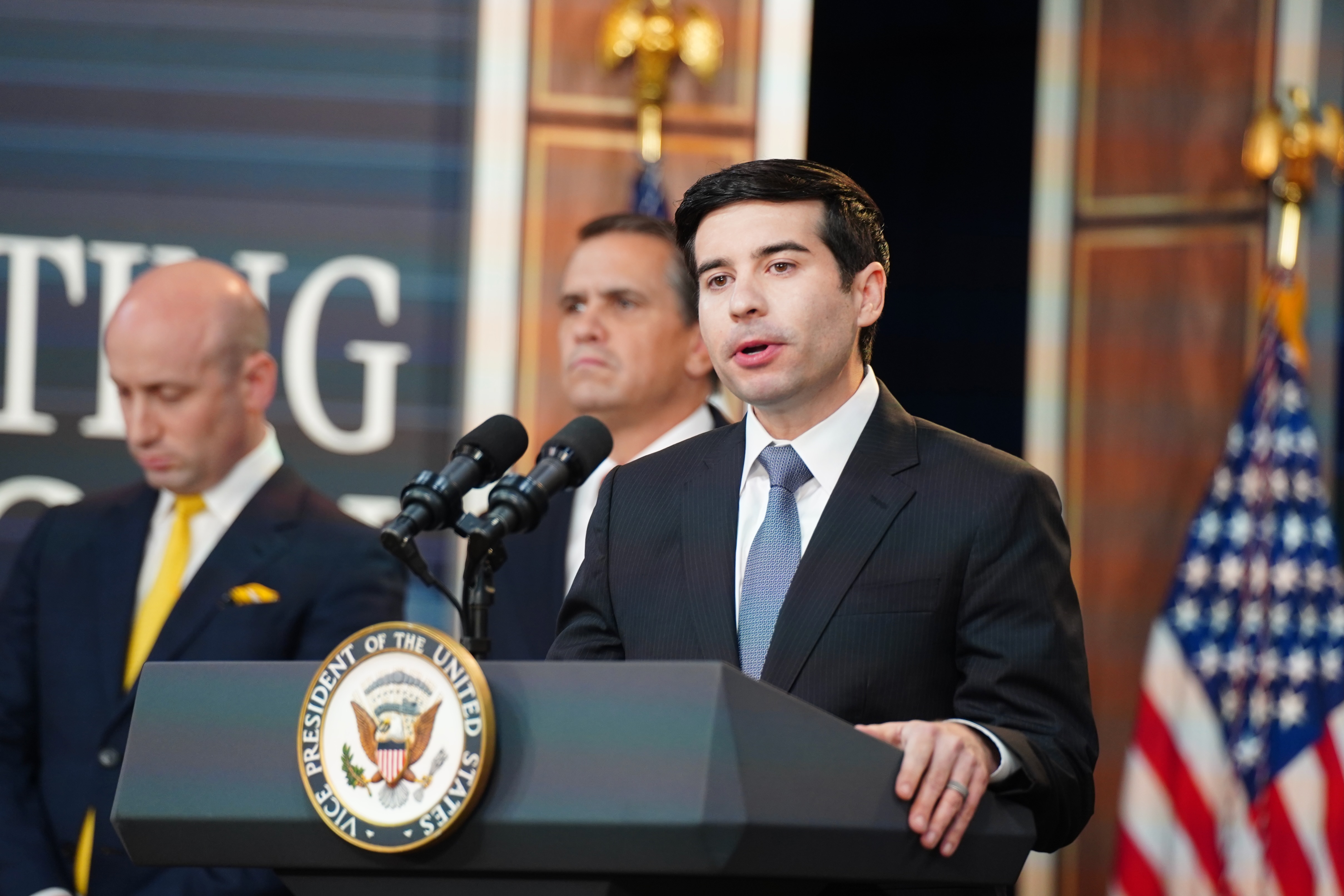 Labor Secretary Keith Sonderling speaks during a White House Anti-Fraud Task Force press conference in the South Auditorium of the Eisenhower Executive Office Building in Washington, on Oct. 8, 2026. (Travis Gillmore/The Epoch Times)
The United States has a limit on the number of petitions employers can file with U.S. Citizenship and Immigration Services each year. That cap—65,000 for H-1B visa and 20,000 for H-1B visa U.S. advanced degree exemption—was reached in 2026.
In the proposed new rule, the Labor Department seeks to eliminate the administrative exemption companies use to bypass the statutory labor market test for some positions.
Employers looking to hire physical therapists, nurses, and workers with exceptional abilities in sciences or arts would be required to consider qualified U.S. workers, the department said.
The rule also proposes to protect qualified U.S. workers affected by layoffs by requiring companies to consider laid-off workers throughout the labor certification and immigrant petition processes.
It also would prohibit certain employers that have laid off American workers within two years from seeking permanent labor certification for similar jobs to those that were cut.
The public has until Jan. 19 to comment on the proposed rule.