
Commentary
The Chinese regime extended the neighborhood grid it has used to control Tibetans and Uyghurs to Chinese communities in at least 91 countries.
In a Nov. 6 report, Safeguard Defenders, a Spain-based human rights group, documented 1,247 formally designated “liaison points” operating on behalf of 74 Chinese authorities and government bodies.
The Chinese Communist Party (CCP) divides every city, town, and village in China into grids of a few hundred households. In each grid, a worker keeps a file on every resident and reports anything the Party regards as a threat.
Beijing piloted the grid in 2004. In October 2013, CCP leader Xi Jinping told the Party to “uphold and develop” the Fengqiao Experience, a 1963 Maoist model that organized villagers to watch and subdue their neighbors.
A month later, the Central Committee adopted grid-based management as its nationwide model for local governance. Nine of the ten tasks assigned to grid workers under a 2017 national standard involve surveillance and control. The standard lists “cult activities” and “antiterrorism” alongside fire and food safety.
Chen Quanguo became Party secretary of Tibet in August 2011 and, within two months, began building “convenience police stations” on street corners. From 2011 to 2015, authorities set up more than 698 round-the-clock police posts, including stations and checkpoints, across seven cities and prefectures. In Lhasa, Chen built 156 stations, according to the South China Morning Post, as cited by Tibetan Review.
The Central Tibetan Administration says the grid first targeted Tibetans who had returned from India or attended the Dalai Lama’s teachings, as well as former political prisoners. From 2011 to 2015, authorities stationed more than 7,000 Party cadres in 1,787 monasteries across the region.
Security forces shifted from responding to violence to trying to prevent and even predict unrest. Authorities established detention camps that eventually held at least 1 million Uyghurs and Kazakhs.
In 2019, the police chief of Qingtian county in Zhejiang Province described how his force adapted China’s domestic grid to monitor Chinese communities abroad. Police recruited more than 1,000 overseas informants to track people they deemed threats to stability during sensitive periods. Officers in China intimidated the targets’ relatives through “home visits,” a tactic they called “educational persuasion.”
The chief said the grid had handled 15 cases involving disruptions of Chinese leaders’ visits or demonstrations by overseas Chinese. The aim, he said, was to protect Xi’s authority by safeguarding “the dignity of the core.” He credited the grid with foiling a plan to disrupt Xi’s attendance at the 2017 G20 summit in Germany.
The overseas grid targets Uyghurs, Tibetans, Falun Gong practitioners, democracy activists, and supporters of Taiwan independence, groups the Party calls the “five poisons.” Chinese police use the “cult” label to treat Falun Gong activity abroad as a security threat.
When Xi traveled to San Francisco for the 2023 APEC summit, investigative reporting alleged that the Chinese Consulate in Los Angeles helped organize pro-Beijing supporters and covered their hotels and meals—a claim Beijing has denied. Clashes broke out in which assailants attacked Tibetan, Hong Kong, and Chinese dissidents with flagpoles, and activists reported that a Tibetan demonstrator’s phone was thrown into the water.
During Xi’s September 2026 state visit to Washington, members of roughly 100 pro-Beijing associations were bused in to line his route, and anti-CCP protesters were pepper-sprayed and beaten over three days, according to Human Rights in China. The group also reported that police told Tibetan activists that at least one assailant was not detained because he had diplomatic immunity.
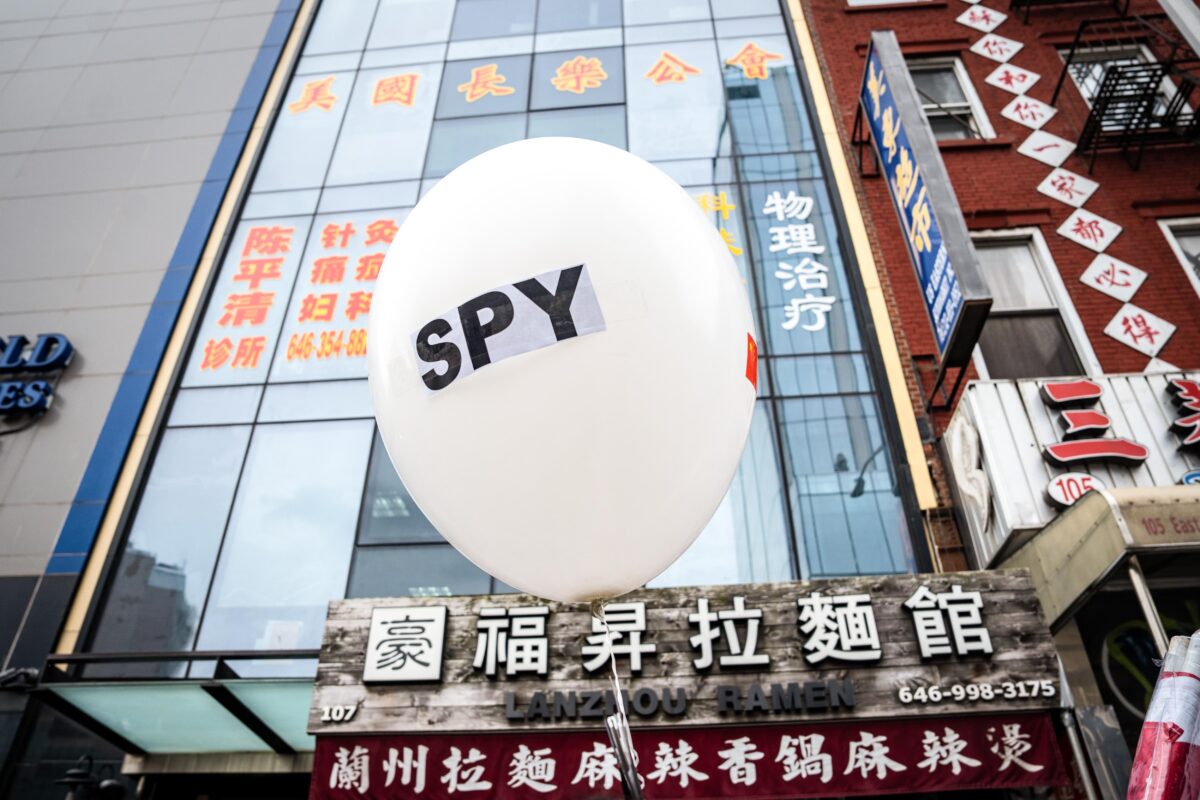
In 2022, Safeguard Defenders exposed more than 100 overseas police stations in more than 50 countries. The FBI raided the station in Manhattan’s Chinatown in October of that year.
In 2023, Beijing told the British government it had closed the sites in the United Kingdom. Safeguard Defenders’ new report found that the “police” nameplates came down but “the system was left standing.”
The report identifies five national policies issued since late 2024 that direct Chinese authorities to expand liaison work abroad. The group concludes that the policies aim to control the Chinese diaspora. Associations affiliated with the CCP’s United Front Work Department and the Overseas Chinese Federation now host liaison points once described as police stations.
Safeguard Defenders also cites four China-based operations that used Anthropic’s AI models for surveillance between December 2025 and August 2026. Among other activities, the operations compiled dossiers on the Tibetan administration in exile, sought the locations of Uyghur cultural events in Turkey, and profiled Uyghurs in Syria based on their relatives in Xinjiang.
In March 2026, Italy issued expulsion orders for eight Chinese nationals for harassing Li Ying, an exiled Chinese dissident blogger. In May, a federal jury in Brooklyn convicted a Bronx man of operating the Manhattan station for China’s Ministry of Public Security.
In June, France’s highest administrative court, the Conseil d’État, upheld the expulsion of the de facto leader of a Chinese business association that had hosted a clandestine Fuzhou police station.
Under the U.S. Foreign Agents Registration Act, groups must register if they carry out covered activities in the United States at the order, request, or direction of a foreign principal, unless an exemption applies. That suggests groups that operated the former police stations or now host liaison points on behalf of the CCP should be required to register as foreign agents.
In July, U.S. Sens. Adam Schiff (D-Calif.) and John Curtis (R-Utah) introduced a bill that would define transnational repression in federal law and add up to 10 years to prison sentences when a federal offense involves knowingly committing, attempting, or conspiring to commit an act of transnational repression. The bill remains pending.
On Nov. 6, 54 lawmakers from 26 countries in the Inter-Parliamentary Alliance on China called for stronger foreign-interference laws and mandatory disclosure of United Front ties.
Until governments act against the associations that host their liaison points, the grid built to control Tibetans and Uyghurs will keep operating abroad.
Views expressed in this article are the opinions of the author and do not necessarily reflect the views of The Epoch Times.