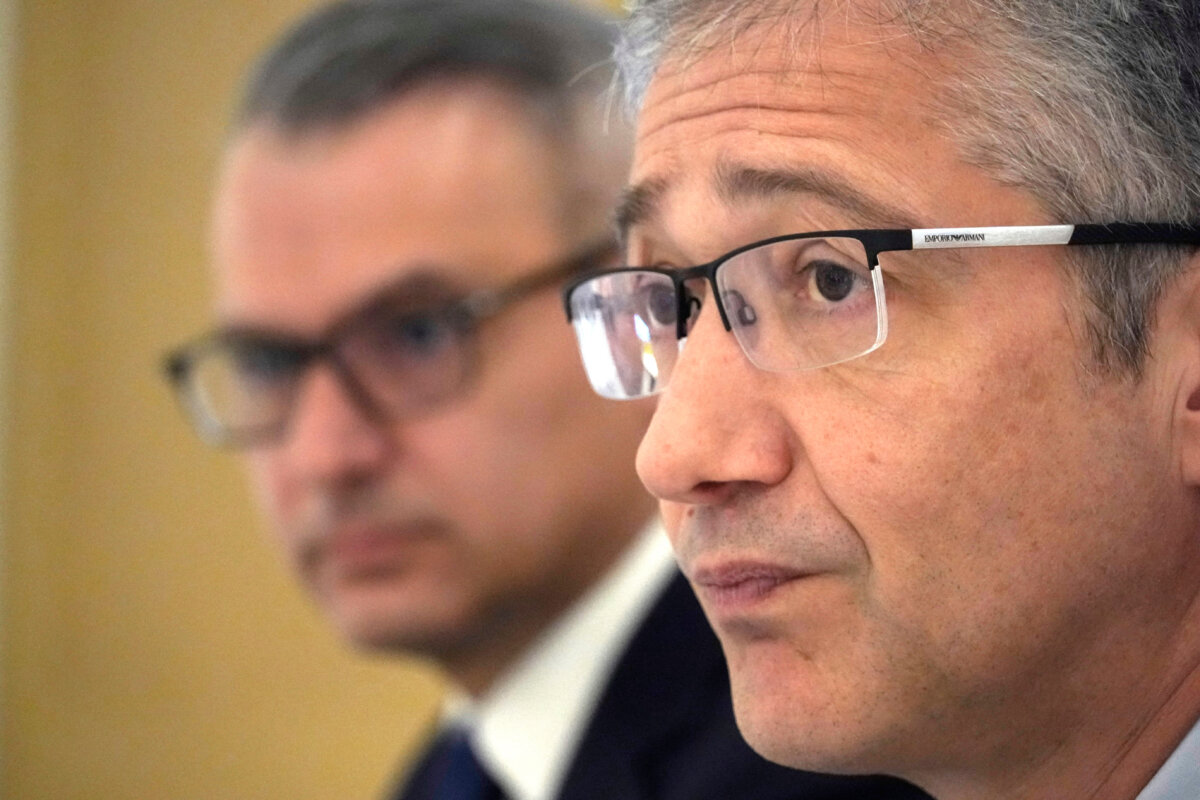

Pablo Hernández de Cos is set to become the next president of the European Central Bank.
Nearly a month after Christine Lagarde announced that she would step down in February following more than seven years at the helm, European Council President António Costa confirmed that euro area member states backed de Cos’s nomination.
Costa will next propose that the European Council launch consultations with the European Parliament and the central bank’s Governing Council.
“This will pave the way for the formal appointment of the new ECB leadership by the #EUCO in December,” Costa said in a Nov. 26 statement posted on X.
Formal approval would make him the first Spanish official to head the ECB in its near-three-decade-old history.
He also confirmed that French economist Laurence Boone and German economist Markus Brunnermeier have been recommended to the ECB Executive Board.
The ECB sets the interest rate for the 21 bloc members using the euro.
The 55-year-old is a veteran central banker with various roles at the European Central Bank, the Bank of Spain, and the Bank for International Settlements. He also chaired the Basel Committee on Banking Supervision from 2019 to 2024.
Prediction markets had viewed de Cos and former Dutch central bank leader Klaas Knot as the top contenders to succeed Lagarde next year.
In the lead-up to the decision, representatives from the euro area’s five largest economies—France, Germany, Italy, the Netherlands and Spain—held a series of discussions to secure representation on the ECB’s six-member Executive Board.
Based on his previous remarks, de Cos could be viewed as a centrist without a clear hawkish or dovish stance on monetary policy.
He supports maintaining the central bank’s 2 percent inflation target. De Cos also favors unconventional monetary policy measures, including negative interest rates, asset purchases, and targeted lending programs.
At the same time, he voiced concern about Europe’s long-term growth, productivity, and investment problems, as well as climate change risks.
Echoing his colleagues worldwide, de Cos has championed crafting policy based on economic data rather than drawing premature conclusions.
In a February 2022 speech on the institution’s medium-term 2 percent target, he championed its benefits.
“I am convinced that the ECB’s new monetary policy strategy … constitutes a solid basis for the conduct of our monetary policy,” he said in prepared remarks.
“This is so, not just looking ahead to the coming decades, but also for coping with the current high-inflation episode.”
ECB Minutes
His immediate challenge will be fighting inflation, which has accelerated since the start of the war in Iran earlier this year.
The eurozone’s October annual inflation rate was 4 percent, the highest level since September 2023.
Shortly before de Cos’s selection for the role, the ECB also released minutes from the October policy meeting.
The summary highlighted that many officials could have supported a rate hike in October, and policymakers appear to favor an increase next month.
Members signaled concern about headline inflation that “would be higher for longer than previously expected.”
While core inflation—removing food and energy—pointed to a slightly better outlook, ECB officials expect the pass-through effects to result in a higher inflation trajectory.
“The pass-through of the energy shock to inflation remained most visible in direct effects. Indirect effects had, overall, evolved as expected and were still limited,” the minutes stated.
For now, there have yet to be “material signs of second-round effects.”
“It was suggested that perhaps underlying inflation could become sticky at around 2.5% rather than receding,” the minutes stated.
While financial markets have already baked a quarter-point hike in December into the cake, the monetary policy path for 2027 “is less obvious,” says Carsten Brzeski, global head of macro at Dutch bank ING.
“In fact, it will depend on whether the still-not-visible impact of higher energy prices on the rest of the economy eventually materializes,” Brzeski said in a Nov. 26 note. “We are less convinced than the ECB and therefore think that additional rate hikes in 2027 would do more harm than good.”
In overseas trading, the global Brent crude oil benchmark is trading around $96 per barrel. Prices have declined about 12 percent over the last month.
But monetary policymakers will also likely keep an eye on bond yields and the euro’s weakness, Brzeski added.
The euro has fallen about 6 percent against the U.S. dollar this year. The euro area 10-year bond yield has also slowed to below 4 percent.
Evgenia Filimianova contributed to this report.