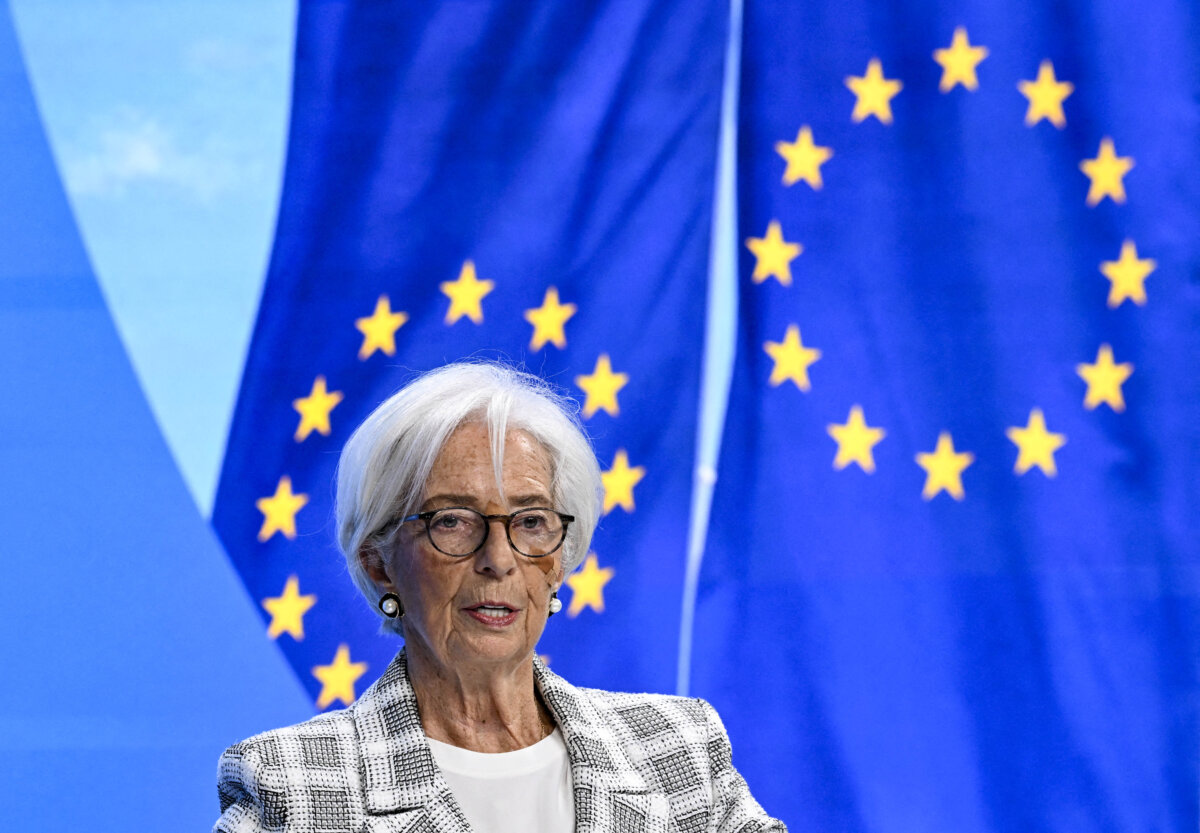

European Central Bank President Christine Lagarde announced on Oct. 29, amid renewed inflation pressures and economic uncertainty, that she would step down in February 2027, ahead of the scheduled end of her eight-year term.
“It has been a source of great pride to serve this institution,” Lagarde wrote in a post on X, thanking colleagues and supporters for the past seven years.
Lagarde arrived at the European Central Bank (ECB) in November 2019 after serving as France’s finance minister and managing director of the International Monetary Fund. Her tenure was quickly dominated by the COVID-19 pandemic, which forced the central bank to launch emergency bond-buying programs to stabilize financial markets.
She later oversaw the bank’s fastest cycle of interest-rate increases after Russia’s 2022 invasion of Ukraine triggered an energy shock and the highest inflation in the eurozone’s history.
Although the ECB later acknowledged it had underestimated inflation’s persistence, it tightened monetary policy aggressively to return inflation to its 2 percent target.
Lagarde also sought to build greater consensus among the euro zone’s 21 national central bank chiefs, using her political experience to bridge divisions among the governors of the euro area’s national central banks.
The announcement came hours before the ECB was due to publish its latest monetary policy decision and hold its regular news conference, where Lagarde had been expected to explain the bank’s latest interest-rate decisions.
Early in the pandemic, she sparked a sharp sell-off in government bond markets after saying the ECB was “not here to close spreads” between borrowing costs across euro area countries before later clarifying her remarks. She also described economists as a “tribal clique,” although she subsequently softened the comment.
In a video message posted to social media, Lagarde said she told fellow policymakers and ECB staff she would step down on Feb. 7, following the Governing Council’s monetary policy meeting.
“I leave this institution with a sense of good work done and an ECB that is fit for the future,” she said.
In a separate post on X, Lagarde said adhesive bandages visible on her face were the result of a minor surgical procedure earlier in the week and urged people to have their skin checked regularly.
Reactions, Succession Process
European Commission President Ursula von der Leyen praised Lagarde’s leadership through multiple crises, saying she had helped keep Europe’s economy stable and resilient during the COVID-19 pandemic, the Ukraine conflict, energy shocks, and rising inflation.
European Council President Antonio Costa said he respected Lagarde’s decision and thanked her for leading the ECB “with a strong sense of duty and responsibility” since November 2019.
The ECB said Lagarde had informed Costa of her decision. The European Council will appoint her successor through the official process set out in EU law.
Costa confirmed that the process to appoint Lagarde’s successor would begin immediately to ensure a smooth transition.
Under EU rules, eurozone countries first put forward candidates to lead the ECB. After consultations with EU finance ministers, the European Parliament and the ECB’s Governing Council, the European Council appoints the new president.
The decision requires broad backing from eurozone governments; at least 16 of the 21 countries, representing 65 percent of the euro area’s population, must vote in favor.
Lagarde’s resignation comes as the ECB continues to grapple with renewed inflation pressures linked to higher energy prices and geopolitical tensions.
The central bank raised its three key interest rates by 25 basis points in September, citing persistent inflation risks stemming largely from the conflict in the Middle East and rising energy costs.
The ECB said inflation was expected to remain above its 2 percent target for an extended period while forecasting economic growth of 0.9 percent this year, 1.4 percent in 2027 and 1.5 percent in 2028.
Reuters contributed to this report.
Correction: A previous version of this article mischaracterized the European Central Bank’s September rate increase. The Epoch Times regrets the error.