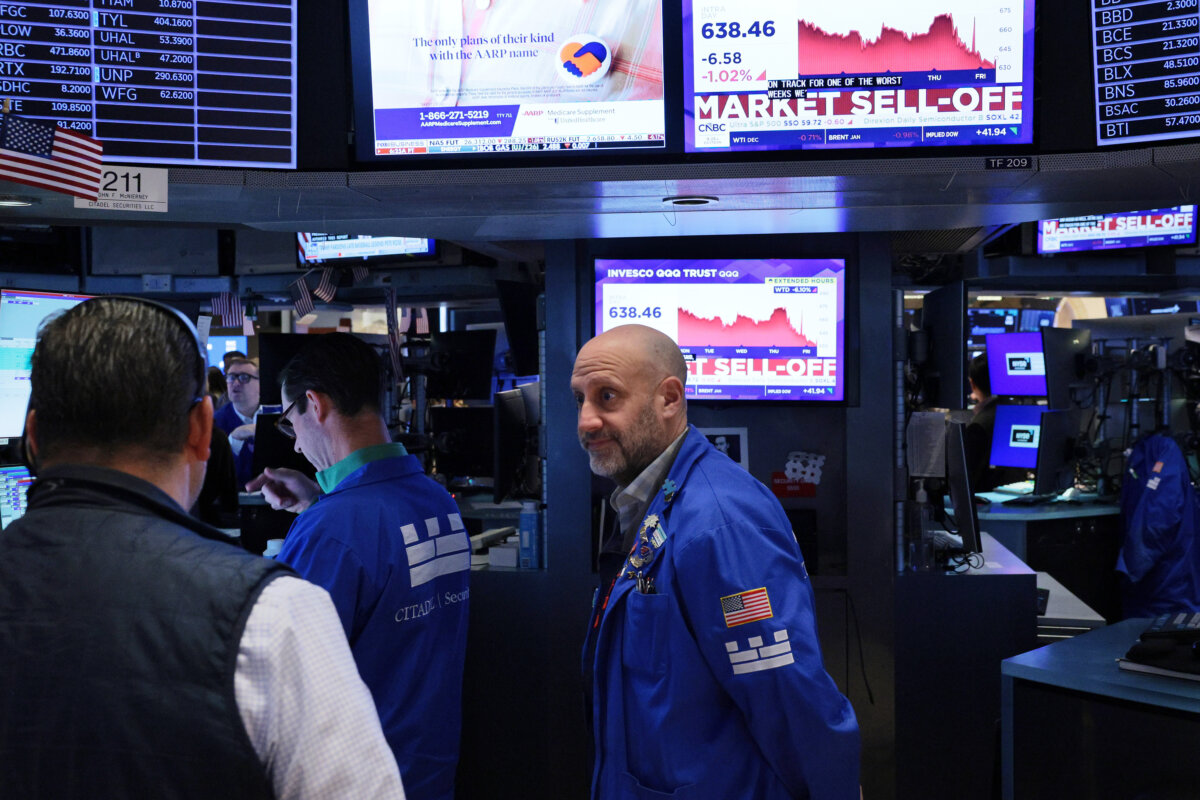

Anthropic’s blockbuster initial public offering (IPO) failed to revive investor enthusiasm for artificial intelligence-related stocks, as concerns over the sector’s outlook, tighter financial conditions, and liquidity pressures triggered a broad sell-off across Wall Street.
The Nasdaq Composite led the decline, falling 10.02 percent for the week to close at 22,617.73, marking the largest weekly percentage decline in more than six years. The S&P 500 dropped 8.61 percent to 6,910.39, while the Dow Jones Industrial Average lost 8.02 percent to 48,147.33. The small-cap Russell 2000 declined 7.48 percent.
The CBOE Volatility Index, commonly known as Wall Street’s fear gauge, surged 85.96 percent to 35.89, reflecting a sharp deterioration in investor sentiment.
Anthropic IPO Fails to Lift AI Trade
Anthropic’s shares closed Thursday 17 percent above their public offering price, giving it a $1.27 trillion valuation and making it one of the world’s most valuable publicly traded companies. However, an early rally in AI-related shares gave way to a sharp sell-off by late morning, and the IPO ended up adding to liquidity pressures in an already shaky market as investors weighed a high cost of capital, persistent inflation, and restrictive monetary conditions.
The Nasdaq, Dow, and Russell 2000 fell 2.25 percent, 2.19 percent, and 2.18 percent, respectively, while the S&P 500 declined 2.02 percent.
Rebecca Walser, chief investment officer of Florida-based Walser Wealth Management, adopted a more optimistic stance.
“Anthropic’s IPO is exactly what the markets need to revive overall sentiment, which has been depressed with all of the negativity in the AI complex over the past several weeks,” Walser told The Epoch Times.
“Anthropic is extremely important for the overall AI story, since it’s the first [large language model] IPO, whereas much of the stock market story around AI had strictly to do with the semiconductor space. This IPO is the show me moment for the AI story,” she added.
Anthropic is the first such IPO in the United States. Beijing-based Zhipu AI debuted on the Hong Kong Stock Exchange in January.
Markets faced renewed selling pressure on Friday, with all major equity indexes opening lower and selling accelerating during the afternoon. Bargain hunters largely stayed on the sidelines, reflecting a shift in market sentiment from buying market dips to selling into rallies.
Semiconductor stocks were hit particularly hard for another session. The iShares Semiconductor ETF (SOXX) plunged 10.55 percent, contributing to a broader technology sell-off that pushed the Nasdaq down 5.28 percent.
Anthropic closed down 8.5 percent. The S&P 500, Dow Jones, and Russell 2000 also declined 3.70 percent, 1.93 percent, and 2.76 percent, respectively.
Behind the sell-off, strategists say, is a growing unease over whether the AI investment boom can sustain itself, and over the financial commitments needed to keep it going.
“The stock market is going through an AI repricing, reflecting an environment of slowing data center buildouts, reduced funding sources for AI-related projects and a slower trajectory of technology-related earnings growth,” Richard Saperstein, chief investment officer of New York-based Treasury Partners, told The Epoch Times. “This has been exacerbated by the Nvidia crisis and the Democratic midterm win, which were a one-two punch for the AI story.”
He said investors were broadly reducing their exposure to technology and AI-related stocks while shifting toward non-technology sectors such as healthcare, energy, and utilities.
Nvidia Earnings in Focus
Nvidia, at the center of the AI trade, reported its quarterly earnings on Tuesday, the first since the resignation of longtime leader Jensen Huang. Both earnings and revenue beat expectations, and management raised its guidance.
Shares initially jumped on Wednesday, lifting the broader chip sector, but later lost ground and closed down 2.89 percent. The stock had already fallen 4.12 percent on Monday, as investors grew concerned over the coming earnings report and questions about who will succeed Huang. The Nasdaq nonetheless ended Wednesday up 0.42 percent.
Money managers welcomed the results and, in particular, the company’s decision to raise its forecast.
“This was a very, very strong quarter. Both the quarter itself and the guidance, with buyback and the dividend,” Lior Prosor, cofounder and managing partner at Deep33, told The Epoch Times.
“Nvidia could have easily pulled its guidance and set a lower bar going forward, which would have been understandable given the uncertainty around the company, but instead they displayed an important show of confidence to nervous investors and employees,” Jay Peters, managing director and portfolio manager of Connecticut-based NewEdge Wealth, told The Epoch Times.
Consumer Resilience
Washington added to the pressure on chip makers early in the week. Tighter U.S. export rules for semiconductor products weighed on Nvidia and the wider industry on Monday, sending the iShares Semiconductor ETF down 5.41 percent and the Nasdaq down 2.49 percent. The Dow, S&P 500, and Russell 2000 fell 1.4 percent, 1.92 percent, and 1.70 percent, respectively.
Healthcare and pharmaceutical stocks also came under pressure, on concerns that the Centers for Medicare & Medicaid Services could change policy on anti-fraud rules, audits, and payment recoveries. The Direxion Daily Healthcare Bull 3X Shares fund fell 5.88 percent on Thursday.
The sell-off came despite a backdrop that, on its face, should have been supportive.
Oil prices fell, with Brent crude dropping 2.39 percent on Monday to below $94 a barrel, extending the prior week’s 2.5 percent decline on signs of better supplies from the Middle East.
The yield on the 10-year Treasury fell from 5.15 percent last Friday to 4.94 percent this Friday. And consumers kept spending: Retail sales rose 0.2 percent in October, although slowing from September’s gasoline-driven 0.8 percent gain.
“Continued consumer resilience was on display in October, with all major retail categories topping expectations. Sales excluding autos and gasoline also beat estimates, while control-group sales, a measure used to estimate personal consumption expenditures for GDP, exceeded forecasts,” Bret Kenwell, an eToro U.S. investment analyst, told The Epoch Times.
“The macro backdrop remains difficult. Rising Treasury yields and interest rates, persistent inflation and elevated energy prices are all weighing on household budgets. Yet the consumer, the heartbeat of the U.S. economy, continues to beat.”