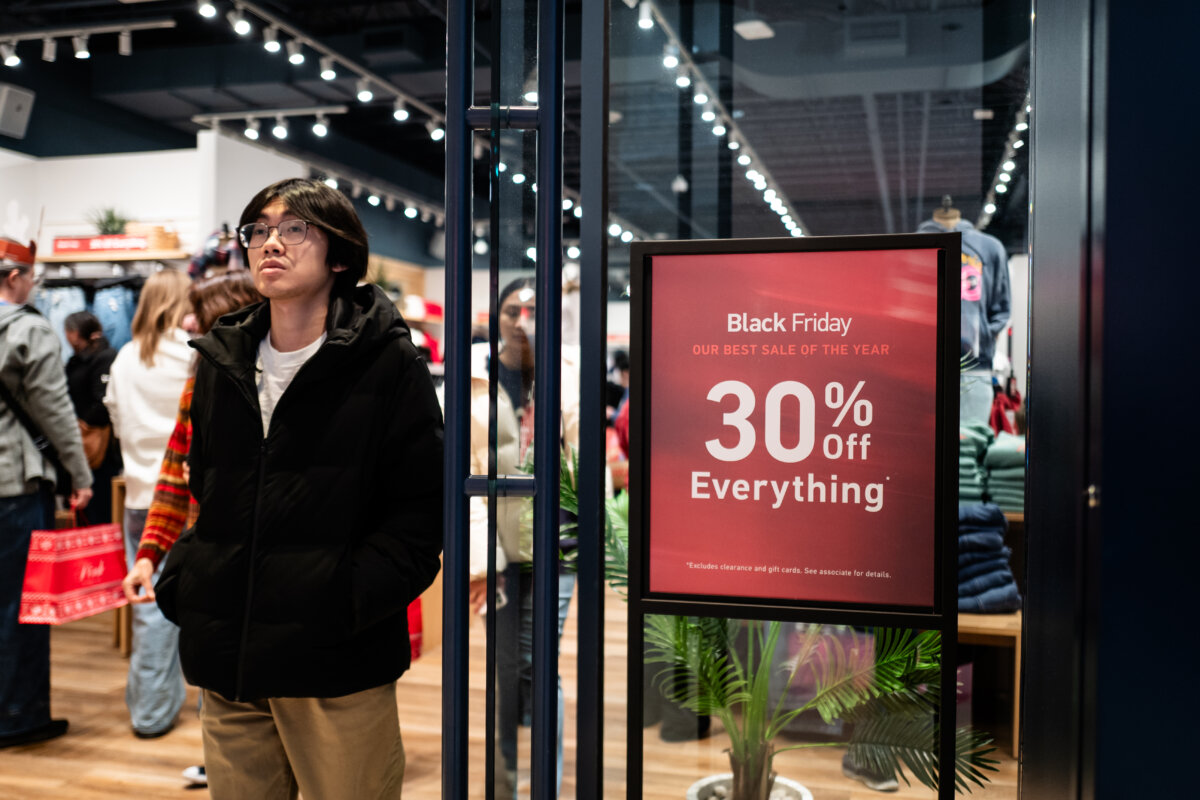

Sales at U.S. retailers held steady last month as shoppers tightened their belts before the holiday season.
Retail sales ticked up 0.2 percent in October, from the previous month’s 0.8 percent increase, according to Census Bureau data released on Nov. 17.
This was in line with the consensus forecast.
On a 12-month basis, retail sales ticked up 6.8 percent, up from a revised 6.6 percent in September.
Growth was mixed across various categories.
The largest monthly percentage gains were in miscellaneous store retailers (4.7 percent), gasoline stations (1.5 percent), health and personal care stores (1.5 percent), and nonstore retailers (1.2 percent).
Declines in sales at furniture and home furnishings stores (-2.3 percent) and motor vehicle and parts dealers (-1.6 percent) partially offset these gains.
Excluding gas and motor vehicle and parts dealers, retail sales advanced 0.5 percent.
October’s deceleration could signal that households closed their wallets a bit heading into this year’s holiday shopping season.
Halloween and early Christmas promotions likely “pulled demand forward,” says Matthew Shay, president and CEO of the National Retail Federation.
“Households are managing budgets carefully, timing purchases around special offers and sales events in order to stretch their dollars. Retailers continue to offer promotions and value pricing,” Shay said in a statement following last week’s CNBC/NRF Retail Monitor data.
The report also showed retail sales, excluding automobile dealers and gas stations, rose 0.2 percent.
The Holidays Are Coming
Holiday retail sales are projected to grow by 4.2 percent to exceed $1 trillion, according to the National Retail Federation.
Almost two-thirds of consumers say they will likely wait until Thanksgiving to complete most of their holiday shopping. In recent years, the holiday has become a multi-day shopping event: Thanksgiving, Black Friday, Small Business Saturday, and Cyber Monday.
Alternative private-sector figures suggest consumers also kept spending last month.
Bank of America reported that aggregated credit- and debit-card spending per household rose nearly 6 percent year over year. Stripping out transactions at gasoline stations, card spending jumped almost 5 percent.
While growth slowed last month—multiple categories saw sales moderate—household finances were “broadly healthy,” the bank said.
As for the holiday shopping season, spending has been “off to a strong start,” although consumers are increasingly value-conscious.
“Spending on holiday items is running well above last year’s levels, led by online purchases, while average transaction values are declining,” the report stated.
Economic Growth
Consumer spending accounts for roughly two-thirds of U.S. GDP.
A key component of the government’s consumption data is the retail sales control group. The statistic omits volatile categories, including gas stations, motor vehicles and parts, building materials, and food services and drinking establishments.
According to the Census Bureau, the retail sales control group rose more than expected, up 0.6 percent from an upwardly adjusted 0.5 percent in September.
This is good news for the U.S. economy, as core retail sales contribute to gross domestic product growth.
In its widely watched GDPNow Model, the Atlanta Federal Reserve forecasts the fourth-quarter expansion could be 3.5 percent. Consumer spending is expected to represent nearly half of the October–December expansion, followed by business investment and changes in private inventories.
“This broad-based strength in consumer spending is in sharp contrast to the ongoing decline in consumer confidence across the income distribution,” Torsten Slok, chief economist at Apollo, said in a note emailed to The Epoch Times.
Despite consumer sentiment picking up earlier this month, it is down 10 percent from February, before the war in Iran began.
The University of Michigan’s preliminary Consumer Sentiment Index rose to 51, up from 48 in October. Beyond ongoing cost-of-living worries, consumers have said they are increasingly anxious about a potential artificial intelligence (AI) bubble.
“The bottom line is that there is a significant difference between what consumers are saying and what they are actually doing,” Slok added.