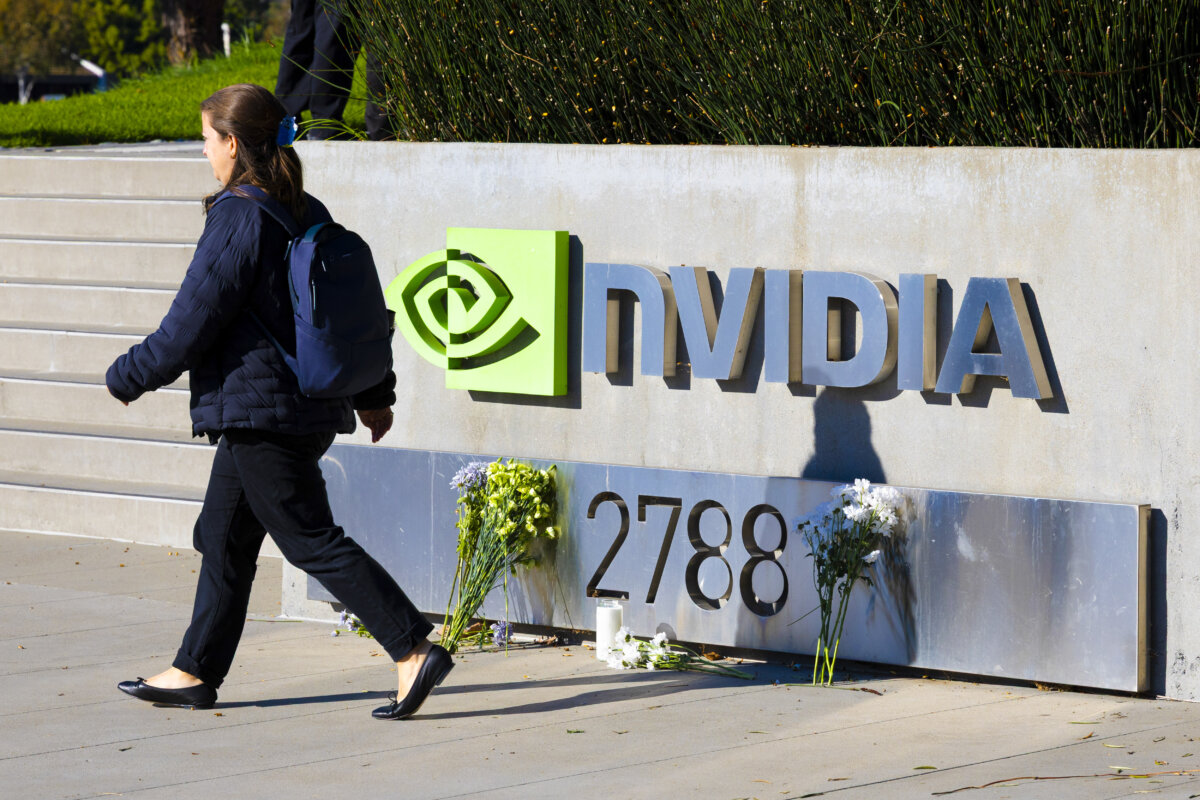

Chipmaker Nvidia’s third-quarter earnings beat Wall Street’s profit and revenue expectations after the Nov. 17 closing bell, the company’s first financial report since cofounder Jensen Huang’s resignation last week.
Nvidia posted revenues of $115.84 billion and earnings per share of $2.68.
Analysts had penciled in earnings per share of $2.47 and revenues of $108.82 billion.
“Our momentum is real,” Colette Kress, interim CEO and executive vice president and chief financial officer at Nvidia, said in a statement.
“Nvidia is an exceptional technology leader, powered by the relentless innovation of our people.”
Shares of Nvidia finished the session down 0.44 percent to below $156. The stock climbed about 5 percent in after-hours trading.
Nvidia’s value has tanked since Huang’s admission of infidelity days before his resignation, with the scandal erasing up to $700 billion. Its market cap now stands at around $3.74 trillion.
Despite concerns that Nvidia will struggle without Huang at the helm, the company raised its guidance for the fiscal year ending in January 2028. Nvidia now expects 75 percent growth.
“It’s business as usual,” Kress said.
“Our leadership has stood up so strongly over the last week to support both what we are doing here at earnings, but also supporting all of our different employees around the world.”
Jensen Huang Not Returning to Nvidia
It was a busy day of headlines for the chipmaking giant.
Huang, in his first public comments since last week’s departure, said he is willing to return to the company if asked to by the board.
“Since my departure, I’ve seen an outpouring of calls from Nvidia’s employees, investors, business partners, and customers for me to return as CEO,” Huang said in a Nov. 17 statement.
“If the Board of Directors decides that my return is in the best interest of our shareholders, our employees, the company, and America, I would be honored to answer these calls and return as CEO.”
But the company said it does not intend to bring back Huang.
Harvey Jones, Nvidia’s new board chair, said on the earnings call that Huang’s personal behavior was “inconsistent with the company’s code of conduct, standards and cultural norms.”
“The Nvidia board unanimously accepted his resignation and does not intend to reinstate Jensen as CEO,” Jones said.
This came shortly after congressional leaders confirmed Huang will appear before House committees in December.
Nvidia also said that it had formed a national security and export-control committee.
Harvey Jones, chairman of the board of directors, said the tech giant plans to work with government and industry partners to create a framework that protects national security and supports ongoing technological innovation.
“As the world’s leading advanced computing company, Nvidia has both a responsibility and an opportunity to lead the industry in addressing these challenges,” Jones said in a statement.
Bull Market Takes a Break
U.S. stocks tanked heading into Nvidia’s third-quarter earnings report during a volatile trading session.
The blue-chip Dow Jones Industrial Average fell 848.75 points, or 1.64 percent, to close at 50,759.42. The tech-heavy Nasdaq Composite Index declined 181 points, or 0.74 percent, to 24,328, to touch its lowest level since April. The broad-market S&P 500 dropped 76.06 points, or 1.03 percent, to below 7,400.
The Russell 2000—an index of 2,000 small-cap companies—fell 41 points, or 1.5 percent, to 2,702.
In addition to angst surrounding Nvidia’s earnings, traders reacted to a CNN report that a classified network used by the National Security Agency—also known as the NSA—had gone offline.
The NSA later confirmed that it had “experienced temporary degradation during scheduled routine maintenance,” adding that “mission-critical capabilities remain fully operational.”
Mixed economic data also weighed on equities.
Retail sales ticked up just 0.2 percent in October, in line with economists’ expectations.
The NAHB/Wells Fargo Housing Market Index—a gauge of U.S. homebuilder confidence—declined for the third consecutive month to its lowest level in more than 14 years.
Still, Wall Street watchers view current market conditions as nothing more than hiccups.
“We don’t believe the bull market is over,” Chris Zaccarelli, Chief Investment Officer at Northlight Asset Management, said in a note emailed to The Epoch Times.
“However, it is showing its age, and there have been—and there will be more in the future—stumbles along the way as it climbs a wall of worry.”