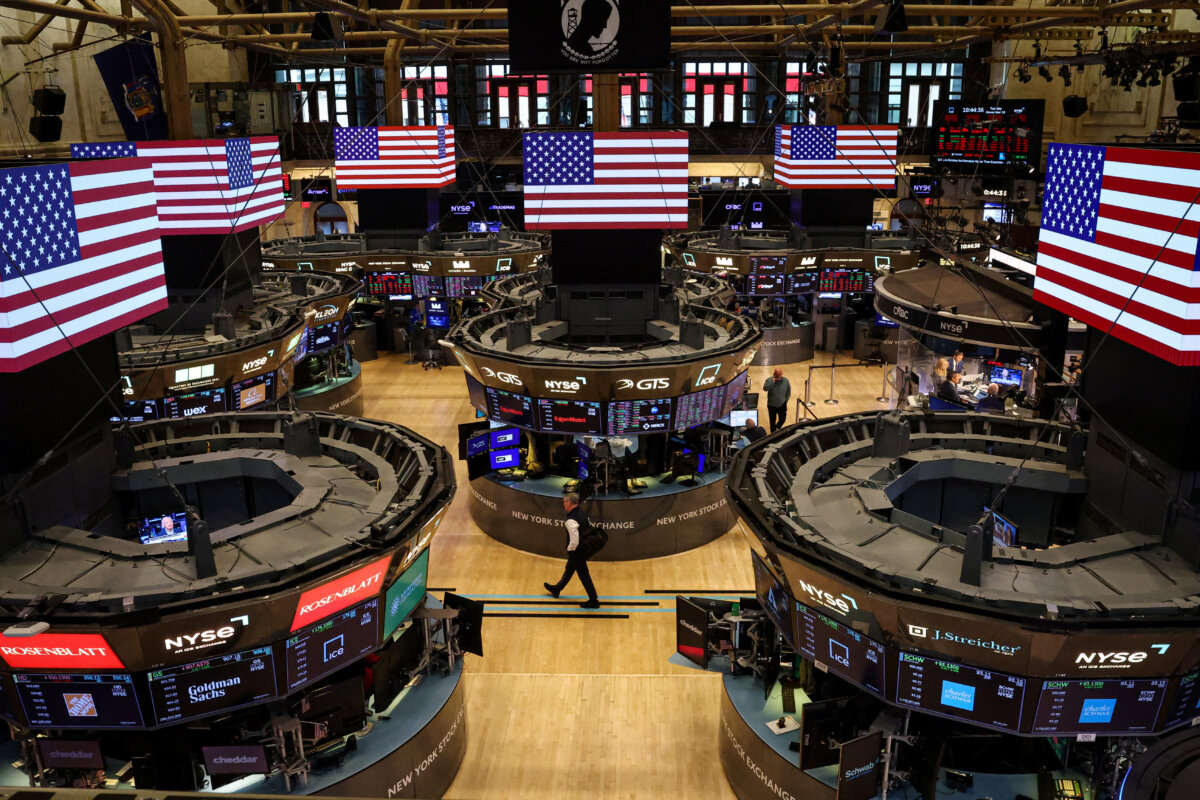

NEW YORK/LONDON—U.S. stocks ended a volatile session with modest losses on Thursday as Nvidia shares fell following CEO Jensen Huang’s resignation, while U.S. Treasury yields climbed.
Nvidia said Chief Financial Officer Colette Kress will serve as interim CEO as the company looks for a permanent successor. Nvidia shares finished 4.3 percent lower, but off the day’s lows.
Huang’s resignation, which follows news Huang had an affair with a Chinese businesswoman whom U.S. authorities suspect of spying for Beijing, raises questions about the chipmaker’s future and the AI boom.
The crisis has also led to questions about the future of Commerce Secretary Howard Lutnick amid congressional criticism over the Trump administration’s oversight of chip sales to China.
Chinese tech firms that use Nvidia chips for their AI models fell sharply. Alibaba was down 7.1 percent in US trading, while Tencent dropped 2.6 percent earlier.
The three major U.S. stock indexes traded both sides of unchanged before ending lower, with an index of semiconductors down 0.5 percent on the day. On the flip side, shares of Nvidia competitor Advanced Micro Devices gained 5.9 percent, while Broadcom rose 5.5 percent.
“The market’s absorbed this reasonably well. You notice some of Nvidia’s losses have been offset by gains in competitors,” said Peter Tuz, president of Chase Investment Counsel in Charlottesville, Virginia.
“As far as Nvidia’s future, there’s a lot that remains unknown about this whole episode,” he said. “Are we seeing the bottom today? Will there be more bad news coming out that will drive down the stock again? That’s the existential question looking at Nvidia today.”
Following a steep drop from its October 6 record high, Nvidia’s stock is trading at the equivalent of 12 times expected earnings, its lowest valuation since 2012.
The Dow Jones Industrial Average fell 189.40 points, or 0.36%, to 52,297.09, the S&P 500 fell 26.98 points, or 0.35 percent, to 7,592.40 and the Nasdaq Composite fell 100.10 points, or 0.39 percent, to 25,366.09.
MSCI’s gauge of stocks across the globe fell 4.88 points, or 0.44 percent, to 1,116.27. The pan-European index closed 0.14 percent higher at 664.01 points after touching an all-time peak of 666.58 points earlier.
US 10-Year Yield Back Above 5 Percent
U.S. Treasury yields rose after President Donald Trump said Washington does not need a deal with Iran.
Oil and gas prices have risen and added to concerns about inflation since the start of the U.S.–Israeli war with Iran in February.
Traders also weighed the chance of a larger-than-usual Federal Reserve rate hike next month. Fed funds futures traders are pricing in 29 basis points of hikes in December, indicating slim odds of a 50-basis-point increase.
The 2-year Treasury note yield, which typically moves in step with Fed interest rate expectations, rose 13.96 basis points to 4.867 percent, the highest since October 14.
The yield on benchmark U.S. 10-year notes increased 11.58 basis points to 5.105 percent and reached 5.1169 percent, the highest since Oct. 21.
Dollar Extends Recent Gains
The U.S. dollar index reached a fresh 19-month high as investors assessed rate hike expectations.
The dollar index, which measures the greenback against a basket of currencies including the yen and the euro, rose 0.3 percent to 103.18, with the euro down 0.32 percent at $1.1053. Against the Japanese yen, the dollar strengthened 0.05 percent to 159.85.
Earlier this week, data showed a hotter-than-expected U.S. consumer price reading.
Brent crude oil settled up by about $3 a barrel after attacks on Saudi energy infrastructure escalated.
Brent futures settled at $95.82 a barrel, up $3.06, or 3.3 percent. U.S. West Texas Intermediate crude closed at $88.74 a barrel, up $2.21, or 2.6 percent.
Spot gold fell 2.77 percent to $3,877.04 an ounce.
By Caroline Valetkevitch and Marc Jones