
U.S. technology stocks had a turbulent week as investors reassessed the artificial-intelligence trade, with semiconductor and data-center-related shares hit hardest after the midterm elections intensified concerns about the pace and cost of the AI infrastructure buildout.
The Nasdaq Composite dropped 3.37 percent for the week, the weakest performance among the major indexes, as a late-week rout in chip stocks erased an earlier rebound.
The S&P 500 fell 2.68 percent to 7,376, while the Dow Jones Industrial Average declined 0.94 percent to 51,285. The small-cap Russell 2000 lost 2.05 percent.
The CBOE Volatility Index jumped 32 percent to 25.64, reflecting a sharp rise in investor anxiety.
The selling marked a shift in sentiment toward AI-linked stocks. For much of the year, investors had treated declines in chip makers, software companies, and data-center suppliers as buying opportunities. This week, rallies met selling as questions grew about valuations, revenue models, and political resistance to the rapid expansion of data centers.
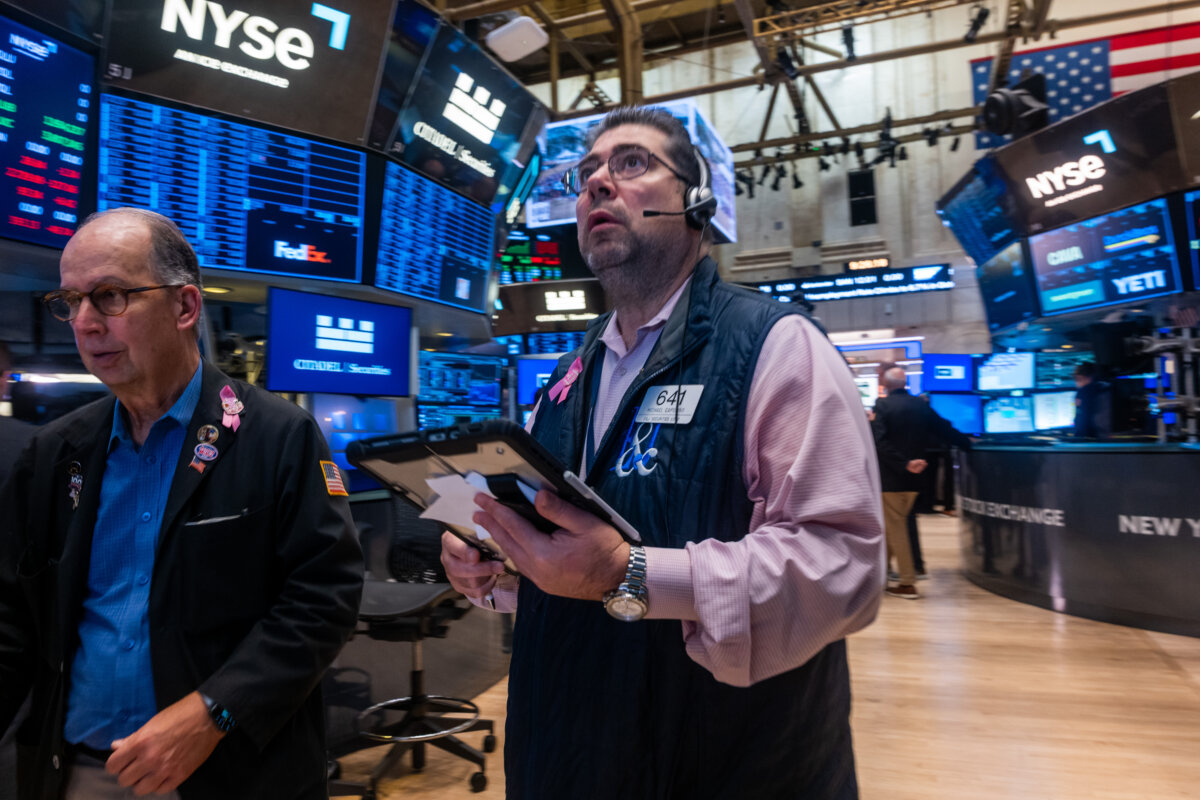
Semiconductor shares led the pullback. On Thursday, the iShares Semiconductor ETF fell 12.15 percent, while Advanced Micro Devices dropped 17.24 percent and Nvidia lost 9.23 percent. The weakness spread to large technology companies, with Microsoft down 3.58 percent and Apple down 1.53 percent.
The Nasdaq tumbled 5.52 percent on Thursday, dragging the broader market lower. The S&P 500 fell 4.38 percent, the Dow industrials lost 3.44 percent, and the Russell 2000 slid 4.45 percent.
David Bahnsen, chief investment officer of The Bahnsen Group in Newport Beach, California, said the pullback reflected the risk of a “blow-off top” in technology stocks after a period of excessive enthusiasm.
“A blow-off top happens when euphoria trumps rationality, when hope becomes strategy, and when hype replaces the lessons of history,” he told The Epoch Times.
“The recent tech-stock pullback does not represent a buying opportunity.”
He said investors remain too exposed to the AI trade and too complacent about risks.
“The concern in the stock-market aspect of the AI story is the complacency around risk and the disconnect from valuations and revenue models that make sense,” Bahnsen said.
A New Source of Uncertainty
The midterm congressional elections added a new source of uncertainty for the AI trade. Democratic victories raised expectations that lawmakers and state officials could slow or restrict data-center construction, especially in areas where rising electricity demand has become a political issue.
Data centers have become central to the AI investment boom. They require large amounts of power, land, chips, and cooling equipment, creating a broad supply chain that includes semiconductor makers, utilities, construction firms, and cloud-computing companies.
Investors now are questioning whether that buildout can continue at the same pace if political resistance grows.
Lale Akoner, global market strategist at eToro, told The Epoch Times that the midterm results signal a period of political gridlock, “which is likely to affect individual sectors more than the market as a whole and make Washington a more persistent source of uncertainty for investors.”
“One of the clearest at-risk sectors is data centers,” she said. “Data-center stocks have already reflected some of these potential shocks since July, but the risk does not yet look fully priced in.”
Jakub Rochlitz, a market analyst at eToro, said investors began repricing the AI supply chain after signs emerged that the infrastructure buildout could slow and get more expensive, potentially rewriting growth expectations across the entire supply chain.
“Rising electricity prices made data centers a political topic during the midterm campaign,” he told The Epoch Times.
“Multiple Democratic politicians want to pause their construction, with AOC and Gina Hinojosa, Texas’s governor-elect, being the most prominent ones.”
Rochlitz said weaker-than-expected growth numbers from Anthropic and OpenAI reported in early October had already made investors more sensitive to negative AI news. He said the midterm results added another pressure point.
Oil and Bonds Offer Brief Support
Sharp swings in oil prices and Treasury yields also shaped the week’s stock-market moves.
Brent crude fell more than 8 percent Wednesday to settle near $95 a barrel, extending losses for a third consecutive session and reaching a one-month low. Earlier in the week, Brent fell below $107 a barrel on renewed hopes of a diplomatic resolution to the U.S.-Iran conflict.
The decline in oil prices helped ease inflation concerns and pushed bond yields lower. The yield on the 10-year U.S. Treasury note fell to 4.9 percent on Wednesday from 4.91 percent on Monday, and further slipped to 4.84 percent on Thursday, its lowest level since mid-September.
Those moves supported a broad stock rally Wednesday. The Dow rose 3 percent, helped by gains in Microsoft and Apple. The S&P 500 and Russell 2000 each gained 1.58 percent, while the Nasdaq rose 1.44 percent.
Justin Buell, chief investment officer of Continuity Group in Springfield, Ore., said the midterm election initially helped reduce uncertainty for investors.
“The midterm elections come at the perfect time to rescue the stock market from its bout of AI-driven volatility,” said Buell, whose firm manages roughly $6.5 billion.
“Stocks have historically tended to rally after the midterms regardless of the outcome, as fading uncertainty brings relief to markets.”
He said divided government can also favor equities because it lowers the likelihood of major policy changes that could unsettle investors.
That relief proved short-lived. By Thursday, investors had shifted their attention from the broader benefits of reduced election uncertainty to the sector-specific risks facing AI infrastructure companies.
Strong Jobs Report Complicates Fed Outlook
A stronger-than-expected employment report added another complication for markets late in the week by raising the possibility that the Federal Reserve could lift interest rates in December.
The U.S. economy added 165,000 jobs in October, well above forecasts for 65,000. September’s gain was revised up to 60,000. Job growth was led by professional and business services, which added 70,000 positions, followed by healthcare with 42,000 and transportation and warehousing with 25,000.
The unemployment rate fell to 4.1 percent.
The report underscored the labor market’s resilience but also reinforced concerns that the Federal Reserve may need to keep policy tighter for longer. Higher rates tend to weigh on growth stocks because they reduce the present value of future earnings, a particular concern for richly valued technology shares.
Still, Clark Bellin, president and chief investment officer of Bellwether Wealth in Lincoln, Nebraska, said the jobs report could help stabilize sentiment by showing that the economy remains on solid footing.
“The stock market is in the midst of a correction, and the only way a correction ends is once we find a bottom, which can take time,” Bellin told The Epoch Times. “We believe it’s important for investors to be patient and put any new money to work slowly.”
He said uncertainty over the future of the AI buildout remains a central concern.
“There are significant fears about the AI trade, and the stock market does not like the uncertainty from the midterm elections, since Democrats have been vocal about slowing the data-center buildout,” Bellin said.
Bargain Hunters Return, but Caution Remains
Technology shares regained some ground Friday as investors stepped in after Thursday’s selloff. The Nasdaq rose 1.09 percent, while the S&P 500 gained 0.31 percent and the Russell 2000 advanced 0.89 percent. The Dow fell 0.46 percent.
The rebound did little to erase the week’s broader message: investors are becoming more selective toward AI-related stocks after a powerful rally left valuations stretched and expectations high.
Bahnsen said Thursday’s selloff showed what can happen when enthusiasm, not fundamentals, drives stock prices.
“Thursday’s market action is what happens when euphoria and hype become the reason why stocks go up, rather than fundamentals, and that’s exactly what has been happening with tech stocks,” he said.