SEARCH


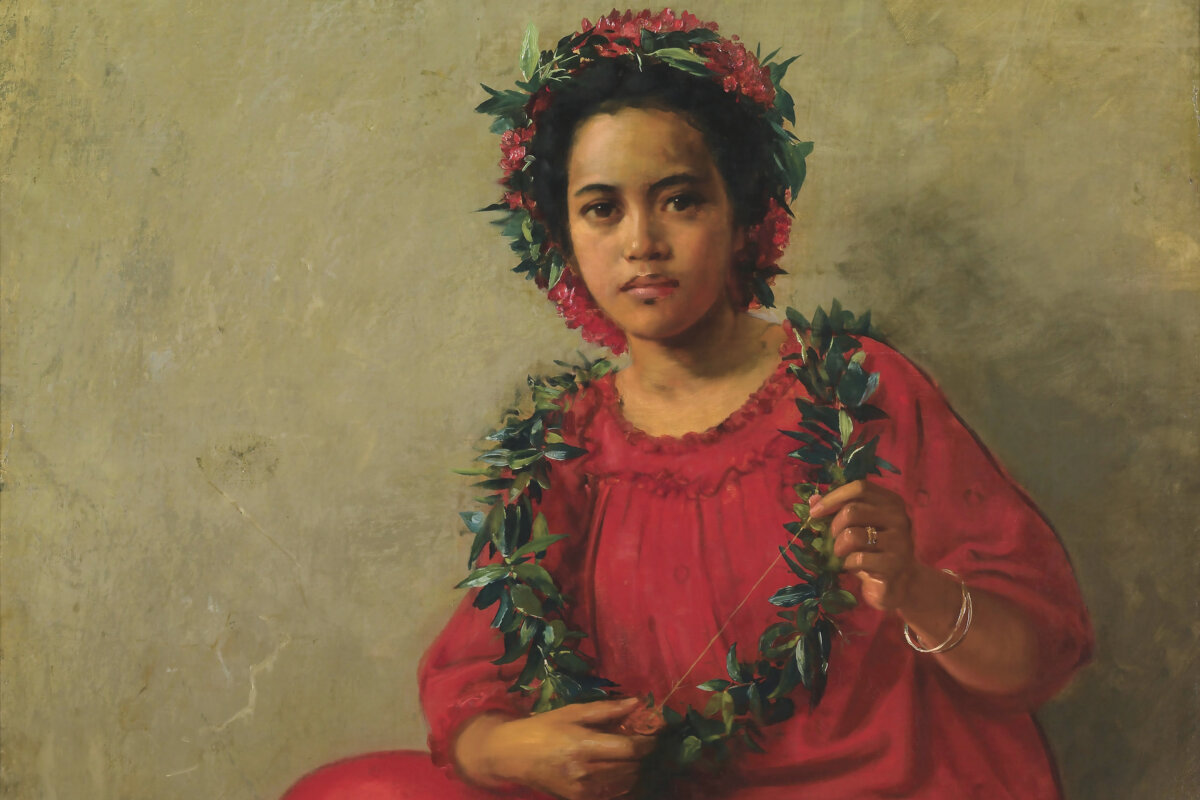
To create a lei of ilima flowers, each tissue-thin blossom must be carefully gathered and strung, with a single lei requiring anywhere from 500 to nearly 1,000 flowers. Once among the most abundant flowers used for lei-making in Hawaii, ilima became closely associated with Hawaiian royalty and was favored by Hawaii’s Queen Emma, who wore the flowers in long, delicate strands. Traditionally, the lei carried meanings far deeper than its modern association of welcoming visitors. It could express affection, honor, spirituality, and connection, making the act of creating one a labor of love.
Perhaps no image captures this tradition more famously than “The Lei Maker,” painted by Theodore Wores. The painting depicts a young Hawaiian woman, Elizabeth “Lizzie” Piilani Victor, carefully stringing a garland of ilima blossoms. After spending just two days in Oahu, Wores was inspired to create the painting because he felt the lei makers captured a unique aspect of Hawaiian life.
The Story Behind the Painting
To fully appreciate “The Lei Maker,” it helps to understand the remarkable life and career of the artist who created it. Born in San Francisco on Aug. 1, 1859, Theodore Wores showed an early talent for art. At just 12 years old, he began studying in the studio of Joseph Harrington, where he learned the fundamentals of color and composition. When the California School of Design opened in 1874, Wores was among its first students. After a year, he left for the Royal Academy at Munich, one of Europe’s leading art schools. The academy gave Wores a strong foundation, which emphasized accurate representation and dramatic contrasts of light and shadow.
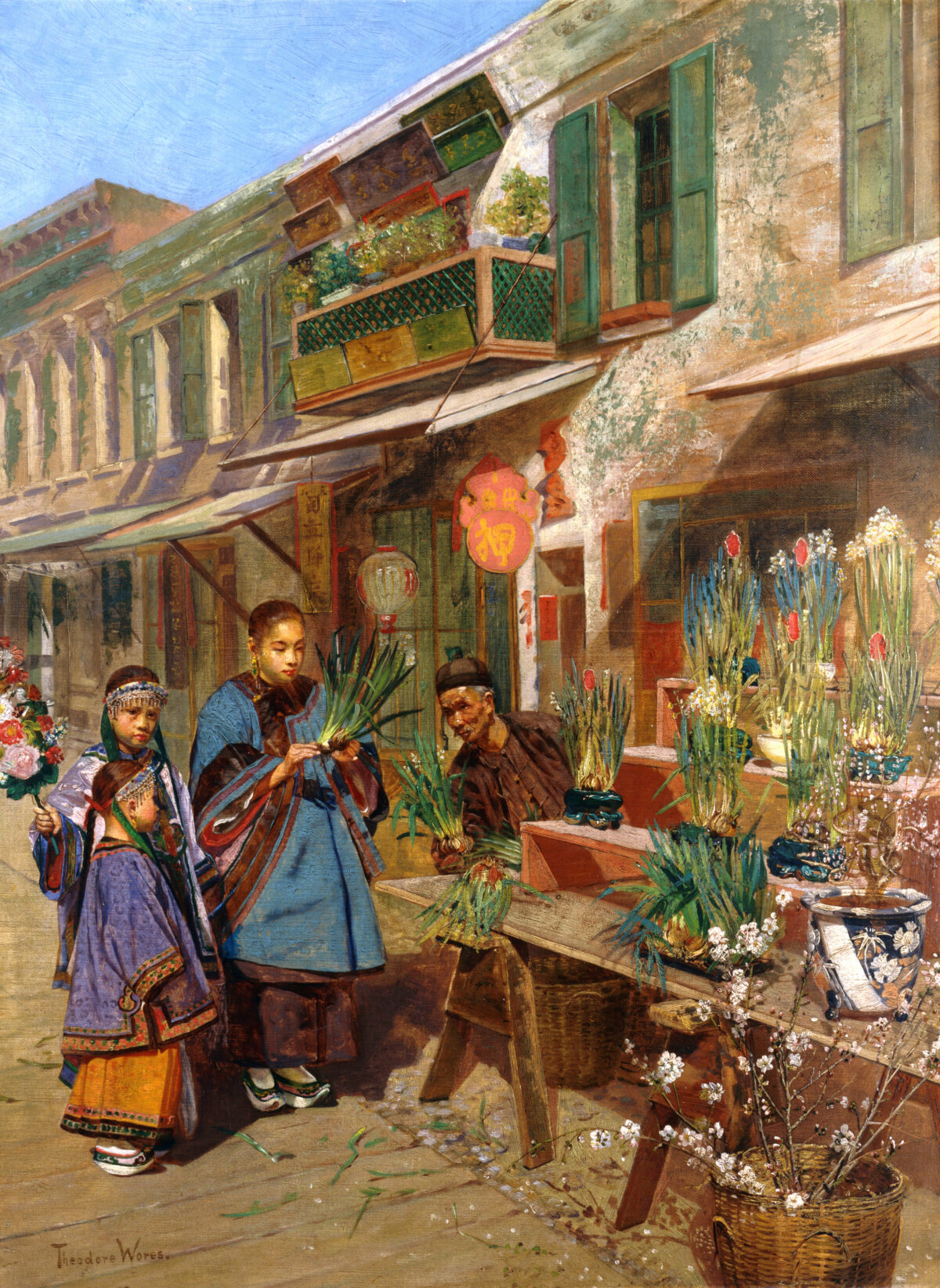
Wores returned to San Francisco in 1881, and he became one of the earliest American artists to spend significant time in San Francisco’s Chinatown. There, he painted scenes of the Chinese community and taught Western art to a small group of Chinese students. His curiosity about other cultures eventually took him much farther afield.
In 1885, he traveled to Japan and remained there for nearly three years, immersing himself in the culture. His experiences there had a lasting influence on his work and led to lucrative exhibitions of his Japanese paintings in New York and London. During this period, he also formed friendships with prominent figures such as James McNeill Whistler and Oscar Wilde.
Travel became a defining part of Wores’s artistic life. He painted throughout Europe, Japan, the South Pacific, and North America, drawing inspiration from the varying landscapes and cultures. In Spain, he was particularly inspired by Diego Velázquez, whom he considered “the greatest painter of them all.” His work reflected both his academic training and his fascination with the wider world.
Wores and a Changing Hawaii

In 1901, Wores traveled to Hawaii and Samoa, where he produced portraits of prominent residents as well as paintings featuring the local landscapes and daily life. From 1901 to 1903, he exhibited more than 100 paintings in Hawaii with the Kilohana Art League.
Wores was fascinated by the islands, yet disappointed by the developing modernization and the disappearance of much of Indigenous life. Although “The Lei Maker” illustrates a traditional practice, it also reflects the romanticized vision of Hawaii that had become familiar to outsiders. These tensions are what make the painting so important now; they show not just a beautiful image but an artist’s perspective and a historical perspective.
Wores’s career continued through decades of change. After losing his San Francisco home and studio in the 1906 earthquake and fire, he served as Dean of the California School of Design from 1907 to 1913. He continued to travel and paint, spending time in Canada, as well as New Mexico, and the Territory of Hawaii. From 1915 to 1917, he lived briefly in Taos, where he painted Indigenous subjects and portraits. He remained active as a painter until his death in San Francisco in 1939.
Today, “The Lei Maker” is part of the permanent collection of the Honolulu Museum of Art. Seen through the lens of Wores’s life, the painting reflects an artist captivated by the beauty and connections he encountered. In this way, Wores translated his sense of appreciation into art, much as “The Lei Maker” transformed flowers into an expression of care and connection.
What arts and culture topics would you like us to cover? Please email ideas or feedback to features@epochtimes.nyc.