SEARCH


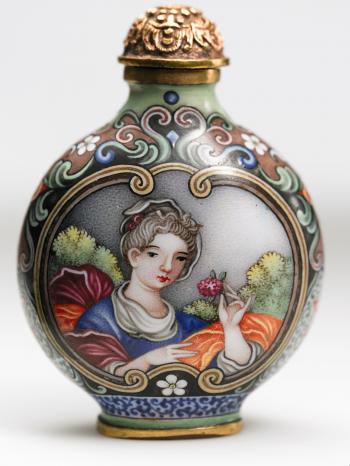
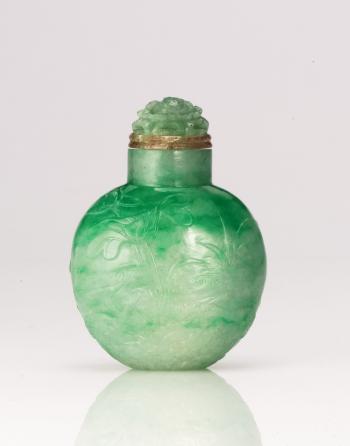
The Joe Grimberg Collection of Chinese Snuff Bottles is a highlight of Asia Week sales in New York according to Sotheby’s. The collection is a personal and tasteful selection that dates back as early as the beginning of the 18th century. They reflect the broad variety of Chinese decorative arts at the time, including from glass, porcelain, copper, and jade.
Grimberg bought only from respected dealers and auction houses, meaning that many of the bottles have extensive and impressive provenance, and, at times imperial attribution. The auction is estimated to fetch up to $6.5 million.
Grimberg developed a compact collection focused only on snuff bottles of the highest quality; therefore to ensure that his collection didn’t grow to over 200 bottles one would leave the collection every time a fresh snuff bottle was added.
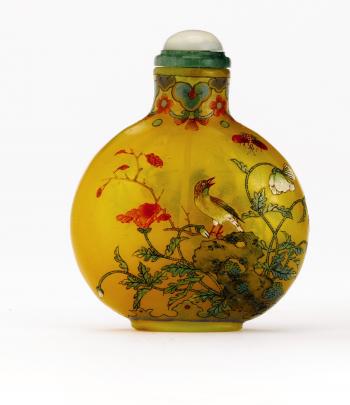
An example of the history that each individual snuff bottle holds, and a highlight of the collection, is an Enamel on Copper Snuff Bottle, Imperial, Palace Workshops, Beijing, Qianlong mark and period (1736-1795), (estimate:$250,000-$350,000). The Qianlong emperor would possibly have owned the bottle; he was fascinated by European culture and in fact, several Jesuit missionaries, who were skilled artists, were attached to the Court and drove many artistic and technical developments.
European subjects, particularly young women, are depicted on snuff bottles, porcelain, and other enamelware, and several famous examples are in museum collections, such as the National Palace Museum in Taipei.
Snuff History in China
Snuff is a form of powdered tobacco that is usually inhaled through the nose. The Chinese considered snuff to be a useful remedy for colds, headaches, stomach disorders, and other minor ailments. During that period, tobacco was forbidden, but because snuff was considered medicinal it was allowed.
The bottles were originally more popular with the upper class society, but eventually became commonly used among all social classes. However the upper class of Chinese society had a taste for the most exquisite and unique snuff bottles.
“The use of snuff became a social ritual of the upper classes. The containers upon which much art, taste and money had been expended became the subject of active acquisition,” explains Chinese snuff bottle expert, Robert Hall, on his website, Snuffbottle.com . “Snuff bottles also became the new currency for the purchase of favors, positions and advancement in government.”
The Joe Grimberg Collection of Chinese Snuff Bottles is on public exhibit daily from Sept. 9-13 at the New York showrooms of Sotheby’s.