SEARCH



Geraldine Page was among the most celebrated actresses of her generation. But since her passing in 1987, this Oscar- and Emmy-winning performer has never been the subject of a biography.
Angelica Page, the star’s daughter from her marriage to character actor Rip Torn, took it upon herself to biographically celebrate her mother. Those expecting a straightforward retelling of Page’s life should heed the warning in the book’s preface.
“This is not a biography, but a cross section of my own lush memories fused with all the bits of information that I’ve gathered throughout my life and on and around the subject,” the author wrote. She added that her mother was “a great storyteller” and the newly published “Bountiful: Growing Up with Geraldine Page: A Daughter’s Memoir” was “simply my witnessing and that autoptic recounting to you, the reader.”
A Secret Marriage
Page may have been “a great storyteller,” but her daughter discovers a story she never shared. This involves her hitherto-unknown first marriage during the 1940s to Edward Nicholls, a World War II veteran who shared Page’s pursuit for a theater career.
The marriage frayed when Nicholls wanted to give up on show business and find a career with more financial stability. He expected Page to do the same, but she refused and the couple separated. Nicholls, who suffered a head injury in the war, committed suicide in 1949. His family blamed Page for his death, going so far as to expel her from his funeral.
Later, the author only devotes three pages to the actress’s brief second marriage in the early 1950s to Alexander Schneider. She identifies him as a “Russian violinist,” although Schneider was Lithuanian. The author claims her mother spoke only once about Schneider, “at the Russian Tea Room over vodka and caviar when I was a teenager enduring my first break up.”
A Celebrity Cavalcade
“Bountiful” devotes much more space to Page’s professional (but not romantic) relationship with James Dean, when the two co-starred in the 1954 Broadway production of “The Immoralist.” The book credits Page for using her connections to help secure Dean’s first starring film role in “East of Eden.”
Fans of show business gossip should enjoy some of the book’s anecdotes. The author notes that Page passed on the inaugural Broadway version of “Who’s Afraid of Virginia Woolf?” and the film version of “The Exorcist”; this enabled Uta Hagen and Ellen Burstyn to earn acclaim in those respective productions. Page claimed that Hagen and Burstyn were jealous of her despite their own considerable successes.
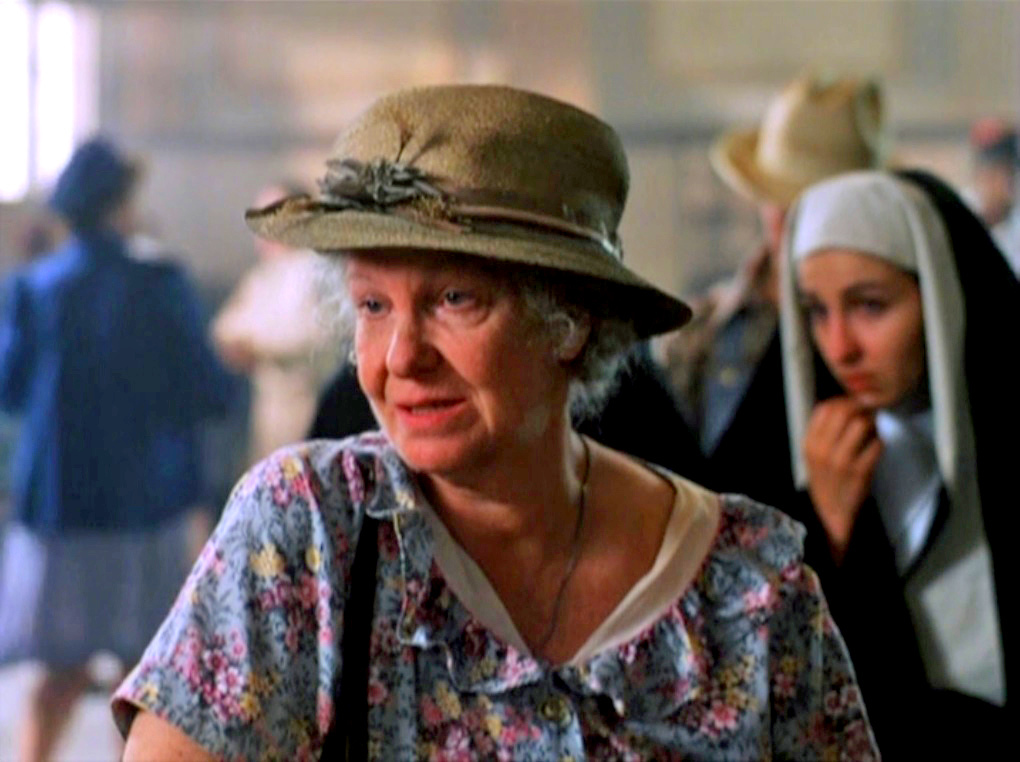
Page was not comfortable working with John Wayne’s take-charge personality during the Mexican location shoot for the 1953 Western “Hondo,” her first Hollywood film. She insisted that Marilyn Monroe was trying to steal acting secrets from her during workshops at New York’s Actors Studio.
She was even more ill at ease with Woody Allen, who directed her in the 1978 “Interiors.” Page accepted the job without seeing the script, believing it would be a whimsical comedy in the spirit of the filmmaker’s previous work. She was aghast at discovering it was a drama and complained that Allen’s direction of her emotionally complex role was too vague.
As for her beloved late-life role in “The Trip to Bountiful,” Page initially rejected it because she felt the $60,000 fee was far too small. She changed her mind and the film won her the Academy Award after she endured seven previous nominations over a 32-year span.
A Not-Overnight Star
The best parts of “Bountiful” involve the pre-stardom Page. Her supposedly overnight celebrity came in the 1952 Off-Broadway production of Tennessee Williams’s “Summer and Smoke.”
In reality, that triumph followed a decade of little-noticed regional theater performances, along with endless struggles to make ends meet via odd jobs. This section of the book offers rich insight into Page’s indefatigable spirit. She pushed forward when her professional life was ripe with disappointments.
“Summer and Smoke” was a happy fluke, given that the play flopped on Broadway a few years earlier and was staged at a tiny Greenwich Village space with minimal promotion. Thanks to an unexpectedly generous review by New York Times drama critic Brooks Atkinson, Page (along with her director José Quintero and the Circle in the Square Theatre) became the toast of New York.

The Author’s Stumbles
When Angelica Page becomes part of her mother’s story, “Bountiful” grows uneven. Her childhood wonder in meeting such luminaries as Walt Disney, Lena Horne, and Clint Eastwood makes for charming reading.
But Page’s late-teen years as a shaved-head groupie in New York’s early 1980s punk rock scene have much less charm; she claims that she was forced to stay away from Sid Vicious after his girlfriend Nancy Spungeon threatened to slash her face with a razor. The author makes no mention of what her parents felt about her antics during this time.
Page’s raucous marriage was to Rip Torn, a hot-tempered philanderer who fathered a child with his assistant. The author insists her mother’s devotion to her third husband came from her ability overlook significantly negative issues and focus on the positive. Strangely, the author only makes fleeting mention of her younger twin brothers.
The least positive aspect of “Bountiful” can be blamed on its copyeditor, who enabled more than a few spelling errors to go to print. References to “Orson Wells,” “Sterling Hyden” and the Oscar Wilde play “Solome” are inexcusable.
Despite its imperfections, “Bountiful” should be welcomed as a long-overdue tribute to an acting luminary. Theater and film aficionados will certainly enjoy this celebration of Geraldine Page’s legacy.
‘Bountiful: Growing Up with Geraldine Page: A Daughter’s Memoir’
By Angelica Page
Three Rooms Press: Oct. 6, 2026
Hardcover, 340 pages
What arts and culture topics would you like us to cover? Please email ideas or feedback to features@epochtimes.nyc