SEARCH


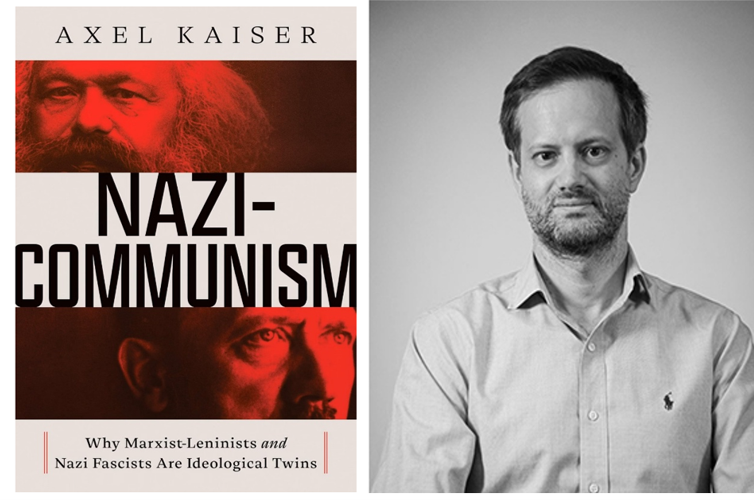
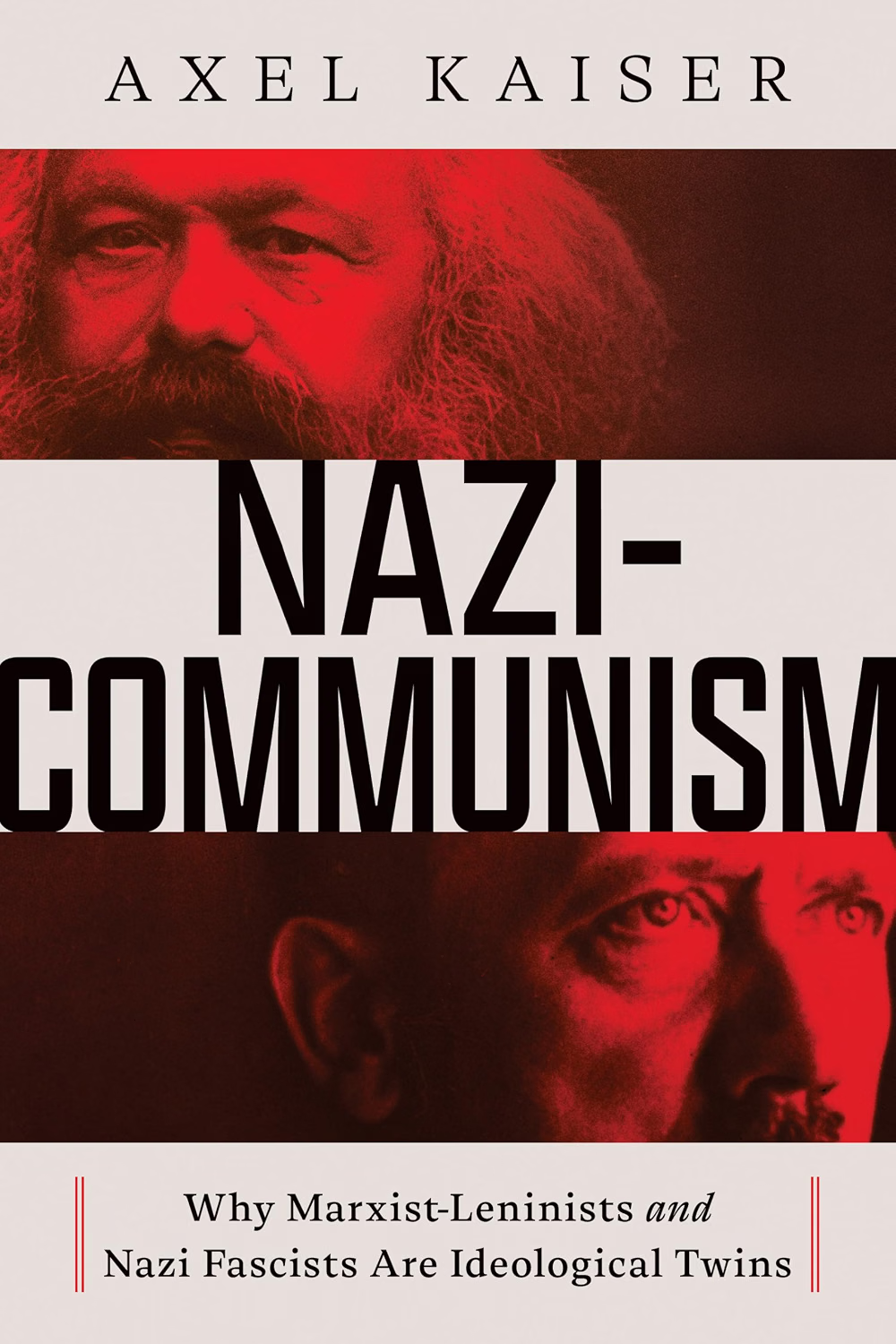
Axel Kaiser’s new book, “Nazi-Communism: Why Marxists-Leninists and Nazi Fascists Are Ideological Twins,” says something everyone knows but few acknowledge: All modern totalitarian systems are essentially the same.
This would be unremarkable except that the purported difference between the two central systems, fascism and communism, dominates mainstream politics through the myth of the left-right political system.
This is how it goes: Communism is on the left, and fascism is on the right, making the two not only different but opposites. It’s a lie that gives license to the left to pursue ends it claims the right is guilty of. Socialism may be on the rise for no better reason than its name and that the name is associated with the left.
The word socialism, and therefore the left in general, has a soft connotation. What’s wrong with being “social”? But the contrasting word, fascism, along with anything “right-wing,” sounds irredeemably harsh.
Given a choice between these two without further information, who wouldn’t choose the left? The author asks readers to explain, then, the following words from leftist black nationalist W.E.B. Dubois, published in the Pittsburgh Courier on January 2, 1937:
“Germany and Russia are the two greatest Socialistic states of the Modern World, and are pursuing their attack on private business along essentially the same lines.”
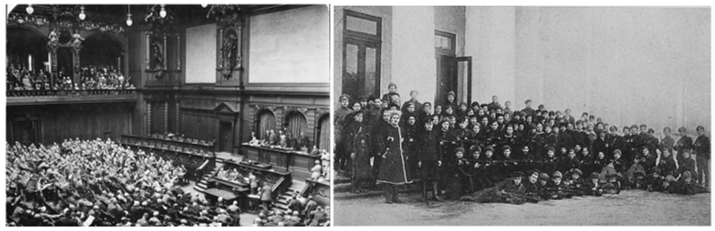
Ideological Brotherhood
Germany in 1937 was Nazi Germany. Like many intellectuals of that time, including such luminaries as George Bernard Shaw, Dubois recognized the brotherhood of communism and Nazism.
The relationship was confirmed by the Molotov-Ribbentrop Non-Aggression Pact of 1939, which made de facto allies of the Soviet Union and Nazi Germany; Hitler broke this peace deal when he launched Operation Barbarossa in 1941. Paraphrasing Hannah Arendt in “The Origins of Totalitarianism”: Stalin so trusted Hitler that he refused to believe numerous intelligence reports of the invasion. This betrayal shocked Stalin.
Kaiser mentions the pact, along with other specifics of the relationship between Nazi Germany and the Soviets, only in passing. He spends the majority of his pages on five areas of intellectual commonality that point to the shared identity of the two nations.
These are Anti-rationalism (Relativism); Anti-individualism (Collectivism); Anti-capitalism (Socialism); Anti-Christianity (Political Gnosticism); and Anti-humanism (Luciferianism).
The last, which may at first seem to be the most fantastic, is in actuality the most fundamental. Once God and the nature of humanity are banned from the intellectual scene, the earlier conditions inevitably follow.
A frequent visiting scholar at the Hoover Institution and co-founder and president of Chile’s Foundation for Progress, Kaiser is a German-Chilean lawyer with a doctorate in philosophy from the University of Heidelberg.
He understands more than most commentators the importance of the ideas buttressing totalitarianism; his book smartly attends to the five most pernicious and most difficult to combat.
Collectivism
The ideas of relativism and collectivism, for instance, are so ingrained in the current culture that only a full-on attack can bring them down. How else could Mayor Mamdani of New York speak of “the warmth of collectivism” without being laughed off the stage?
Here, Kaiser has begun that attack. He cites as allies fellow writers and philosophers Ludwig von Mises, Friedrich von Hayek, Karl Popper, Arendt, Aleksandr Solzhenitsyn, Thomas Jefferson, Adam Smith, and even Bertrand Russell, who in one of his moments of greatest clarity, dismissed Karl Marx as “muddle-headed.”
The ideological roots of communism and Nazism are ideology itself. Kaiser writes, paraphrasing Mises, that until recently, “(N)o one questioned the idea that human reason was structurally identical among all individuals regardless of race, sex, or social class. Everything would change … with Marx and the Marxists, for whom thought is determined by the thinker’s class position.”
Thus was born ideology. While today we are taught to consider the thinker’s race or sex rather than his class, the core of this remains the rejection of reason. Ahead of the game in a morbid sense, the Nazis substituted race for class. “Jewish thinking,” even when—or perhaps especially when—it was objectively true, was forbidden. Kaiser wrote: “Marxism and Nazism are, therefore, irrefutable doctrines since they do not accept any argument based on evidence or the universal rules of logic,” since they don’t accept them.
Identity
From this point, it’s a tiny step to the assertion that collective identity is superior to individual identity, Kaiser observes.
“As collectivist doctrines, communism and Nazism postulate that the individual is nothing more than an element within the whole, a part of a greater organism with transcendent characteristics to which he must submit: the nation, the class, the race, and so on. … For the Nazi, any crime committed by a Jew against an Aryan is committed by all Jews against all Aryans,” while for the communist, a single bourgeois act against a member of the proletariat is the entire bourgeoisie abusing the entire proletariat.
Socialism is the only economic system that correctly expresses the irrational ideological nature and collectivist prejudices of these beliefs. It declares facts irrelevant.
This is why the cry “Socialism has never worked” has no impact; it’s a mere fact. In both its communist and Nazi forms, socialism rejects individual justice for collective “justice,” which is why the legitimacy (or lack thereof) of court decisions is, for communists and/or Nazis, a moot point. Judicial decisions either serve the ideology, or they don’t.
Answering one of the left’s most damaging lies, Kaiser firmly rejects the notion that the Nazis were pro-capitalist. Quoting extensively from Hayek’s refutation of this calumny, he points out that Hitler enacted numerous socialist acts that limited or eliminated owners’ property rights.
The categorical identity of a belief system that rejects facts, reason, and the existence of individuals apart from that belief system is: a religion.
A Religion
On his last two points, Kaiser’s argument is particularly forceful: Totalitarianism—whether communist, Nazi, or in any other conceivable form—is a secular religion. It’s the anti-Judeo-Christian religion of a material world robbed of a spiritual dimension. We battle against material entities, yes, but also against principalities and powers.
Of what immediate importance is Kaiser’s understanding of communism and Nazism as twin belief systems? It’s of enormous importance, equaling or surpassing any issue now before the body politic.
It can be made clear through a program of accurate speech and information. Socialists are now on the rise, and their ultimate goal, in their own words, is communism. Essentially, they are no different from Nazis.
If the false left-right political spectrum could be struck down and a new one put in place that opposes socialism-fascism on the left with freedom on the right, then decades of progressive propaganda in the universities might be reversed, or at least weakened.
Opportunities to make this point must not be squandered. Imagine the powerful results that might have occurred had President Trump had answered Mayor Mamdani’s accusation of fascism with something along the lines of: “Fascism is anti-capitalist. One of us is indeed a fascist, but it’s not me.”
For far too long, the radical left has confused the public with its ideological lies. It’s time to confuse them back with the truth.
‘Nazi-Communism: Why Marxists-Leninists and Nazi Fascists Are Ideological Twins’
By Axel Kaiser
Encounter Books: Nov. 3, 2026
Hardcover, 226 pages
What arts and culture topics would you like us to cover? Please email ideas or feedback to features@epochtimes.nyc.