SEARCH


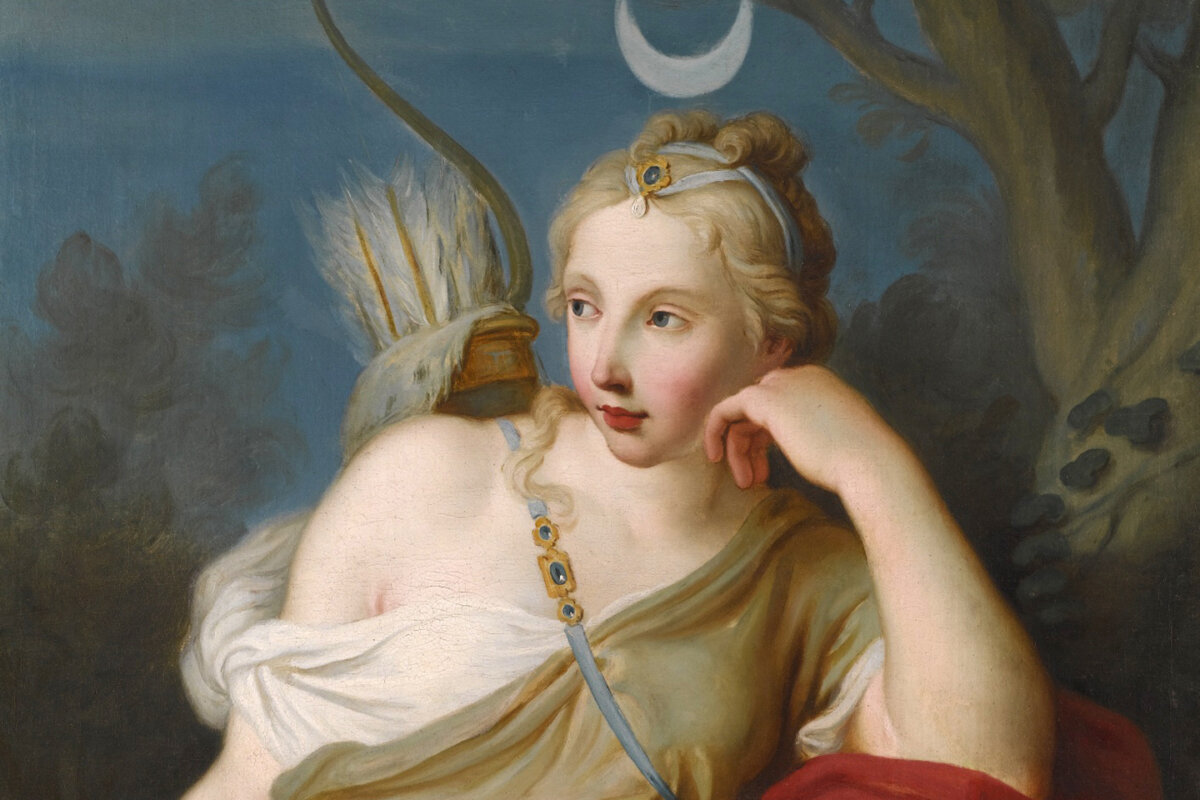
She has been cast in lead, engraved in ink, and painted at rest beneath a tree. She has even raced across a mantel in a gilded chariot, one wheel doubling as a clock face. For thousands of years, artists have reimagined the goddess Diana. What is it about her that has held their imagination for so long?
The answer begins with her multiplicity: In Roman mythology, she presided over the hunt, the moon, the wilderness, and childbirth. This breadth gave artists many ways to portray her. Some emphasized her bow and arrow or her faithful hunting dog; others favored the crescent moon or her command of the natural world. Even her name carried layers of meaning, derived from Latin roots associated with “shining,” “divine,” and “daylight.”
Her adaptability proved especially valuable in the 18th and 19th centuries, when European interest in classical antiquity resurged. Archaeological discoveries, the popularity of the Grand Tour, and the rise of neoclassical art encouraged artists and collectors to revisit ancient subjects. Diana was omnipresent, showing up in paintings, sculptures, porcelain, furniture, and decorative objects. Following her from a Roman mosaic in Tunisia to a neoclassical clock in Washington reveals how a single mythological figure became a mirror for changing tastes, ambitions, and ideas.
Ancient Roots, Classical Models
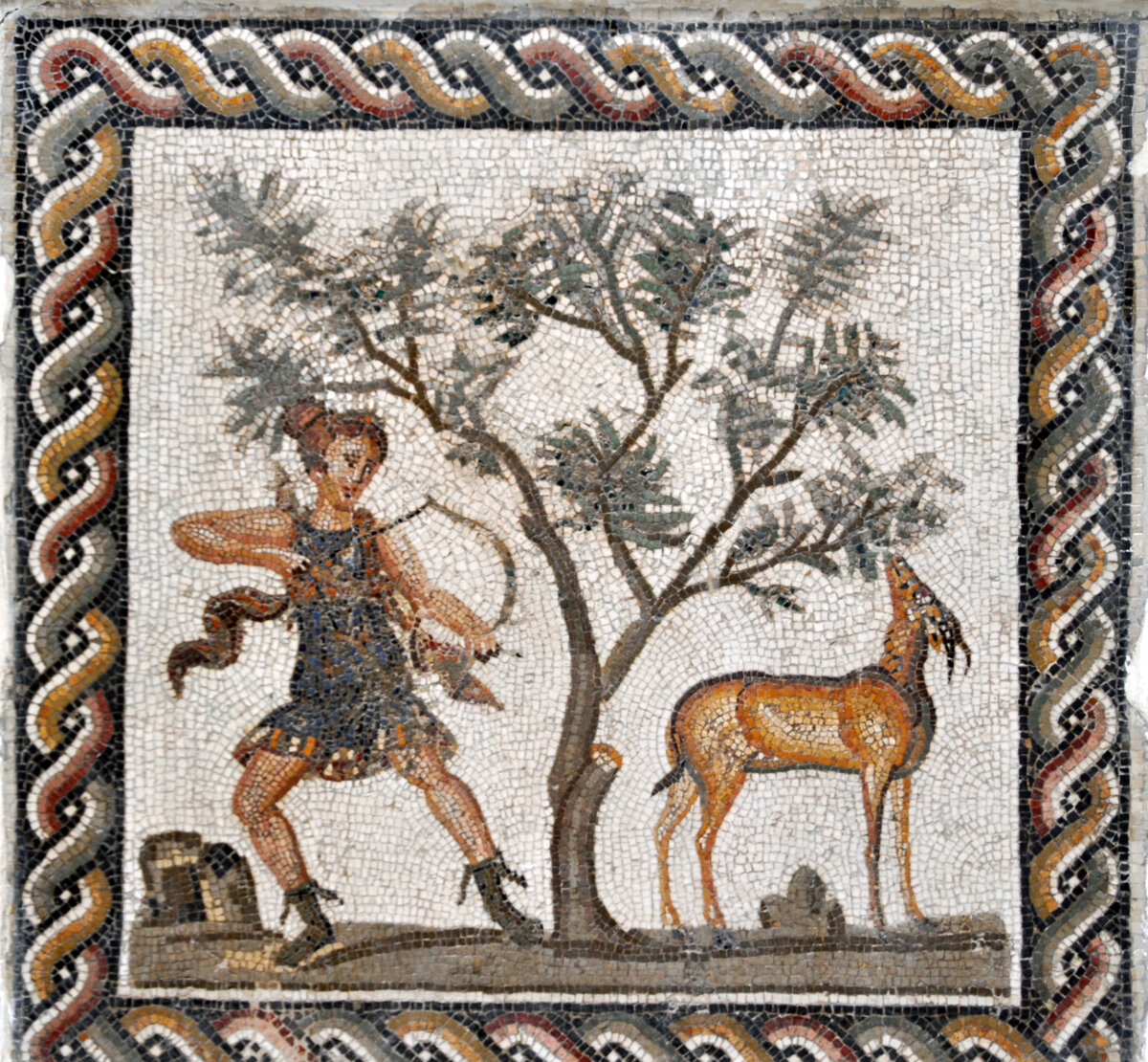
The journey begins in ancient Italy, where Diana was first worshipped as a goddess of the woods. Through sustained cultural exchange with Greece between the 6th and 4th centuries B.C., she was identified with the Greek goddess Artemis and took on her myths and imagery, including the bow and quiver of a huntress. These blended traits shaped Roman depictions of the goddess, and her visual legacy begins in Roman art. A mosaic from roughly A.D. 150 to 200, now in the Bardo National Museum in Tunisia, shows her as an active huntress armed with a bow and arrow.
Mosaics were important features of Roman private residences and public buildings. Skilled artisans assembled small pieces of colored stone, known as tesserae, into intricate images and patterns. Mythological subjects were popular, allowing homeowners to display their taste while drawing on stories familiar throughout the Roman world. Diana’s presence in a North African mosaic also shows how Roman artistic traditions traveled beyond Italy, as local communities across the empire adopted and adapted Roman visual culture.
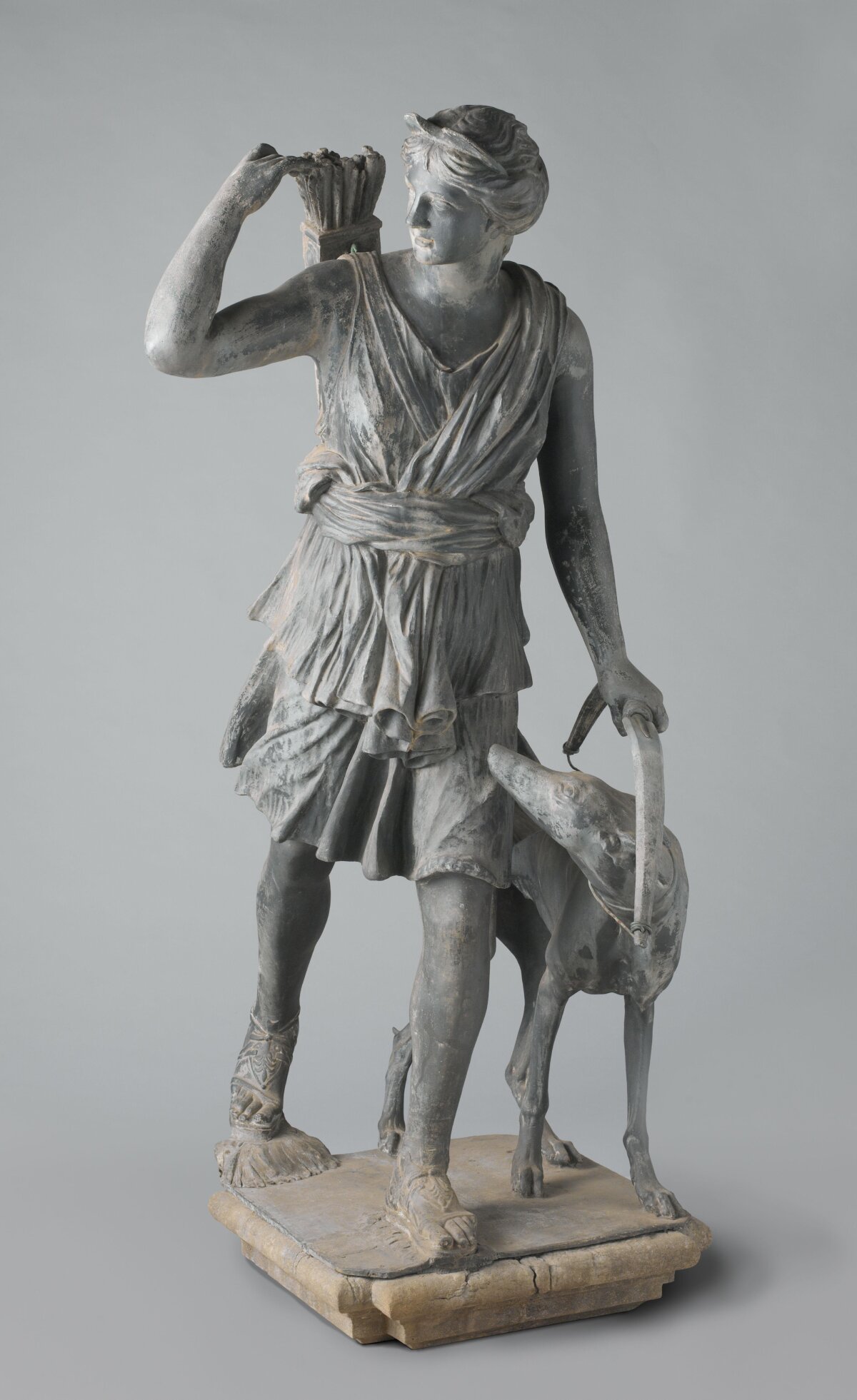
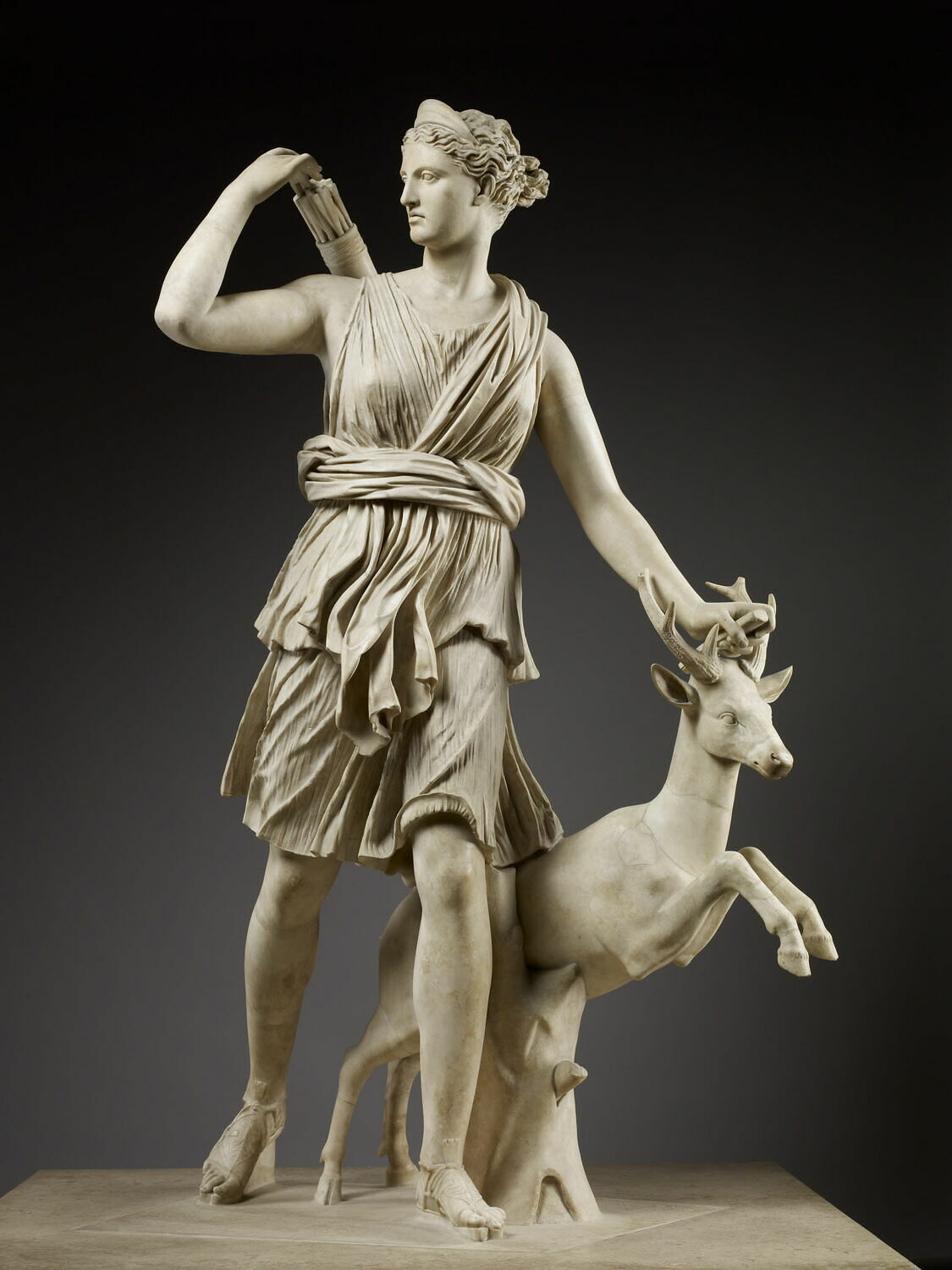
More than a millennium later, ancient models continued to shape images of the goddess. In the early 18th-century Dutch lead sculpture “Diana the Huntress,” Diana appears in mid-stride, holding her bow in one hand while reaching behind her shoulder for an arrow with the other. A greyhound looks up at her. The composition is based on an ancient Roman marble of Diana now in the Louvre, and its dynamic pose reflects how European artists and collectors looked to antiquity for inspiration.
The sculpture was originally displayed in a garden in Monnickendam, a town in North Holland. Its placement reflects the popularity of mythological garden sculpture on European estates, where gods and goddesses turned outdoor spaces into carefully arranged classical landscapes.
Portraiture and Personal Identity
In the 18th century, Diana became a symbol of independence and aristocracy, as wealthy women commissioned portraits historiés that cast them as the goddess. Instead of depicting an exact likeness, these portraits linked the sitter to the qualities of a historical or mythological figure. Each offered a different set of associations. Venus evoked beauty and love, and Minerva suggested wisdom. Diana combined physical strength, independence, and beauty. A noblewoman portrayed as a Diana offered her an appealing image of self-possession.
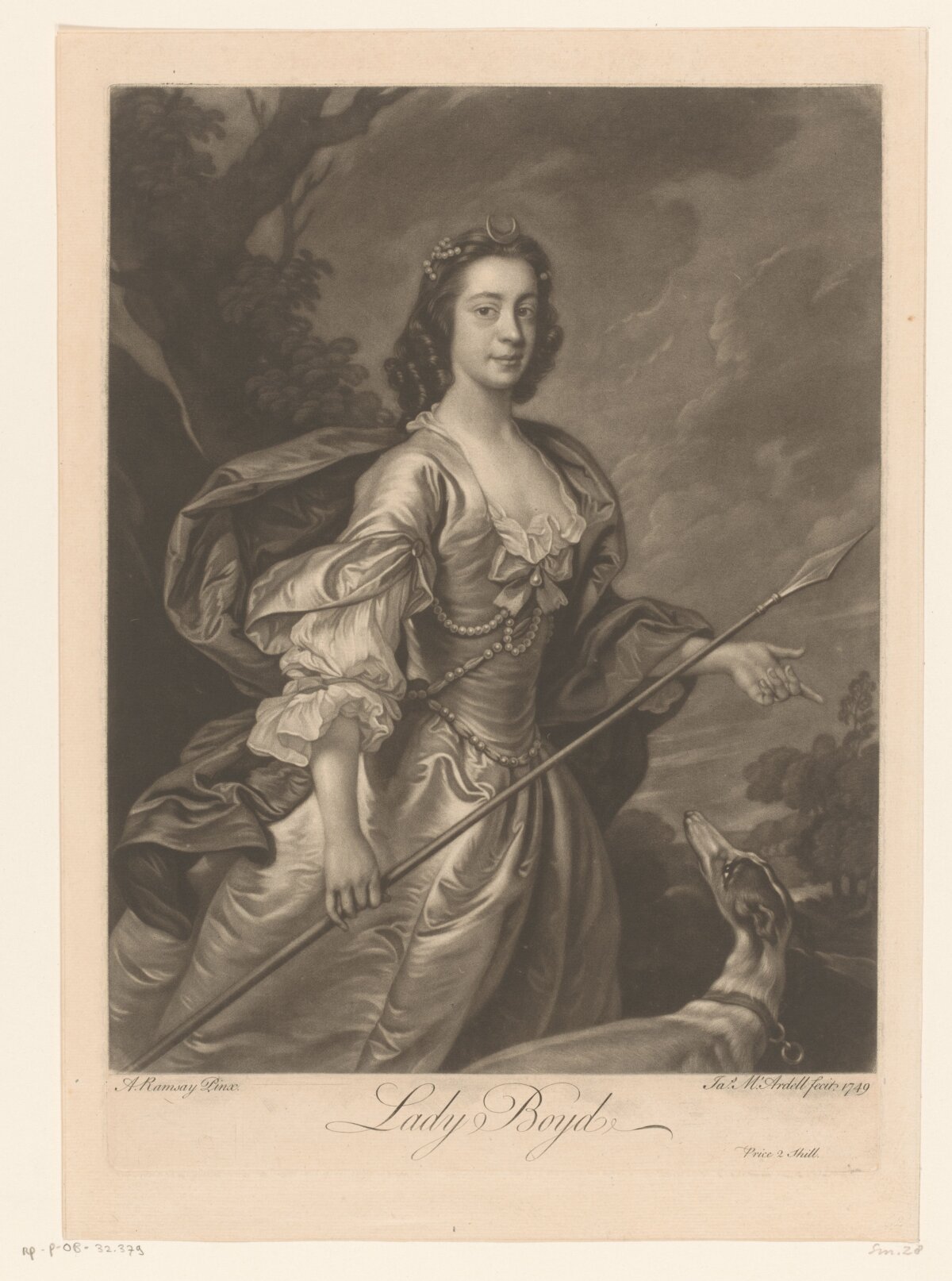
In the mezzotint “Lady Boyd as Diana,” Irish engraver James McArdell portrays Rebecca Lockhart, Countess of Erroll, who was known at the time as Lady Boyd. She appears as Diana, accompanied by a hunting dog. McArdell’s choice of medium is also noteworthy. Developed in the 17th century, mezzotint allowed rich tonal gradations, making it well suited to reproducing painted portraits and circulating the work of prominent British and Scottish portraitists to a wider audience.
Through his print, Lady Boyd’s portrait joined a broader tradition that transformed contemporary women into classical figures.
Nature, Movement, and Grace
While some artists emphasized Diana’s strength and skills as a huntress, others explored her connection to the natural world. Italian painter Pietro Antonio Rotari offers a contemplative interpretation in “Diana, Goddess of the Hunt, Leaning Against a Tree.” Her bond with the wilderness remains central, but the composition invites viewers to consider the goddess outside the action of the hunt.

Rotari was known for his portraits and elegant figure studies. Born in Verona, he worked in several European cities before traveling to Russia, where he served at the court of Empress Catherine II. His international career reflects the movement of artists and ideas among the royal courts of 18th-century Europe.
Rotari’s painting shows how artists could use mythology to explore mood, character, and narrative. Diana’s identity does not depend on the act of hunting, and a wooded setting is enough to evoke her association with the wilderness. The result emphasizes grace and composure, a striking contrast to the lead garden sculpture that depicts Diana in motion. Yet both works reveal the range Diana inspired, from contemplation to dynamism.
Classical Style in the Home
By the early 19th century, Diana’s image moved beyond paintings and sculptures into increasingly inventive decorative objects. “Mantel Clock with Diana Hunting in a Chariot,” a French work from approximately 1810, is a particularly ornate example.
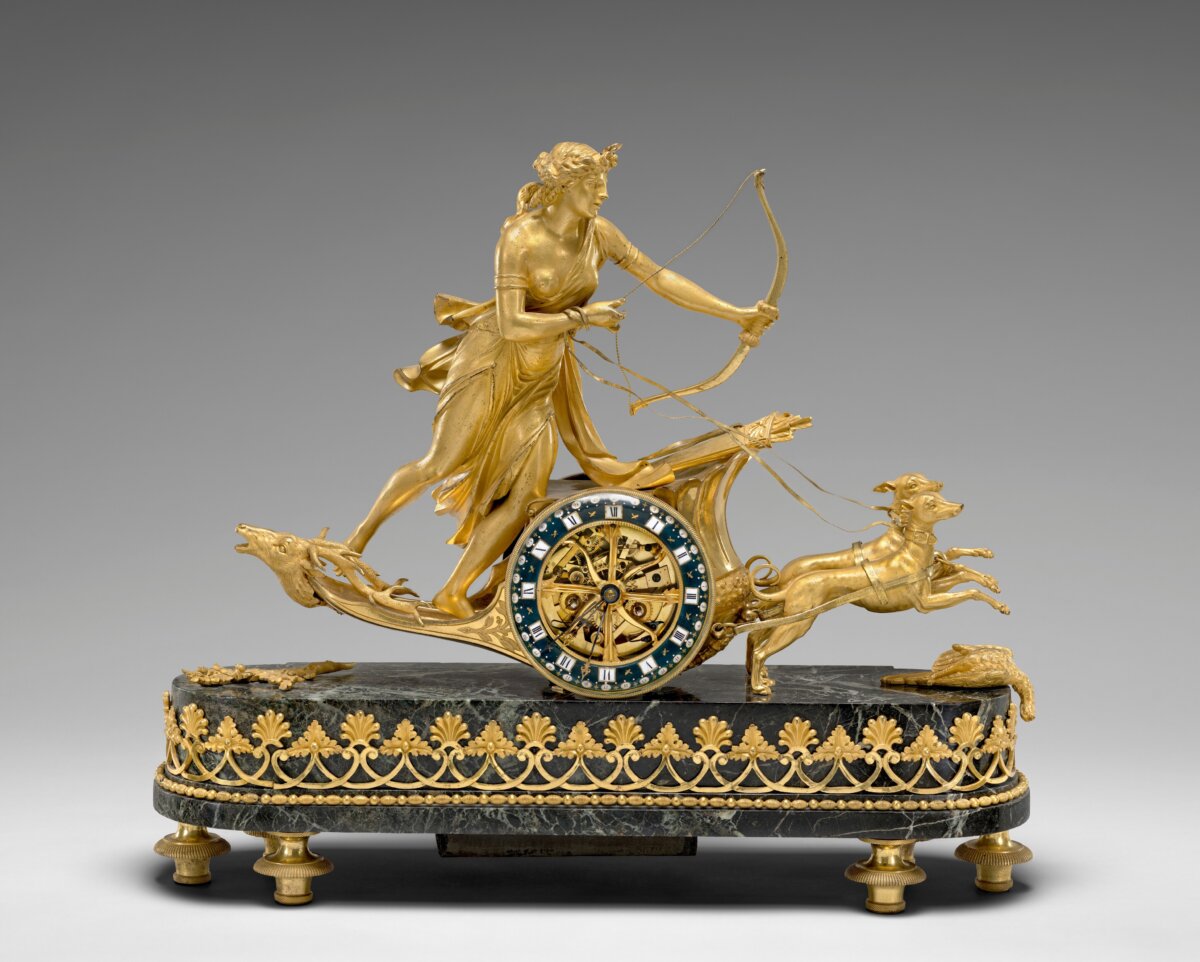
Made of gilded bronze, marble, enamel, and glass, the clock depicts Diana standing in a chariot pulled by two dogs. She draws back her bow as though preparing to release an arrow, and her flowing clothing heightens the sense of movement. The most unusual feature is the timepiece itself: Its dial is incorporated into one of the chariot’s wheels.
This design transforms an ordinary household object into a small theatrical scene. Rather than setting a conventional clock face within a decorative case, the maker integrated the mechanism into Diana’s mythological world, so that the wheel is both a working timepiece and part of the chariot’s motion. Diana appears to race through the landscape while the clock measures time, pairing an ancient figure with a distinctly modern concern: measuring everyday life.
The clock reflects the popularity of classical imagery in French decorative arts of the late 18th and early 19th centuries. Neoclassical design favored references to ancient Greece and Rome, allowing wealthy patrons to display their appreciation of antiquity while enjoying the craftsmanship and luxury of contemporary design.
Centuries after the Tunisian mosaic, she is still mid-stride, still reaching for an arrow, with another generation of artists in pursuit.
What arts and culture topics would you like us to cover? Please email ideas or feedback to features@epochtimes.nyc.