SEARCH


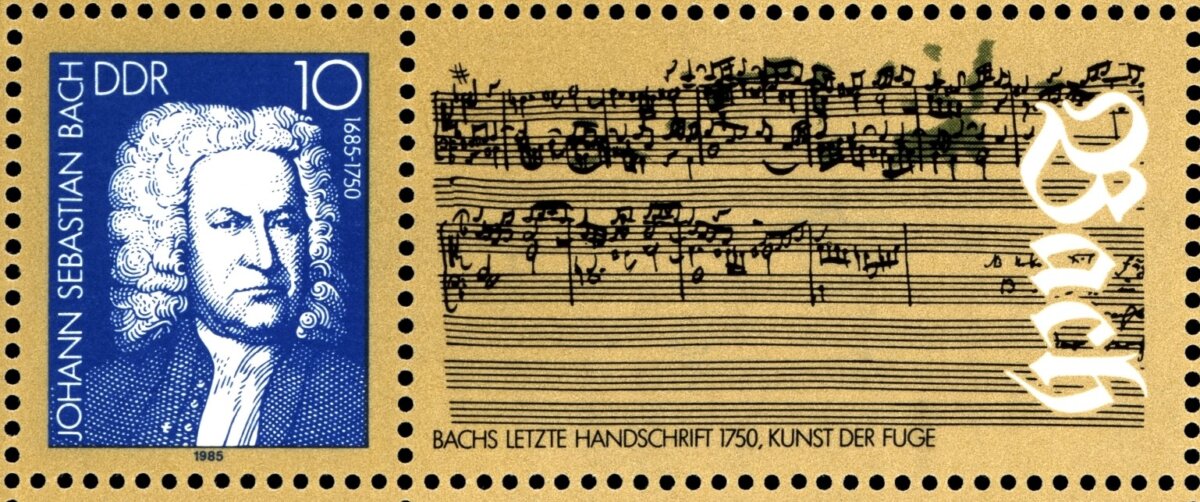
Bach loved to hide riddles, puzzles, and Easter eggs into his musical works.
So many are hidden, in fact, that finding them has become a bit of a farce. Some have counted the numbers of sharps and flats in his music, others the measures in a piece or the notes in a melody, interpreting their frequency as a symbolic statement.
Yet, while some of the “discoveries” seem tenuous and forced, others are blatantly obvious.
In German musical notation, B-natural is represented by the letter “H.” So by using German musical notation, you can spell out Bach’s surname with musical notes: B-flat, A, C, B-natural (B.A.C.H.). For Bach, the temptation to turn his name into music was too great, and he began to reference himself throughout his works.
The notes begin to pop up in Bach’s compositions, like a hidden signature, before eventually becoming synonymous with his pieces. The motif became known as the “Bach’s motif,” and later composers, such as Robert Schumann and Franz Liszt, would use it as a way to pay homage to their predecessor.
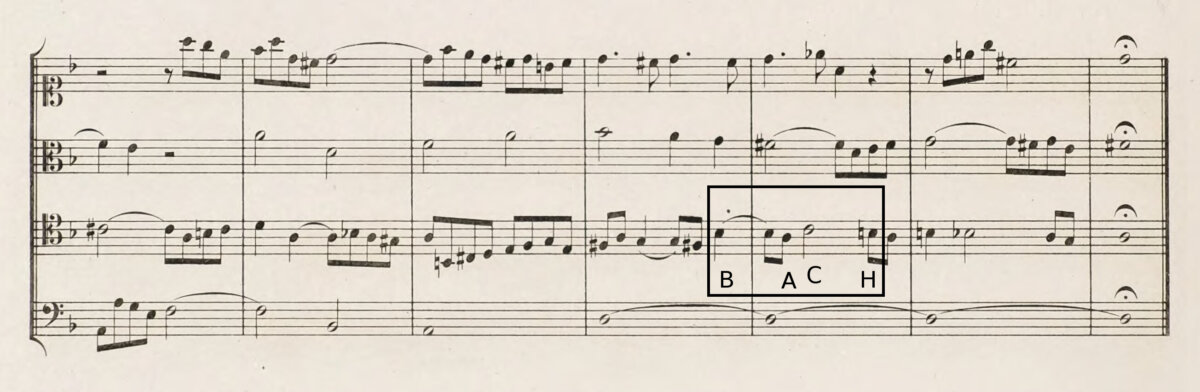
However, according to legend, Bach’s motif was also his final musical statement. Upon writing the four notes into his last composition, Bach died shortly after.
Bach’s ‘Contrapunctus XIV’
One of Bach’s last musical projects was titled “The Art of Fugue.” A fugue is like a musical composition in which the same theme gets passed between different voices, repeated, and transformed—creating a complex interweaving of musical lines born from a single idea. In “The Art of Fugue,” Bach decided to use his name as one of the main themes. Titled “Contrapunctus XIV,” it was left unfinished.
Today’s recording is performed by Canadian pianist Glenn Gould on the piano. While the instrument for the piece is not specified, Bach most likely wrote the piece with some sort of keyboard in mind. (Listen)
For this recording, Gould plays from the Peters Edition No. 218 instead of the original manuscript. In this version, the editor ends the music a few measures before the unfinished ending, upon the final statement of Bach’s theme. Unlike his recording of the “Goldberg Variations,” Gould takes the “Contrapunctus XIV” much slower than convention. He fixates himself on clarity over virtuosity.
If you hear humming in the piece, do not be surprised, Gould is known to sing to himself while performing.
Bach begins by introducing the first theme (0:14), before stacking imitations and variations of it over itself (0:33). A complex tapestry of a single idea begins to get woven. Suddenly, the first theme recedes, giving way to an exploration of a second new theme (5:55).
Bach then introduces his name as the third motif (9:38). In the recording, Gould creates a eulogy out of Bach’s motif: He goes down to a whisper, each note becoming dream-like. The way Gould grounds his interpretation on contrasting colors and dynamics, however, is only facilitated by the modern piano. During Bach’s time, keyboards lacked the tonal range and dynamic flexibility of the modern instrument.
As we approach the final statement of Bach’s theme, Gould works himself into a frenzy (11:55). His humming becoming emphatic before Bach’s motif gets both played and uttered at the same time (12:10), bringing everything into a jarring halt.
In the manuscript, after the music suddenly ends, Bach’s son, Carl Philipp Emanuel, added the footnote: “At the point where the composer introduced the name B-A-C-H in the countersubject to this fugue, the composer died.” While a poetic end for an artist, it seems that Bach’s son may have made up the anecdote to mythologize his father.
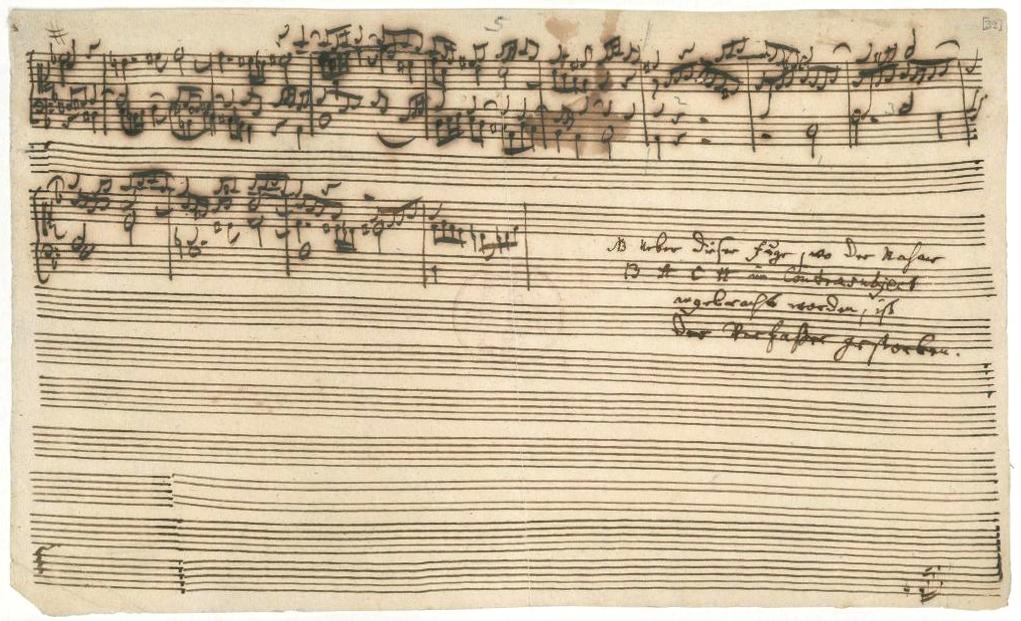
By the end of his life, Bach’s eyesight was deteriorating and he had trouble writing, and it was nearly impossible for him to write the “Contrapunctus XIV” on his dying bed. Many have instead speculated that the “Contrapunctus XIV” was started much earlier and left unfinished.
Carl Philipp Emanuel perhaps felt that his father’s unfinished masterpiece needed some sort of ending and, unable to provide one musically, gave a story instead.
So while Bach turned his name into a motif, his son turned his name into a legend.
What arts and culture topics would you like us to cover? Please email ideas or feedback to features@epochtimes.nyc.