SEARCH



Though many stories provide a good moral, some are good because they are simply fun, whimsical, silly, and unrealistic. In his short story “The Widow’s Cruise,” Frank Stockton proves that sometimes a story should be told for the story’s sake, rather than for its wisdom or veracity.
A Serious Widow
Widow Ducket lives alone along the New Jersey coast with Dorcas Networthy, who could be considered Mrs. Ducket’s unwavering disciple. Widow Ducket is an extremely strong, serious woman who wastes no time doing the tasks at hand each day. She rises at six o’clock, does the chores, then, when everything is complete, she sits and reads for an hour in the evening with Dorcas. But, whenever she reads Miss Mary Wilkins’s books, she is certain to question the story’s realism.
Yet, despite being a serious woman, Mrs. Ducket still possesses a generous heart. One evening, while she and Dorcas sit on the front porch, a wagon arrives with four sea captains in it. Upon asking for a good meal, Mrs. Ducket invites the men in and prepares them a wonderful supper.
The grateful men eat their delicious meal and then, with Mrs. Ducket’s approval, they all go out on the porch and smoke their pipes. Mrs. Ducket and Dorcas sit just inside, so that they can speak to the men, who take up all the seating available on the porch. Knowing sea captains fairly well, Mrs. Ducket asks them to tell a tale about their voyages.
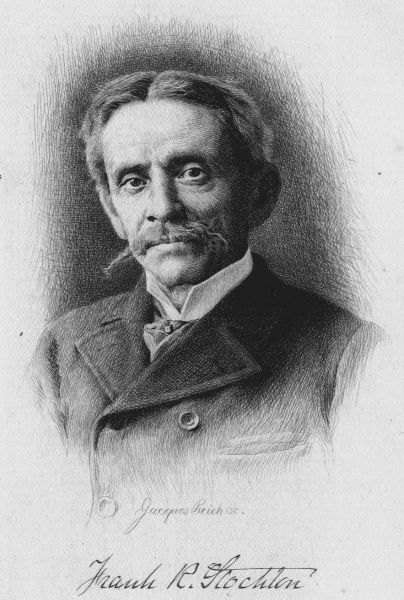 Frank Stockton in a 1903 illustration. (Public Domain)
A Fine Tale to Tell
The four captains oblige the two ladies. One by one, each regales them with wild tales from the sea (though, of course, they are all true). The first, Captain Bird, tells how, on one trip, a huge sperm whale hit their boat, breaking a hole in the hull. However, instead of sinking the boat, the whale kept it afloat, for, as fast as the water poured in, the whale swallowed it up and squirted it back out.
Captain Sanderson, the second captain, claims that he was aboard a steamboat that ran into an island. The steamboat was going so fast that it tipped the entire island upside down and sailed right over it.
The third, Captain Burress, says that he was on a ship carrying a large obelisk from Egypt to New York. The obelisk made the ship so heavy that they were sure to hit an approaching bank. So, rather than turn, the ship’s captain rammed the ship head first into the bank. The ship hit it so hard the obelisk broke through the front of the ship, making the ship so light that it floated over the bank.
The fourth, Captain Jenkinson tells how he and his old captain found a shark frozen in ice. The captain wanted to free the shark, so Jenkinson and another sailor broke it out, but the shark was still alive and proved very hungry.
However, though these tales prove very entertaining, none of them compare to Mrs. Ducket’s own. She embarked on the wildest journey imaginable and was lucky to survive.
Through this story, Stockton shows that, no matter how much Mrs. Ducket questions the veracity or realism of other people’s tales, she could join in with the best of them. Her tale is by far the most ridiculous.
Thus, as G.K. Chesterton says in “History and Inspiration”: “But the essential on which I should insist would be, not that the tale must be true, but that the tale must be fine.” Sometimes stories should be told for stories’s sake—a good tale is a good tale and should be enjoyed.
What arts and culture topics would you like us to cover? Please email ideas or feedback to features@epochtimes.nyc.